Scientists Use Supercomputers to Solve Universe's Magnetic Field Mystery
Massive plasma simulations reveal how cosmic turbulence creates the enormous organized magnetic structures found throughout space, from stars to galaxies.
Scientists at the University of Wisconsin-Madison have unlocked one of the universe's most perplexing mysteries by discovering how chaotic turbulence in space generates the vast, organized magnetic fields that span entire galaxies. Using some of the most advanced plasma simulations ever created, researchers found that large-scale magnetic structures emerge when turbulent plasma develops organized jet-like flows. The breakthrough, published in Nature, could fundamentally change our understanding of cosmic phenomena ranging from black hole formation to the dangerous solar storms that threaten Earth's technology.
Magnetic fields permeate the universe, influencing everything from the behavior of high-energy particles to the formation of stars and galaxies. While small-scale magnetic fields are typically chaotic and turbulent, astronomers have long observed that much larger magnetic structures appear surprisingly organized and coherent. This apparent contradiction has puzzled scientists for decades: how can destructive turbulent motion create constructive, large-scale magnetic order? The paradox has implications for understanding solar storms, neutron star collisions, and the fundamental processes that shape cosmic evolution.
Lead author Bindesh Tripathi, a former UW-Madison physics graduate student now at Columbia University, approached the problem by focusing on three-dimensional magnetic field generation rather than the simplified two-dimensional models used in previous studies. The research team added constantly renewed velocity gradients to their simulations, mimicking the conditions that occur throughout the universe when different parts of a system move at dramatically different speeds. These gradients occur naturally in many cosmic environments, including inside the Sun and during catastrophic events like neutron star mergers.
The computational breakthrough required unprecedented detail, with simulations using 137 billion grid points to model how magnetic fields interact with unstable velocity gradients. The team discovered that when turbulent plasma encounters these velocity differences, it can spontaneously organize into jet-like structures that generate large-scale magnetic fields. This process represents a fundamental shift in understanding how order emerges from apparent chaos in cosmic systems, providing a mechanism for the magnetic field generation that powers many of the universe's most energetic phenomena.
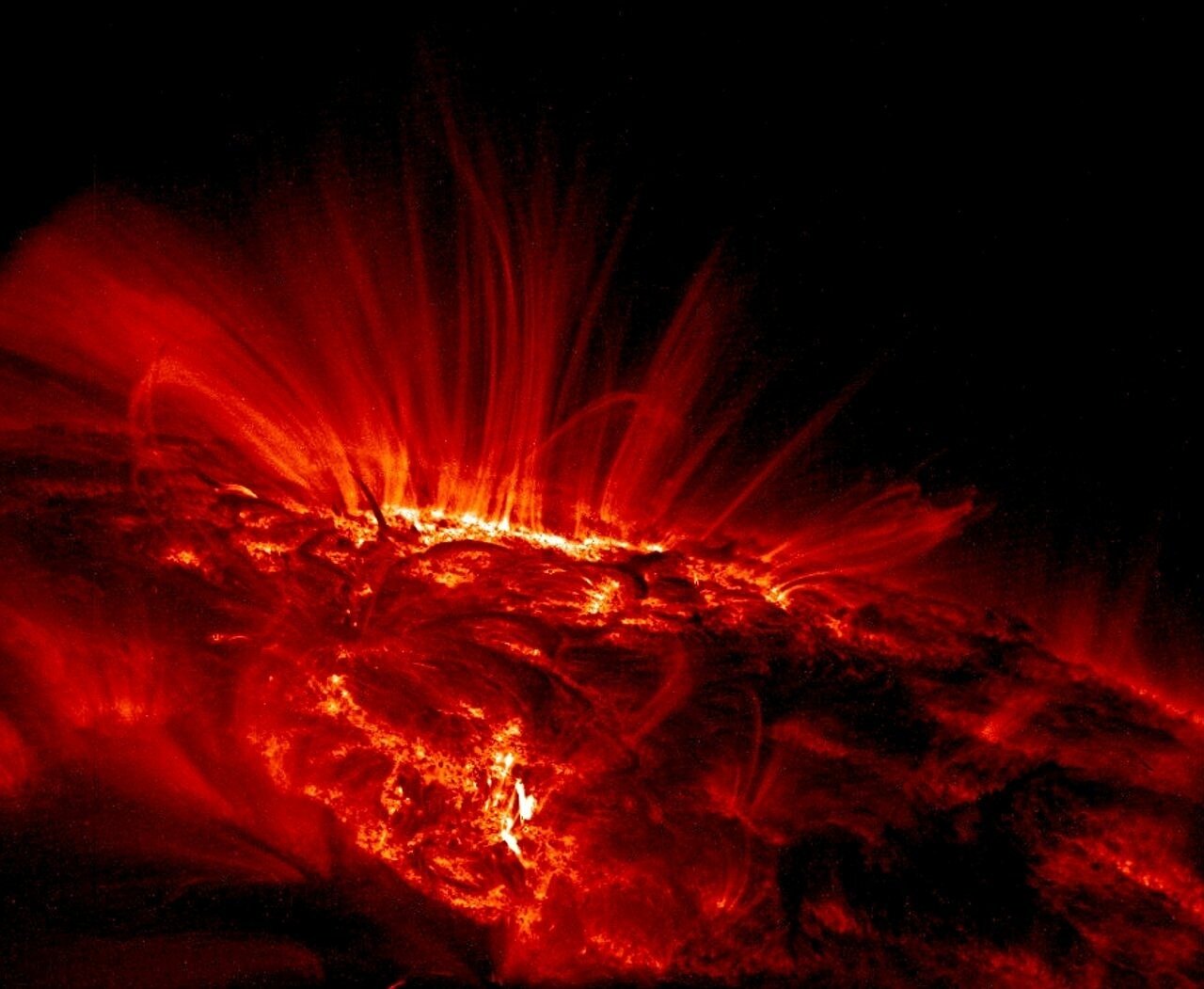
The findings have immediate implications for space weather prediction and our understanding of stellar behavior. Solar magnetic fields drive the coronal mass ejections and solar flares that can disrupt satellite communications, GPS systems, and power grids on Earth. By better understanding how these magnetic structures form and evolve, scientists may be able to improve predictions of space weather events. The research also sheds light on the magnetic processes in neutron stars, black holes, and other extreme cosmic objects, potentially revealing new insights about how magnetic fields influence the universe's largest structures and most violent events.