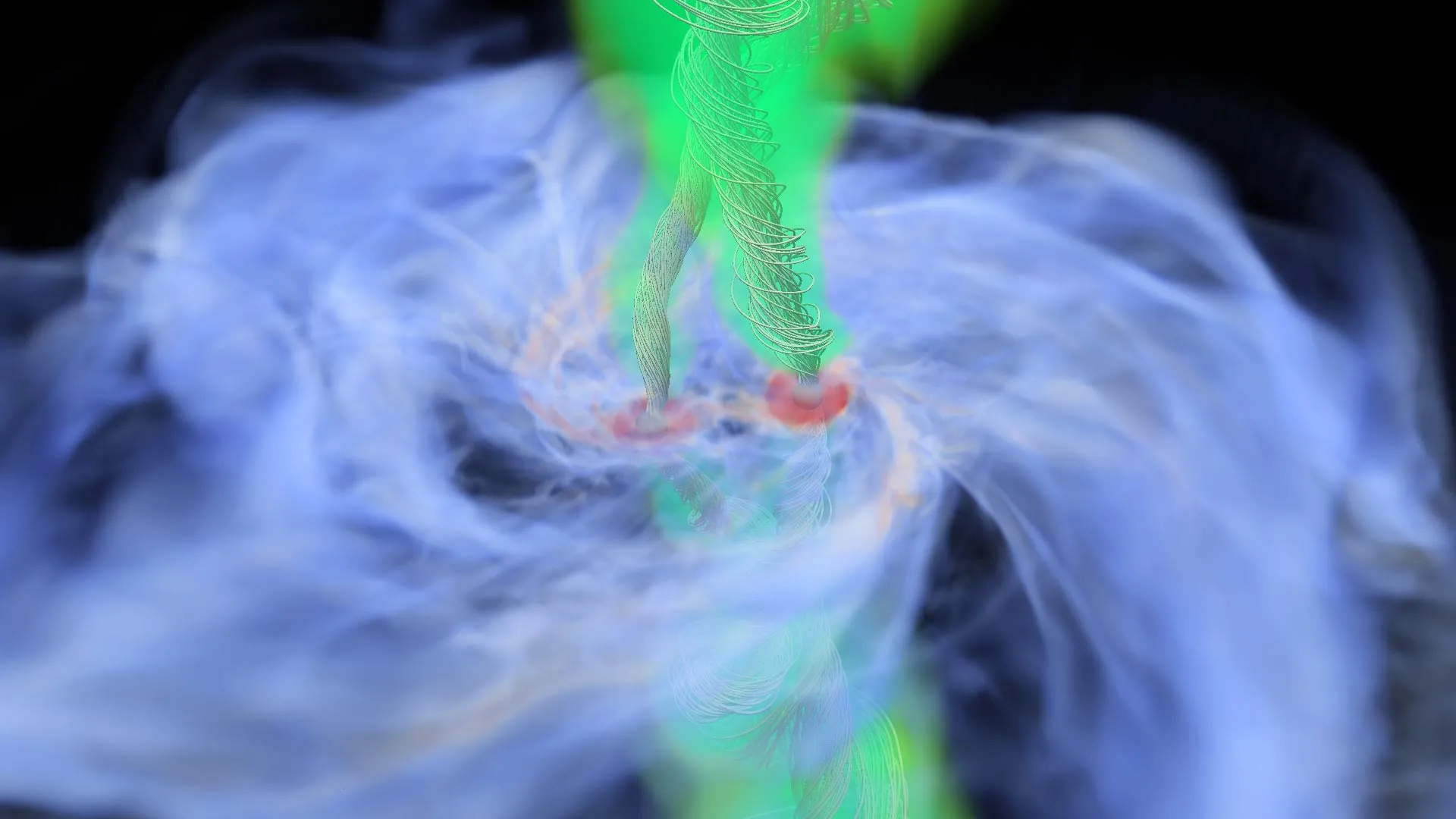
Supercomputer Simulations Solve Mystery of Universe's Massive Magnetic Fields
Scientists use most detailed plasma simulations ever created to discover how cosmic turbulence builds enormous organized magnetic structures from chaos.
Scientists have unlocked a fundamental mystery about how the universe creates its largest magnetic structures using some of the most advanced plasma simulations ever developed. The breakthrough research, published in Nature, reveals how turbulent, chaotic plasma can generate the enormous organized magnetic fields found throughout the cosmos, from stars and black holes to entire galaxies.
The discovery addresses a long-standing puzzle in astrophysics: how does destructive turbulence create constructive, large-scale magnetic order? Led by researchers at the University of Wisconsin-Madison, the team found that large magnetic fields can emerge when turbulent plasma develops organized jet-like flows, providing a new framework for understanding cosmic magnetism.
"Magnetic fields across the cosmos are large-scale and ordered, but our understanding of how these fields are generated is that they come from some kind of turbulent motion," explains lead author Bindesh Tripathi, a former UW-Madison physics graduate student. "Given that turbulence is known to be a destructive agent, the question remains, how does it create a constructive, large-scale field?"
The research team made two crucial innovations to solve this puzzle. First, they added constantly renewed velocity gradients to their simulations, similar to the sharp changes in motion that occur when a cyclist hits a curb or during neutron star mergers. These gradients appear throughout the universe and play a major role in shaping magnetic fields.
The second breakthrough was computational power. The scientists conducted what may be the most detailed simulation yet of magnetic fields interacting with unstable velocity gradients, using 137 billion grid points to model the complex physics. This massive computational effort revealed how organized flows can emerge from chaos and build the large-scale magnetic structures observed throughout the universe, potentially explaining phenomena from solar storms to galaxy formation.