Cosmic Brake: Magnetic Fields Solve a 70-Year Mystery of How Binary Stars Form So Fast
Supercomputer simulations on Japan's ATERUI III show interstellar magnetic fields strip rotational energy from forming star pairs, letting two protostars spiral together fast enough to match what astronomers actually see.
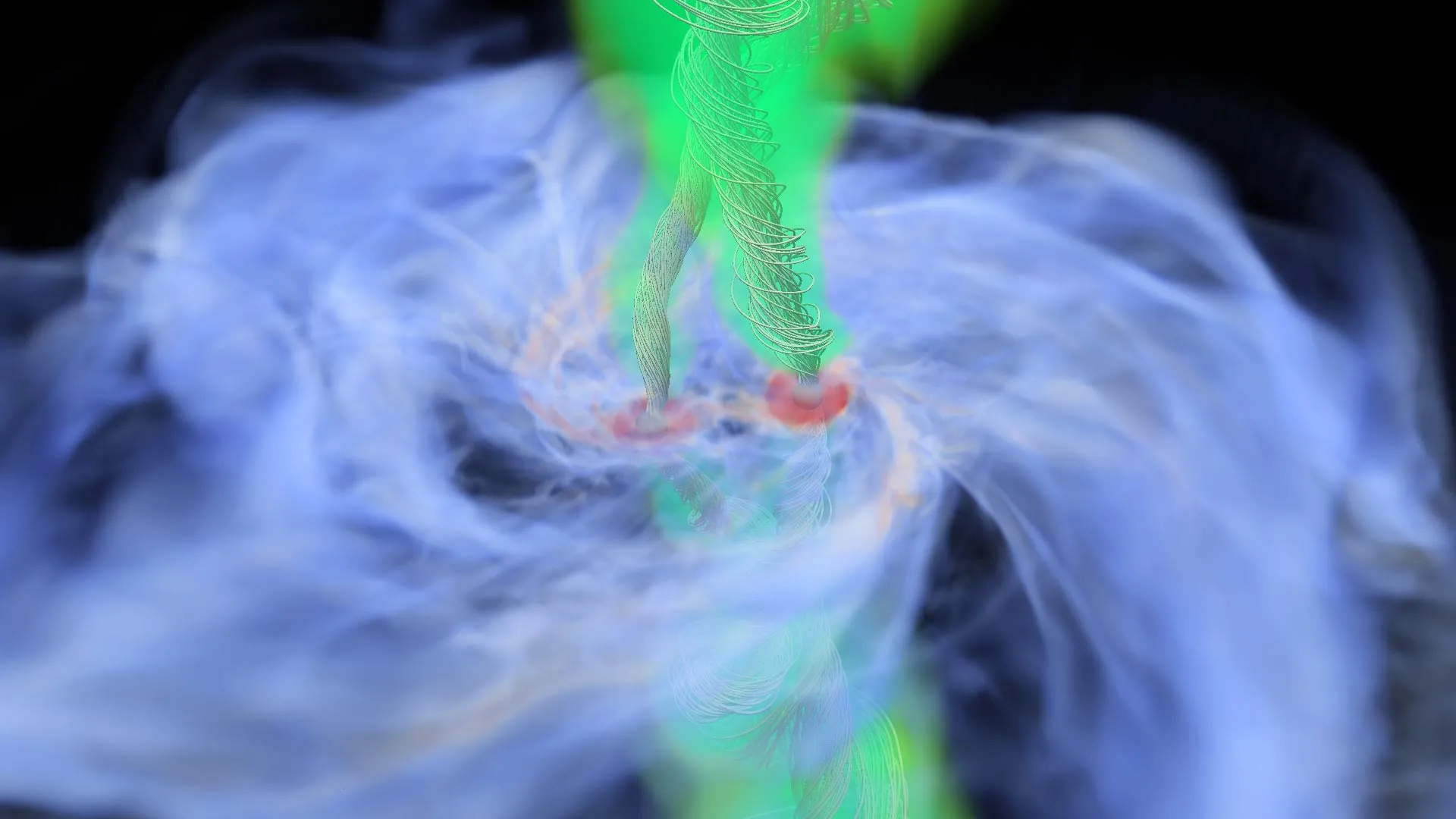
New supercomputer simulations have cracked a stellar puzzle that has stumped astrophysicists for seven decades: how binary star systems — the most common kind of star in the galaxy — manage to form quickly enough to match what telescopes actually observe. The answer, researchers say, lies in magnetic fields acting as a cosmic brake.
The study, published June 5 in the Monthly Notices of the Royal Astronomical Society, was led by Tomoaki Matsumoto of Hosei University, working with Kenta Hotokezaka of the University of Tokyo and Kohei Inayoshi of Peking University. Using three-dimensional magnetohydrodynamic simulations run on Japan's dedicated astronomy supercomputer, ATERUI III, the team modeled the tangled physics of two protostars forming side by side inside a collapsing cloud of gas.
For decades, theorists faced a contradiction. Most stars in the Milky Way exist in pairs or larger groupings, yet the basic physics of star formation seemed to work against them. As a cloud collapses, conservation of angular momentum should cause forming stars to spin faster and drift apart, much as a spinning skater speeds up by pulling in their arms. That left a nagging question: what removes enough rotational energy to let two stars settle into a tight, stable orbit?
The simulations point to interstellar magnetic fields as the missing ingredient. The models show that magnetic fields strip rotational energy — angular momentum — from the forming pair at a rate of up to 0.7% per orbital period, channeling it away through magnetized outflows. That steady drain acts as a brake, allowing the two protostars to spiral inward toward each other rather than flying apart, and producing binary systems on timescales consistent with observations.
The result offers the most quantitatively precise confirmation yet of a mechanism astronomers had long suspected but struggled to pin down. By putting hard numbers on how fast magnetic fields siphon away angular momentum, the work bridges the gap between theory and the abundant binaries seen across the night sky, resolving a contradiction that has sat near the center of stellar physics since the mid-20th century.
The implications reach beyond ordinary stars. The researchers note that the same physical principles can be extrapolated to binary black holes, offering insights into how pairs of black holes — and ultimately supermassive black holes — draw together and evolve. As gravitational-wave detectors increasingly catch the mergers of such pairs, understanding the magnetic "brake" that brings them close could help explain some of the most extreme events in the universe.