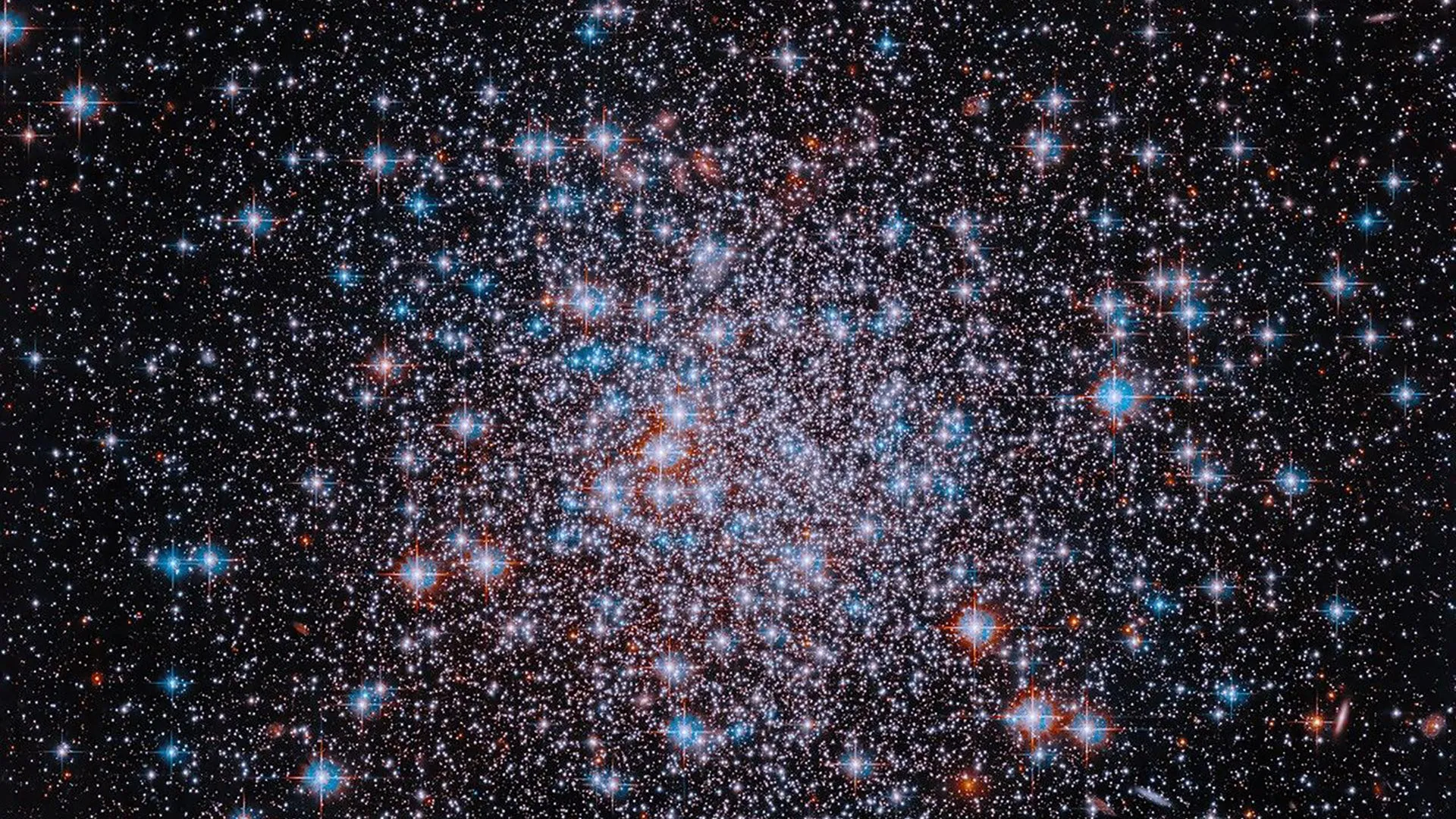
Dust-Veiled Star Cluster at the Milky Way's Heart Is 13.4 Billion Years Old
Astronomers dated VVV CL001 using Hubble images and say that if it formed in place, it could be the oldest globular cluster in the galaxy's bulge.

Astronomers have determined that VVV CL001, a metal-poor globular cluster near the center of the Milky Way, is about 13.4 billion years old, making it one of the oldest known star clusters in the galaxy. The cluster sits behind thick clouds of interstellar dust that long made its distance and age hard to pin down. The paper describing the method was posted to the arXiv preprint server on Oct. 20 and has been accepted for publication in Astronomy & Astrophysics.
Globular clusters are among the oldest members of the Milky Way. Their stars are typically 10 billion to 13 billion years old and preserve a fossil record of the conditions under which the galaxy first assembled. A cluster's age and chemical makeup can help set a limit on the age of the galaxy itself, which is why astronomers prefer metal-poor clusters, whose low metal content marks them as especially ancient.
VVV CL001 was discovered in 2010 by the VISTA Variables in the Vía Láctea Survey and confirmed as a cluster in 2019. It appears very close to the galactic center, but it moves toward us at a very different speed than the stars around it, which raised the possibility that it did not truly belong there. Because a cluster's orbit depends on its distance, earlier studies that assumed different distances arrived at different paths. The distance was the main culprit, and it is tricky to measure: the cluster is small and faint, dust dims its starlight, the region is crowded, and RR Lyrae stars, which astronomers normally use as distance markers, have not been found in it.
The new study, led by J. Olivares Carvajal of the INAF Capodimonte Astronomical Observatory, used deep near-infrared observations from the FourStar Infrared Camera on the Magellan Baade 6.5-meter telescope to refine the distance. The team tracked how stars move across the sky and used a machine learning algorithm to pick out those that truly belong to the cluster. They found around 155 member stars, including stars on the horizontal branch and at the main-sequence turnoff, two evolutionary stages that earlier studies had not revealed in this cluster.
The turnoff is where a star finishes burning hydrogen steadily in its core and then swells into a red giant, and because its position depends on age, it is the best marker for dating a cluster. Horizontal-branch stars have a steady brightness, so they work as reference points for distance. Comparing the stars with a theoretical stellar evolution model, the team found a distance of about 7.34 kiloparsecs, roughly 24,000 light-years, placing the cluster inside the galactic bulge. The researchers say that is the smallest distance error reported in the literature to date.
Using Hubble Space Telescope images, which are less affected by dust, they then measured the age at about 13.4 billion years, and the turnoff stars gave a similar range. "Both methods estimate the cluster age at 13.4±0.4 Gyr, suggesting that VVV CL001 could be the oldest GC in the bulge and perhaps the galaxy," the team writes. Since the universe is roughly 13.8 billion years old, any estimate has to fall below that limit within its uncertainty, and this one sits close to it.
The result is not final. If the cluster was born where it sits and is truly this old, the authors say, astronomers may need to rethink the age of the galaxy and possibly of the universe. The team plans a high-resolution spectroscopic follow-up to confirm the age using the cluster's chemical makeup, along with new optical observations to sharpen the distance.