Saturn Has Grown a Ten-Sided Wave Around Its South Pole, and Hubble Says It Has Been There Since at Least 2023
The planet's north pole has worn a hexagon for four decades. The new southern decagon is still strengthening — and two amateur astronomers saw the first hints of it.

Saturn's north pole is circled by a hexagon — a six-sided jet stream roughly the width of two Earths that has held its shape since Voyager first photographed it in 1981. Astronomers have argued about it for forty years. Now the planet has produced a second one, at the opposite pole, with four more sides.
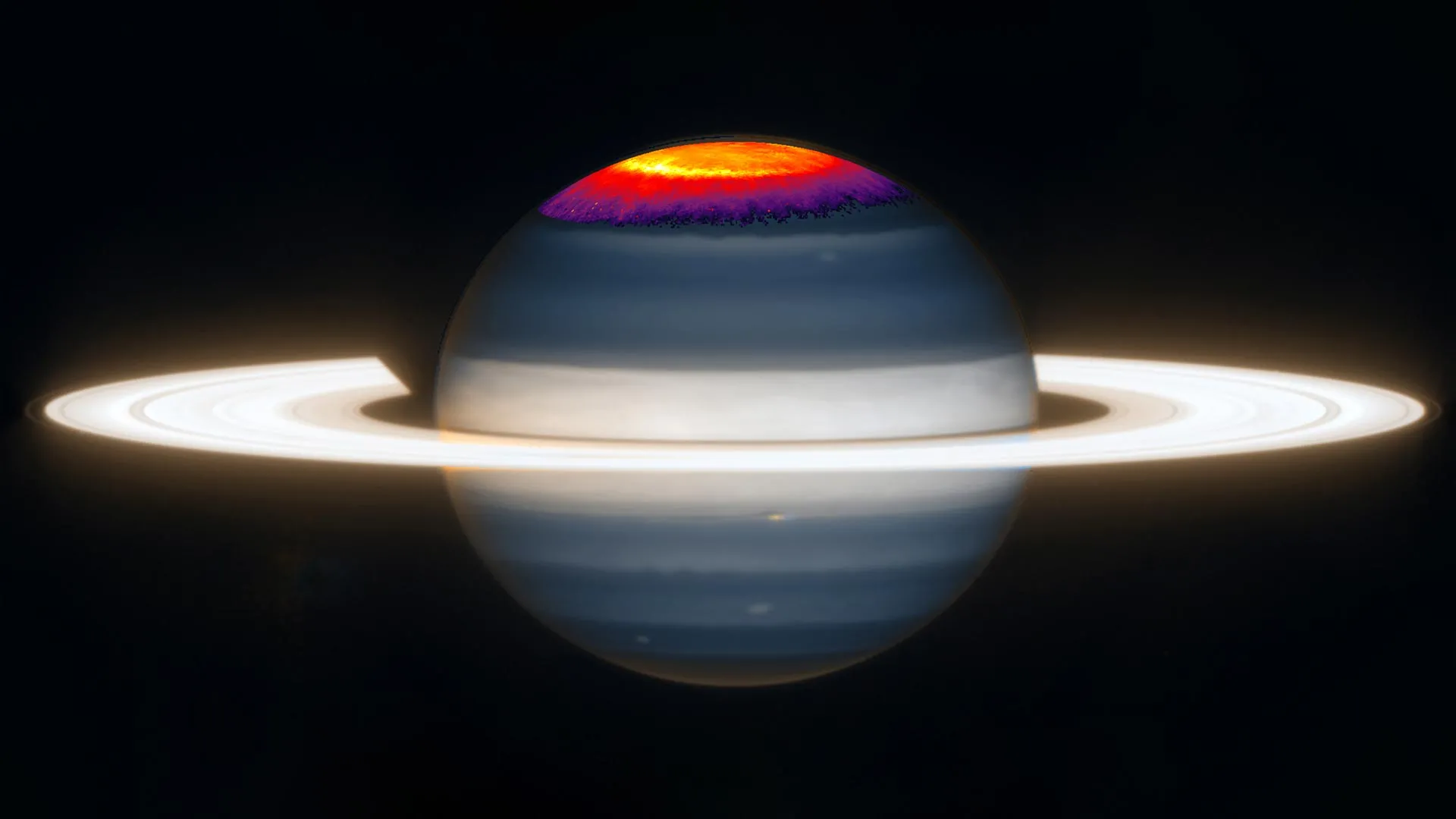
A team led by Agustín Sánchez-Lavega of the University of the Basque Country reports in Science Advances that a ten-sided atmospheric wave — a decagon — encircles Saturn's south pole. The paper, published under DOI 10.1126/sciadv.aee4251, draws on ground-based imaging and on NASA's Hubble Space Telescope, and concludes the structure has been present in the data since at least 2023.
It was not a professional observatory that noticed first. Amateur astronomers Trevor Barry and Jean-Paul Oger picked up subtle hints of polygonal structure in ground imagery taken in 2024. The signal grew stronger in 2025 observations. Only then did the team go back through Hubble's archive and find the feature sitting in images from two years earlier, unremarked.
Hubble was decisive because of resolution. Saturn's south pole is a small, foreshortened target from Earth, and the wave's corners are subtle in amplitude — a distortion of a circular jet, not a hard-edged shape. Hubble's sharpness, combined with the multi-year cadence of the Outer Planet Atmospheres Legacy program, which images the four giant planets on a fixed annual schedule, made it possible to distinguish a persistent pattern from seasonal noise. The decagon extends through multiple atmospheric layers, which means it is not a shallow cloud-deck ornament but a vertically extended structure rooted deeper in the atmosphere.
The most useful difference between the two poles is developmental. The northern hexagon has been essentially static for as long as anyone has been able to look at it, which makes it a poor test case: a fully formed structure tells you little about how such a thing assembles. "This feature is different — it appears to be strengthening, giving us the rare opportunity to watch a giant atmospheric pattern develop," said Amy Simon, a NASA planetary scientist who works on OPAL.
The leading explanation for polygonal jets is that a fast circumpolar jet stream becomes unstable and buckles into a standing wave, with the number of sides set by the jet's speed, latitude and the wind shear across it. Laboratory experiments with rotating fluid tanks have reproduced polygons with anywhere from three to nine sides by tuning rotation rate and viscosity. Ten is at the high end. A wave that is still growing offers something the hexagon never has: the chance to measure how the jet's parameters and the polygon's shape change together, rather than inferring the process from a finished product.