Spinning Black Holes Could Split in Two, Danish and French Physicists Calculate
A Physical Review D paper finds that near-maximal rotation might open a narrow loophole in the entropy rules that normally forbid a black hole from dividing. No splitting has ever been observed.
Black holes swallow, merge and evaporate, but they are not supposed to split. A new theoretical study suggests there may be a narrow way around that rule, at least on paper. The paper, titled "When black holes admit pair-of-pants topologies," appeared in Physical Review D and was announced by the University of Southern Denmark. It argues that a black hole spinning fast enough might in principle divide into two.
The authors are Giacomo Cacciapaglia of France's CNRS and the Laboratoire de Physique Théorique et Hautes Énergies in Paris, Francesco Sannino, who directs the Quantum Field Theory Center at the University of Southern Denmark and is a professor at the University of Naples Federico II, and Manuel Del Piano and Vania Vellucci of the Danish center.
The obstacle is thermodynamics. A black hole's entropy, a measure of the number of microscopic arrangements that could produce it, grows with the area of its event horizon. For a non-rotating black hole, two smaller black holes would have less total entropy than the original, so the split would break the second law and does not happen. The team found that extreme rotation might change the arithmetic. Spin can in principle carry enough energy to overcome the entropy restriction.
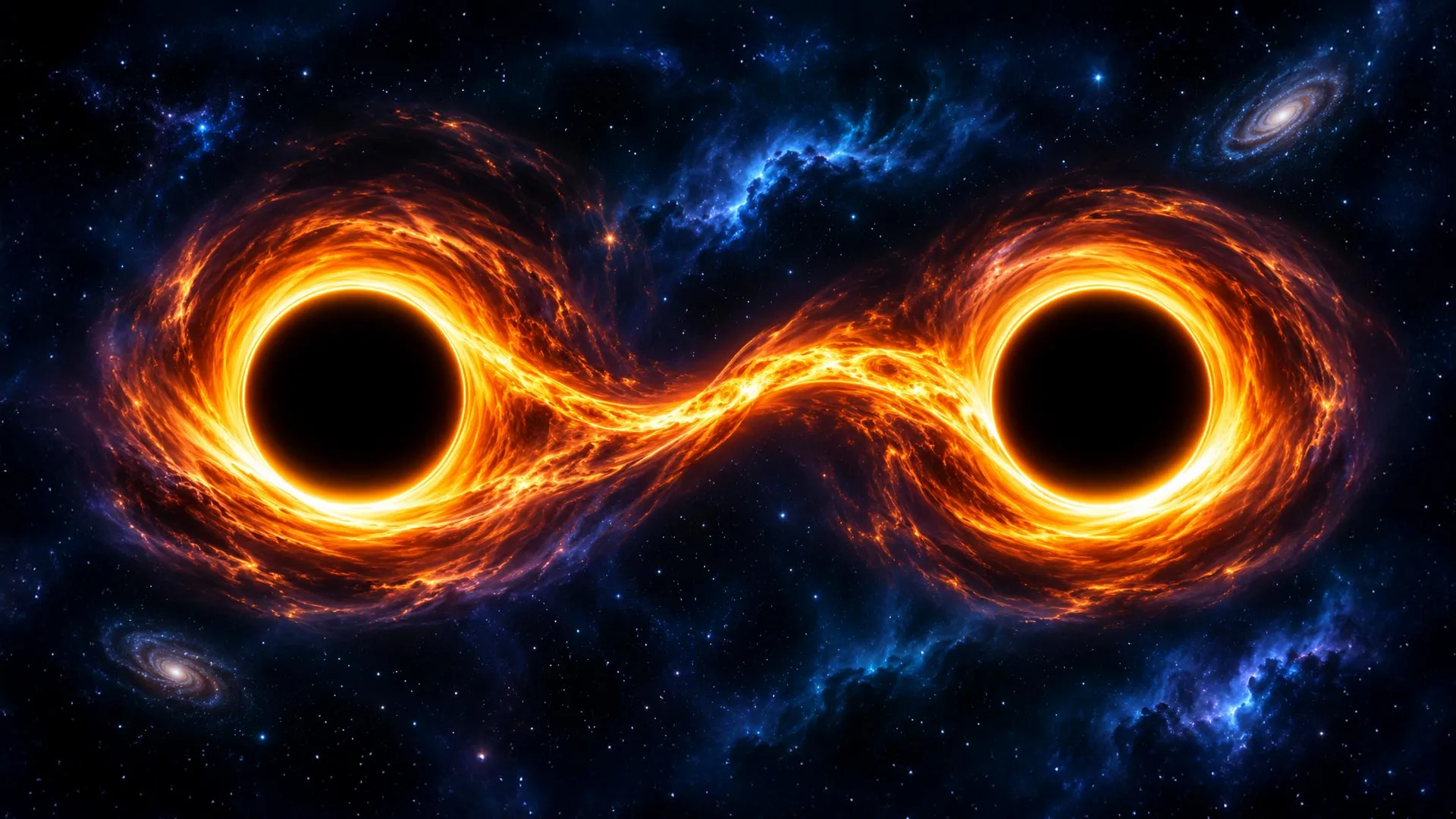
A second problem is separation. After dividing, the two black holes would have to move apart rather than fall back together at once. Sannino said the window "largely closes again," except possibly for holes spinning close to the maximum rate allowed by general relativity. The title refers to the shape of the horizon in spacetime. It begins as a single structure and then branches into two, like a pair of trousers with one waist and two legs.
The team also examined theories with extra spatial dimensions. In some of those models, black-hole-like objects can become unstable and break apart, and in certain cases splitting is thermodynamically favored, especially when one fragment is much smaller than the other. The researchers stress that a process being allowed or favored does not mean it happens. "We cannot yet give a single probability for a black hole to split," Sannino said, because the answer depends on how gravity behaves beyond Einstein's theory, which the team is working to pin down.
There is a possible observational route. Small primordial black holes, hypothetical objects formed in the early universe, are expected to be more prone to splitting than the huge black holes astronomers see today. Sannino suggested that gamma-ray telescopes such as NASA's Fermi Large Area Telescope could look for signals from tiny fragments that might form during mergers. For now the result is a calculation, not a detection. No black hole has ever been seen to split, and the paper's value lies in mapping exactly which conditions would have to be met before one could.