Some Exploding Stars May Have Been Detonated by Black Holes Left Over From the Big Bang
A team led by SUNY Poly and the Kavli IPMU finds that a primordial black hole passing through a white dwarf could tidally heat it into a thermonuclear runaway — and that the resulting explosions would leave a distinctive chemical signature already visible in the Milky Way.
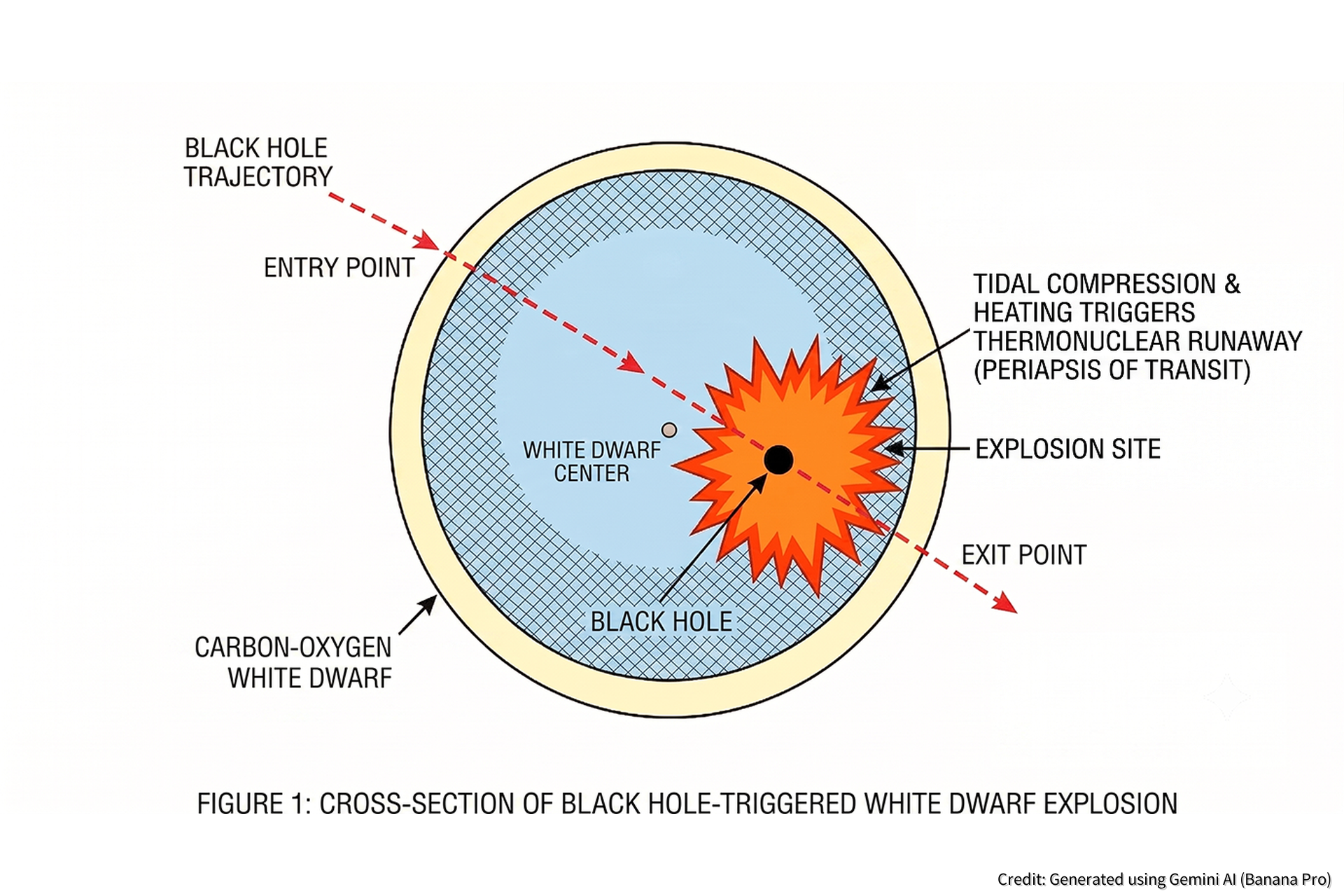
Type Ia supernovae are supposed to be the well-understood ones. A white dwarf — the dense, burnt-out core left behind by a sun-like star — pulls material from a companion or merges with another white dwarf, crosses a mass threshold, and detonates. The explosions are uniform enough that astronomers use them as standard candles to measure the expansion of the universe. But not every one of them fits the pattern, and a new study proposes a culprit for some of the outliers: a black hole older than the stars themselves.
Shing-Chi Leung, an assistant professor of physics at SUNY Polytechnic Institute and a visiting associate scientist at the University of Tokyo's Kavli Institute for the Physics and Mathematics of the Universe, led the work with Ken'ichi Nomoto of Kavli IPMU, Alexander Kusenko of UCLA, SUNY Poly student Seth Walther and Tomoharu Suzuki of Chubu University. The results appear in The Astrophysical Journal.
The mechanism is tidal. A primordial black hole — a hypothetical object formed from density fluctuations in the first fraction of a second after the Big Bang, rather than from a collapsing star — passes through a white dwarf. Along its path, its gravity stretches and compresses the surrounding material, heating it. When the heated matter reaches roughly half a billion kelvin, carbon fusion begins outrunning the neutrino cooling that normally carries the excess energy away. Once the burning region grows large enough, it goes into a local thermonuclear runaway, and the runaway detonates the star.
That route to explosion is different from the standard one in a way that shows up in the ash. A white dwarf that blows up because it slowly accreted its way to a critical mass produces one mix of elements; one that is detonated from the inside by a passing black hole at a different density produces another. The team examined the supernova remnants Tycho, Kepler and 3C 397, along with the well-observed nearby supernovae SN 2011fe and SN 2012cg, focusing on the radioactive isotopes nickel-56 and nickel-57 and on stable manganese and nickel. Those abundance ratios are the diagnostic, and the researchers argue the black-hole-triggered channel could account for a chemical abundance pattern seen among stars in the Milky Way that the standard picture has struggled to reproduce.
"Our work suggests that some supernova that we observe in the sky could be a result of the PBHs," Leung said, adding that even though these objects cannot be observed directly, "they leave many interesting clues in nature for us to probe their properties."
Primordial black holes remain unconfirmed. They are one of the longest-standing candidates for dark matter, and searches for them have relied largely on gravitational lensing and, more recently, on gravitational-wave signals. What this analysis offers is a different kind of detector: not an instrument, but a population of exploded stars whose chemistry may already have recorded the passage of something no telescope will ever see.
Originally reported by Kavli IPMU.