The Wavefunction Cannot Be Seen. A German Lab Just Reconstructed One in Three Dimensions Anyway
Göttingen physicists imaged a molecular orbital with resolution finer than the gap between its own carbon atoms, using a tabletop X-ray source instead of a synchrotron.
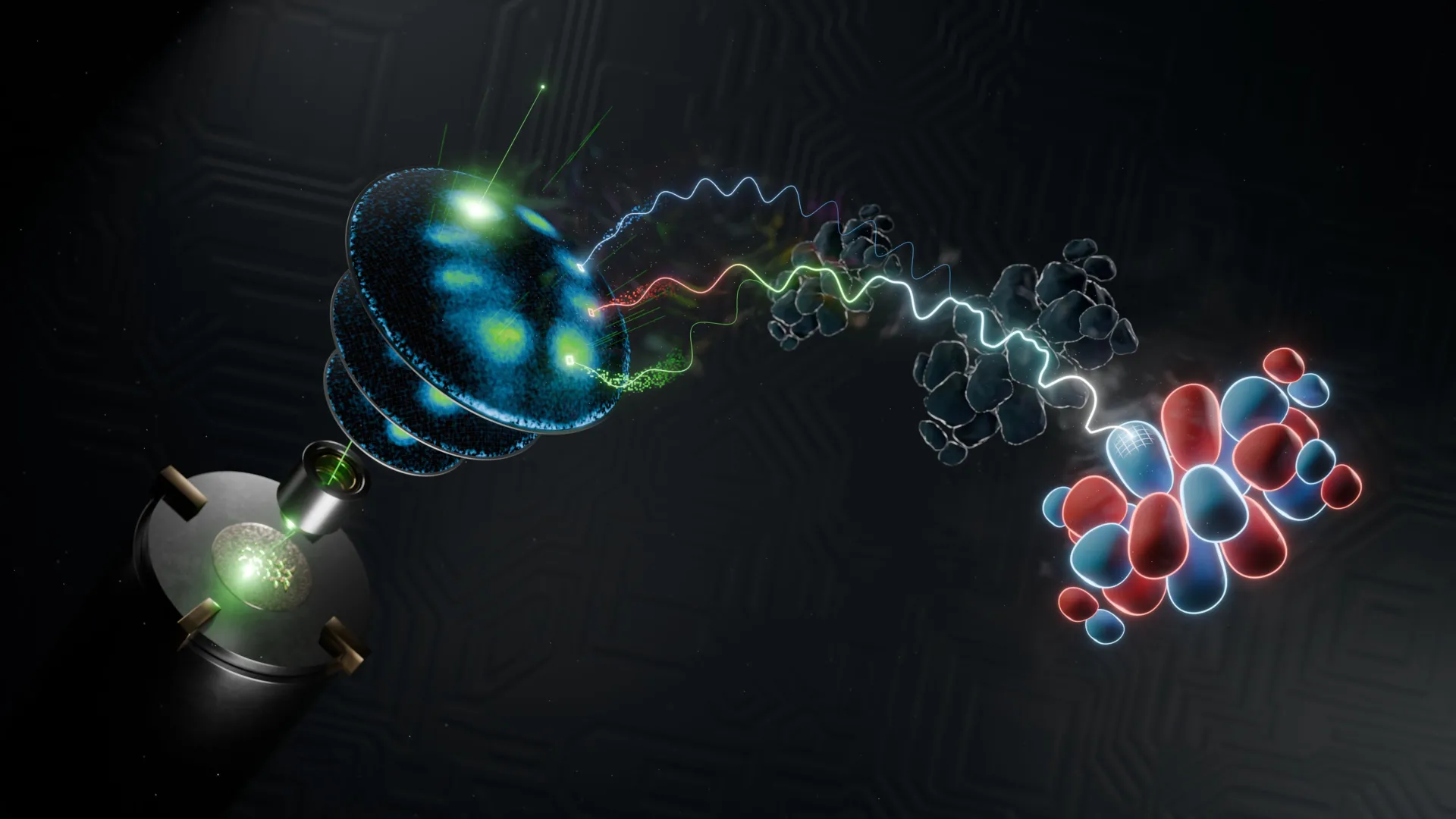
The wavefunction is the central object of quantum mechanics and also its most frustrating one. It contains everything that can be known about a system, and it is not a thing you can point an instrument at. "The wavefunction is a fundamental quantity in quantum mechanics, yet it cannot be directly observed or measured," said Professor Stefan Mathias of the University of Göttingen.
His group has now produced the next best thing: a complete three-dimensional reconstruction of a molecular orbital in an organic molecule, resolved more finely than the spacing between the carbon atoms that make it up. The work appears in Nature Communications.
The technique is photoemission orbital tomography. Light of a known energy knocks electrons out of a molecule, and the angles and energies at which those electrons emerge encode the shape of the orbital they came from — in mathematical terms, the measurement samples the orbital's momentum-space distribution. Recovering the real-space shape from that data means inverting the transform, and the hard part has always been that detectors record only intensities, discarding the phase information the inversion needs. The conventional workaround is to collect enormous datasets at many photon energies, which in practice has meant long shifts at a large synchrotron facility.
The Göttingen team attacked both bottlenecks. "We introduce two powerful new concepts," said Dr. Matthijs Jansen, describing an approach that combines new reconstruction algorithms with a very different light source: "the experiment is based upon a powerful, lab-based soft-X-ray light source that provides ultrashort light pulses." Soft X-rays generated on a benchtop, rather than in a storage ring hundreds of meters across, plus algorithms that need far less data to converge — together those turn a facility experiment into a laboratory one.
Dr. Wiebke Bennecke, the paper's first author, is looking at what the shorter pulses make possible next. Because the reconstruction no longer requires a long acquisition, it can in principle be repeated as a series of snapshots taken at intervals of femtoseconds — quadrillionths of a second, the timescale on which chemical bonds actually break and form. "This technique might mean that stroboscopic videography becomes a reality," Bennecke said, "to see how it changes with ultrafast, even femtosecond or one quadrillionth of a second, resolution."
That is the ambition worth watching. Chemists have spent a century inferring what electrons do during a reaction from what the products look like afterward, and drawing orbitals as textbook cartoons. A method that reconstructs the real three-dimensional distribution of an electron, on a tabletop, fast enough to string frames together, would replace the cartoon with a recording — of a quantity that quantum mechanics insists can never be observed directly at all.