Astronomers Tally 606 Galaxies and Find the Lopsided Ones Aren't a Story of Collisions
A catalog built from 37 studies shows heavier, faster-rotating galaxies are more balanced, the opposite of what a purely tidal origin predicts.

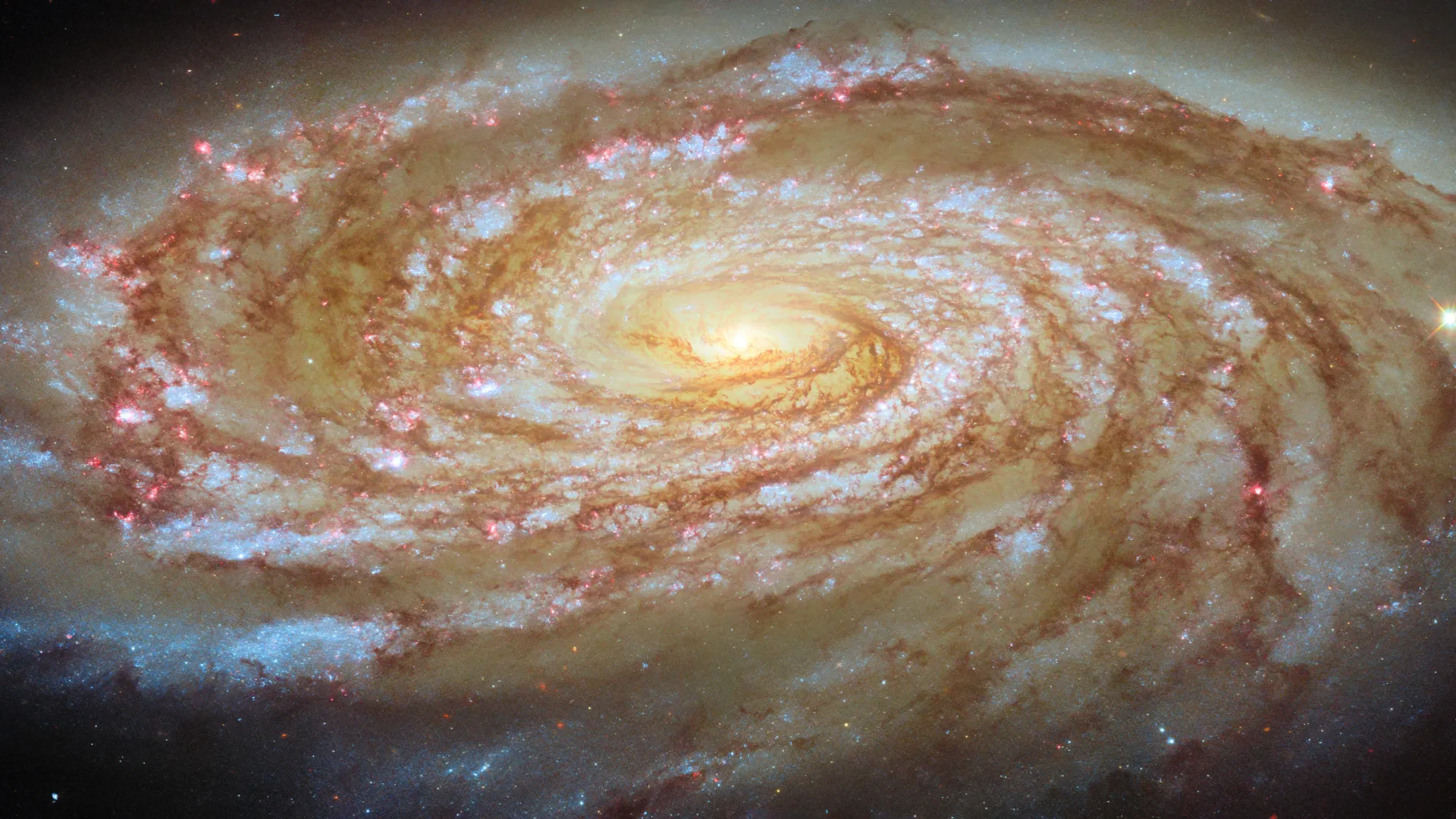
Some spiral galaxies look heavier or more stretched on one side than the other, and astronomers have long argued about why. Collisions, gravitational tugs from neighbors, uneven gas falling in and instabilities in the disk itself could each pull gas and stars off-center. A new analysis of hundreds of galaxies points to the galaxy's own internal dynamics as the main driver.
The study, posted to the arXiv preprint server on Nov. 10 and led by Abbos Omonov of the National University of Uzbekistan, merges measurements from 37 earlier papers into one large catalog. After removing duplicates from an existing list of 683 entries, the team was left with 606 galaxies. Of those, 442 have a measured lopsidedness, and 302 have both lopsidedness and a second measure of asymmetry tied to bars and spiral arms.
Astronomers quantify lopsidedness by tracing a galaxy's brightness around a circle centered on its core. That produces an uneven pattern, which can be split into simple waves called Fourier modes. The first, called A1, has one bright side and one dim side and measures how lopsided a galaxy is. The second, A2, has two bright regions on opposite sides and signals a central bar or a pair of opposite spiral arms. A value of zero means the pattern is absent. An A1 of 0.1 means brightness swings roughly 10% above and below average around the circle.
The typical galaxy in the sample has an A1 of about 0.12 and an A2 of about 0.11, so both patterns are mildly present. Galaxies with higher A1 also tended to have higher A2, which suggests the two features may be linked.
The key finding is how lopsidedness changes with size. It rises toward smaller, later-type galaxies and falls as stellar mass and gas rotation speed increase. In other words, the faster a galaxy rotates, the more balanced it tends to be. The team compared the results with TNG50, a large computer simulation of galaxy formation, which reproduced the trend with stellar mass very accurately.
That matters because of what a collision-driven picture would predict. "A purely tidal origin would predict the reverse, since massive galaxies more often sit in dense environments where interactions are frequent," the authors write. If crowded neighborhoods caused most of the asymmetry, massive galaxies in groups and clusters should look the most lopsided. They don't. The researchers conclude that internal dynamics play the main role, though outside interactions may still shape individual galaxies.
The simulation was not a perfect match. Simulated galaxies came out about 1.4 times less lopsided than real ones overall, a gap the authors attribute to several compounding effects. The paper is a preprint and has not yet been through peer review. Still, a catalog this size gives astronomers a baseline for testing simulations, and the mismatch in amplitude points to physics, possibly in how gas flows into galaxies, that models don't yet capture.