Hubble Catches Spiral Galaxy M88 Being Stripped Bare on a Perilous Plunge Through the Virgo Cluster
New images from the Hubble Space Telescope show the galaxy losing its star-forming gas as it races through the dense cluster, a process that is slowly snuffing out its ability to build new stars.
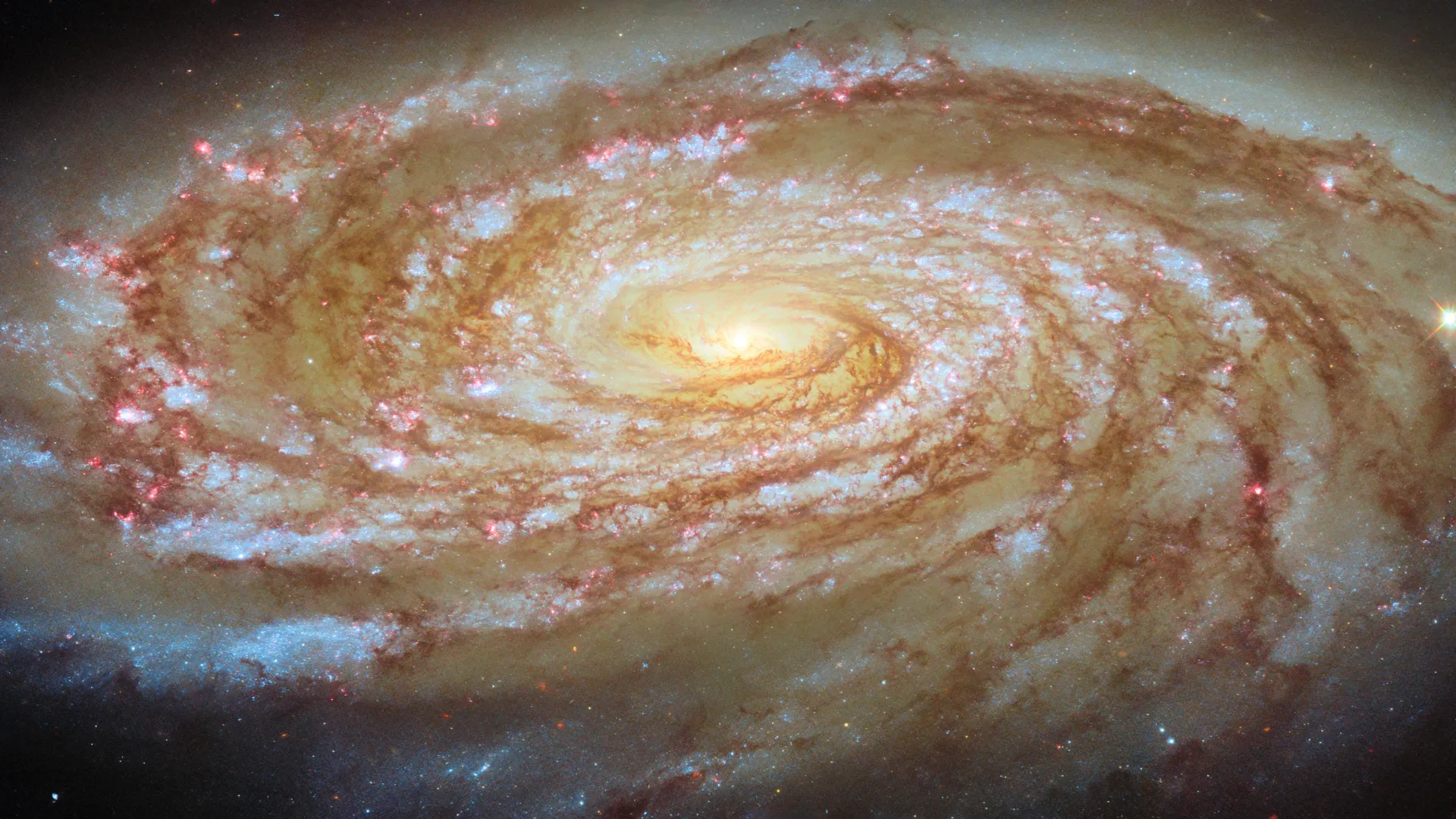
A new portrait from the NASA/ESA Hubble Space Telescope has captured the spiral galaxy Messier 88 in the middle of a slow-motion catastrophe, being stripped of the cold gas it needs to forge new stars as it plows through the crowded Virgo Cluster of galaxies.
Located about 63 million light-years away in the constellation Coma Berenices, M88 is a graceful spiral with symmetrical arms studded with bright star clusters and threaded by dark dust lanes. But its elegance belies the violence of its surroundings. As the galaxy moves through the hot, tenuous gas that fills the Virgo Cluster, it is experiencing what astronomers call ram pressure stripping — a process in which the surrounding medium acts like a headwind, peeling away the galaxy's own gas.
The effects are visible in Hubble's imagery, captured with the telescope's Wide Field Camera 3. M88's gas disk appears shortened and compressed along its leading edge, the side facing into its motion, where the pressure is most intense. The galaxy already contains significantly less cold gas than astronomers would expect for a spiral of its size, a sign that the stripping has been underway for some time.
That gas loss carries a steep cost. Cold gas is the raw material from which new stars condense, and as M88 is drained of it, the galaxy's ability to form fresh generations of stars is steadily diminishing. Over cosmic timescales, galaxies subjected to this kind of environmental pressure can have their star formation quenched entirely, transforming from vibrant spirals into quiescent systems.
M88 harbors its own internal engine of activity as well. At its heart sits a supermassive black hole with a mass roughly 100 million times that of the Sun, powering an active galactic nucleus from which streams of gas flow outward from the core. The interplay between that central activity and the external stripping makes the galaxy a rich laboratory for studying how galaxies live and die.
The observations were gathered as part of Hubble observing program #18103, led by principal investigator D. Thilker. By documenting M88's distorted gas distribution in detail, the program adds to a growing body of evidence about how galaxies evolve when they travel through dense cosmic neighborhoods rather than drifting in isolation.
M88's journey is far from over. Astronomers project that over the next 200 to 300 million years, the galaxy will continue its trajectory toward Messier 87, the giant elliptical galaxy that anchors the Virgo Cluster. The gravitational interactions and continued stripping that lie ahead will further reshape M88, offering a preview of the forces that sculpt galaxies across the universe.