Webb Telescope Unveils the Most Detailed Map of the Cosmic Web Ever Made
Using its largest survey to date, the James Webb Space Telescope traced the vast network of filaments and voids connecting more than 164,000 galaxies back to when the universe was just a billion years old.

Astronomers have produced the most detailed map ever made of the cosmic web — the colossal scaffolding of galaxies, filaments and voids that structures the entire universe — using data from NASA's James Webb Space Telescope.
The map, described in a study in The Astrophysical Journal, was led by researchers at the University of California, Riverside. The team drew on the largest Webb survey conducted to date, known as COSMOS-Web, analyzing more than 164,000 galaxies to reconstruct how the cosmic web has evolved across roughly 13.7 billion years of cosmic history. Remarkably, the data trace the network all the way back to when the universe was only about one billion years old.
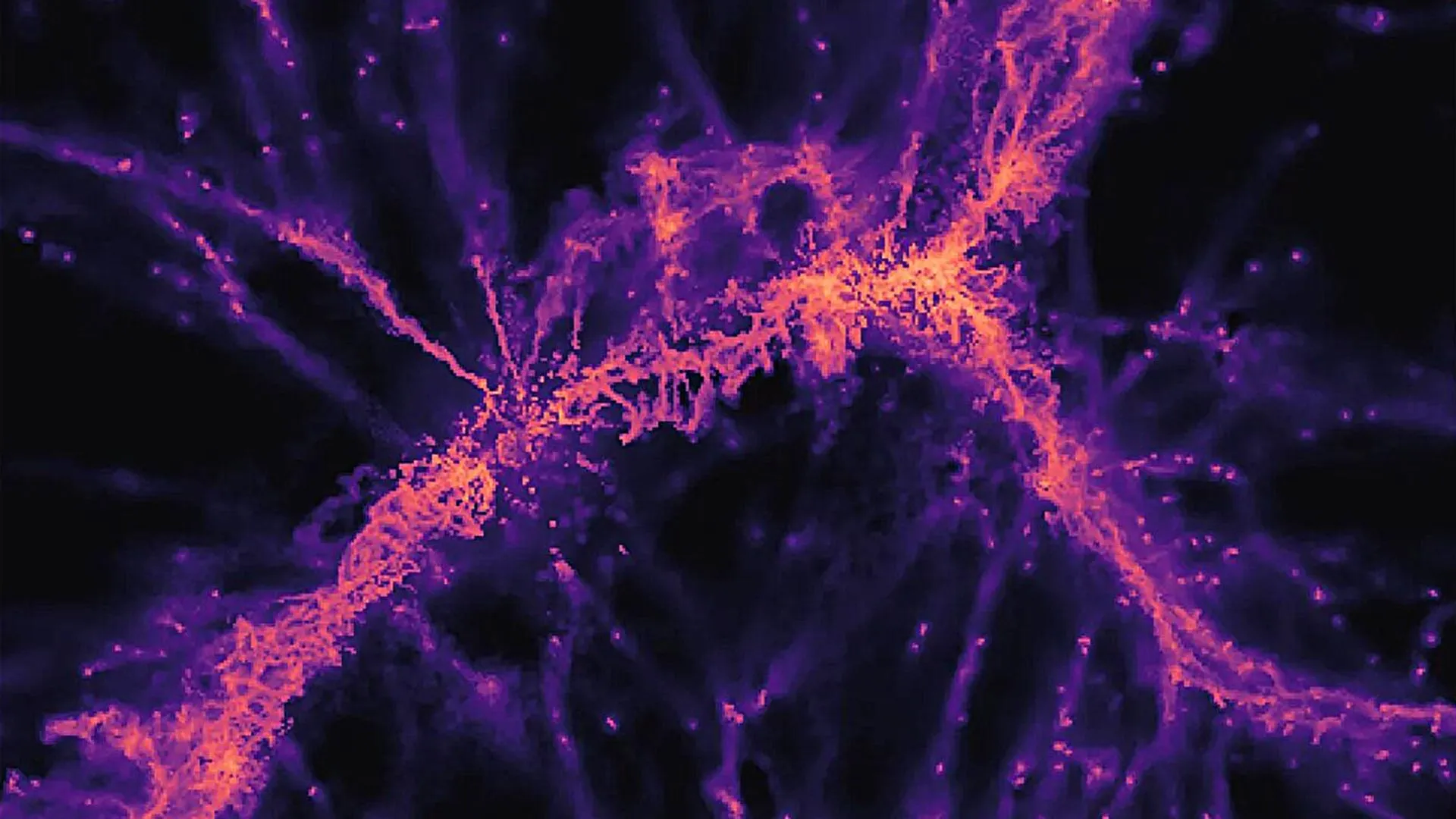
The cosmic web is the universe's largest-scale structure: a sprawling lattice in which galaxies cluster along dense filaments separated by enormous, near-empty voids. In the new map, bright yellow regions mark the dense clusters and threads where matter concentrates, while dark regions reveal the cavernous voids in between. Earlier observations from the Hubble Space Telescope could only hint at these formations, but Webb's sensitivity and resolution have brought intricate filaments, clusters and previously hidden structures into sharp focus.
Mapping this structure matters because the cosmic web is closely tied to dark matter, the invisible substance thought to make up most of the universe's mass. Visible galaxies trace the underlying scaffolding of dark matter, so a more precise map of where galaxies sit offers astronomers an indirect but powerful probe of how dark matter is distributed and how it has shaped cosmic evolution.
By capturing the web in such fine detail and so far back in time, the survey gives scientists a new benchmark for testing models of how galaxies assembled in the early universe. The findings reveal that the network of filaments and clusters was already taking shape when the cosmos was young, sharpening researchers' understanding of how the structures we see today first emerged from the smooth aftermath of the Big Bang.
COSMOS-Web's sheer scale is part of what made the achievement possible. By surveying a wide patch of sky in exquisite depth, Webb gathered enough galaxies to statistically reconstruct the underlying web rather than glimpsing isolated fragments of it. Researchers say the resulting map will serve as a reference dataset for years, allowing competing theories of cosmic structure formation to be tested against real observations spanning most of the universe's history. Future analyses of the same survey are expected to refine estimates of how quickly the web grew and how the interplay between ordinary matter and dark matter sculpted the cosmos into the intricate lattice astronomers now observe.