Our Nearest Galactic Neighbor Was Shattered by a Billion-Year-Old Collision, Astronomers Find
The Small Magellanic Cloud — long used as a stand-in for early-universe galaxies — passed directly through the disk of the Large Magellanic Cloud hundreds of millions of years ago, permanently disrupting its structure in ways that invalidate decades of cosmological assumptions.
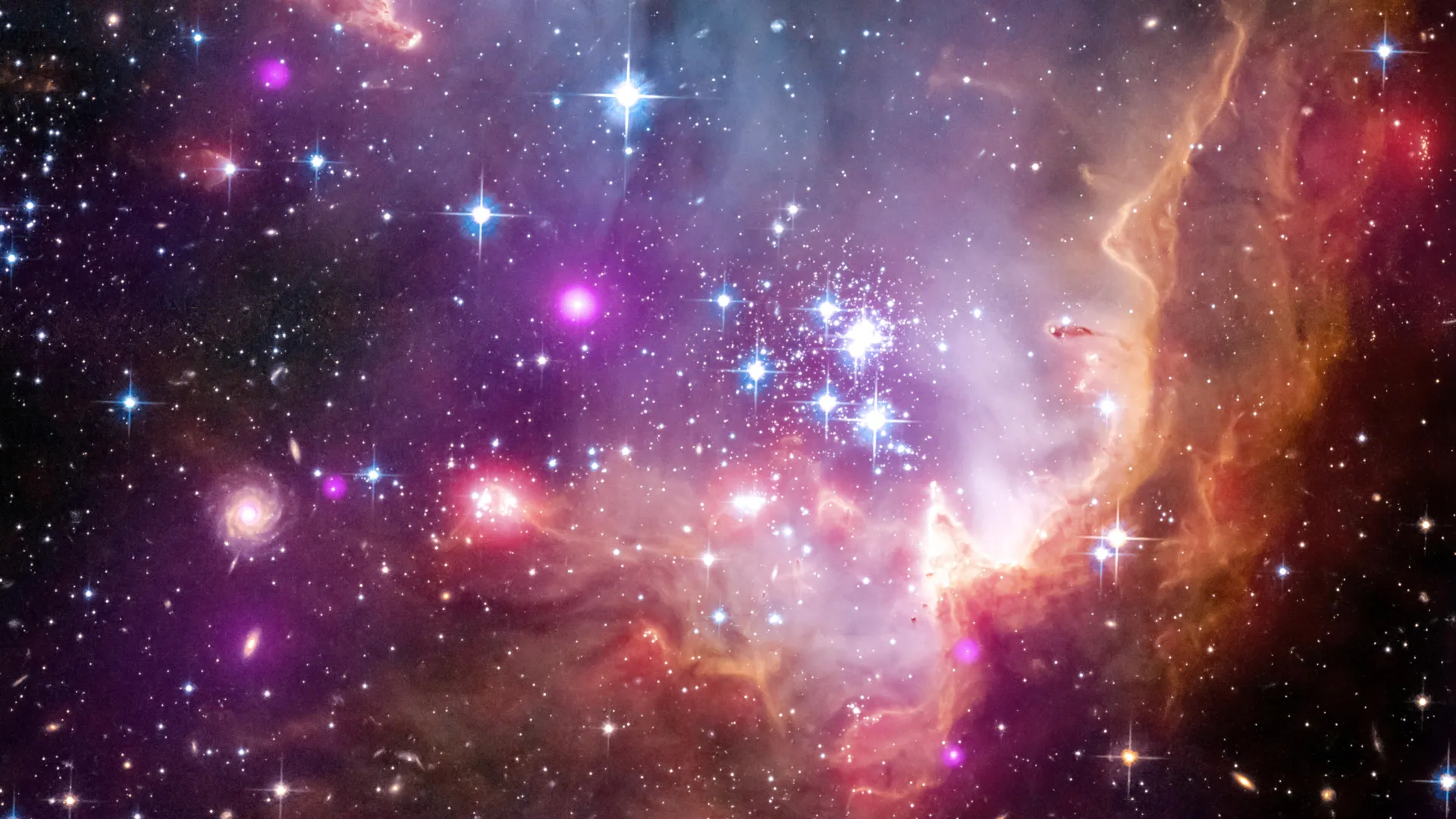
A galaxy that astronomers have long used as a proxy for studying the early universe has turned out to be far more complex — and far more damaged — than previously understood. New research published in The Astrophysical Journal reveals that the Small Magellanic Cloud (SMC), one of Earth's closest galactic neighbors at roughly 200,000 light-years away, was essentially shattered by a direct collision with its larger companion, the Large Magellanic Cloud (LMC), hundreds of millions of years ago. The finding fundamentally changes how scientists think about the SMC and raises questions about its reliability as a cosmological laboratory.
The research was led by Himansh Rathore, a graduate student at the University of Arizona's Steward Observatory, working with co-authors Gurtina Besla, Roeland P. van der Marel, and Nitya Kallivayalil. The team used a combination of observational data from the Hubble Space Telescope and the European Space Agency's Gaia satellite, combined with detailed computer simulations, to reconstruct the SMC's collision history.
"We are seeing a galaxy transforming in live action," Rathore said in a statement accompanying the paper's publication on March 20. The SMC, he explained, provides "a unique, front-row view" of what galactic transformation actually looks like — a process usually too slow or too distant to observe in real time.
The key finding concerns the SMC's internal kinematics: the way its stars and gas move relative to one another. Unlike most galaxies, which show organized rotation, the SMC's stellar motions appear chaotic and disordered. Previous studies attributed this to tidal stripping — the LMC's gravity gradually pulling material away from the smaller cloud over billions of years. The new paper argues for a more violent history: the SMC passed directly through the disk of the LMC during a close passage a few hundred million years ago.
During that encounter, the LMC's gravitational pressure was sufficient to strip the SMC's gas of its rotational coherence. This matters enormously because the SMC contains more mass in gas than in stars — meaning the disruption of its gas dynamics fundamentally altered the galaxy's structure and star-formation behavior. The simulations match the current observed state of the SMC with remarkable precision, the authors note.
The implications extend well beyond galactic astronomy. The SMC has for decades served as a stand-in for so-called dwarf irregular galaxies — small, metal-poor systems thought to resemble the building blocks of larger galaxies in the early universe. Astronomers studying star formation in low-metallicity environments, or modeling how the first generations of stars formed after the Big Bang, have routinely used SMC data as a reference point.
If the SMC's structure was significantly disrupted by the LMC collision, those comparisons become suspect. Rathore and his colleagues argue that the SMC can no longer be reliably used as a model for early-universe galaxies, because its current state is the product of a specific gravitational encounter rather than pristine evolution.
The research also has implications for understanding the future of the Magellanic Clouds system. Both the LMC and SMC are on trajectories that will eventually carry them into the Milky Way — an event expected in roughly 2 billion years. The new findings suggest that the LMC's influence on the SMC has been more dramatic and sustained than models indicated, which may require revisions to predictions about how the merger will ultimately unfold.