Astronomers Detect First Close Pair of Supermassive Black Holes in Death Spiral Set to Merge Within 100 Years
Scientists tracking galaxy Markarian 501 for 23 years found two black holes orbiting each other every 121 days at a separation of just 250–540 AU — a system unprecedented in astronomical history.

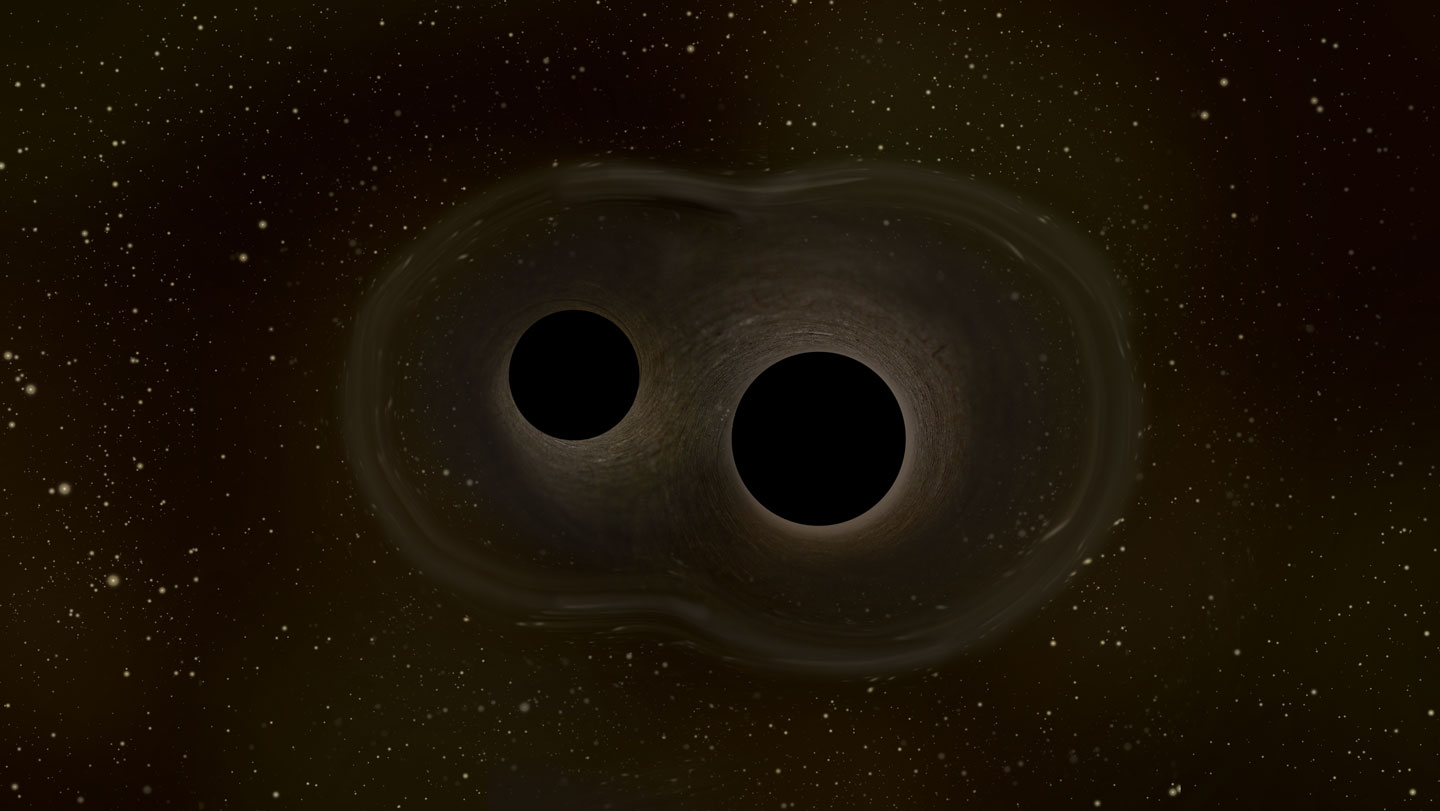
Astronomers have detected the first known close pair of supermassive black holes locked in a gravitational death spiral, orbiting each other in the galaxy Markarian 501 once every 121 days — and expected to merge within approximately 100 years in a cataclysm that will release more energy than all the stars in the Milky Way combined. The discovery, announced in the Monthly Notices of the Royal Astronomical Society by a team led by Dr. Silke Britzen of the Max Planck Institute for Radio Astronomy in Bonn, came after 23 years of high-resolution radio observations tracked the two black holes' distinctive twin jets across multiple frequencies. It is the closest-orbiting supermassive black hole binary ever confirmed.
The two black holes, each with a mass between 100 million and one billion times that of the sun, are separated by just 250 to 540 astronomical units — roughly 250 to 540 times the distance between Earth and the sun. On a cosmic scale, this is extraordinarily close for objects of such extreme mass. Their orbital period of just 121 days means that every four months, each black hole completes a full revolution around the other. The pair's eventual merger — now predicted within a human lifetime — will generate gravitational waves of a frequency and intensity detectable even with equipment not yet built, potentially providing the first direct observation of two supermassive black holes colliding.
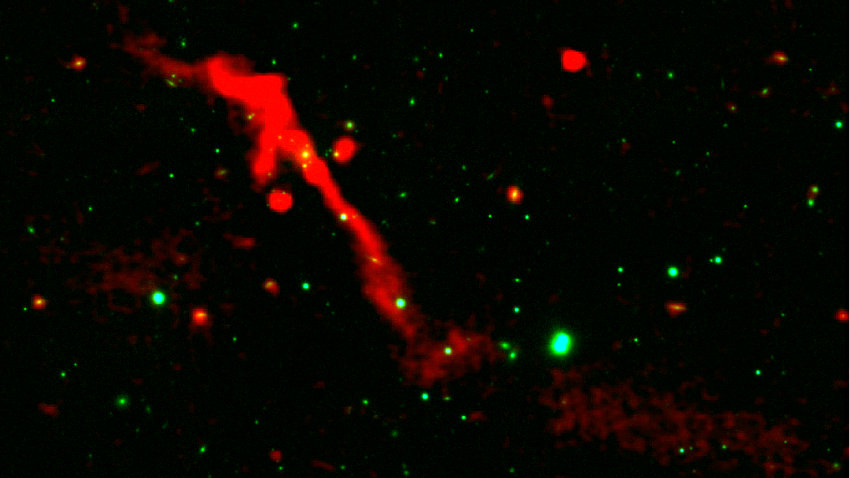
The discovery came as a complete surprise to the research team, who were originally studying only one jet from Markarian 501's central region. "We searched for it for so long, and then it came as a complete surprise that we could not only see a second jet, but even track its movement," Britzen said in a statement. The second jet was detected moving counterclockwise around what appears to be the larger of the two black holes. A key confirmation came in June 2022, when radio observations captured an Einstein ring — an alignment of Markarian 501's jet with Earth so precise that light bends perfectly around the gravitational field, creating a complete halo. This extremely rare optical phenomenon provided independent confirmation of the binary black hole structure.
The implications for gravitational wave astronomy are significant. The LIGO and Virgo detectors that have revolutionized our understanding of stellar-mass black hole mergers operate at frequencies far too high to detect the gravitational waves produced by supermassive black holes. But the Laser Interferometer Space Antenna (LISA), the European Space Agency's space-based gravitational wave observatory planned for launch in the 2030s, is specifically designed to detect waves from exactly this type of system. Co-author Dr. Héctor Olivares noted that "if gravitational waves are detected, we may even see their frequency steadily rise as the two giants spiral toward collision, offering a rare chance to watch a supermassive black hole merger unfold in real time."
Markarian 501, located in the constellation Hercules at a distance of roughly 500 million light-years from Earth, has been extensively studied as a blazar — a galaxy whose central jets happen to be aimed almost directly at our solar system. That fortunate alignment is what made the detection possible, since it allowed astronomers to observe the jet motion with unusual precision. Researchers plan to continue monitoring the system with the upgraded Very Long Baseline Array, the Event Horizon Telescope, and other facilities to refine measurements of the orbital period and better predict the timing of the merger. The find raises the possibility that other known blazars and radio galaxies may harbor hidden binary supermassive black holes awaiting discovery.