Astronomers Discover a Temperate Super-Earth 28 Light-Years Away in the Habitable Zone of Quiet Red Dwarf Ross 318
A six-Earth-mass exoplanet found by Italian and Brazilian astronomers using HARPS-N data orbits one of the calmest M-dwarf stars within 30 light-years, making it a prime atmospheric-spectroscopy target for the James Webb Space Telescope.

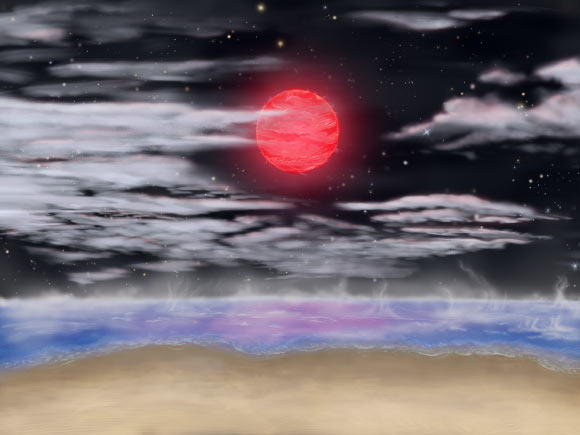
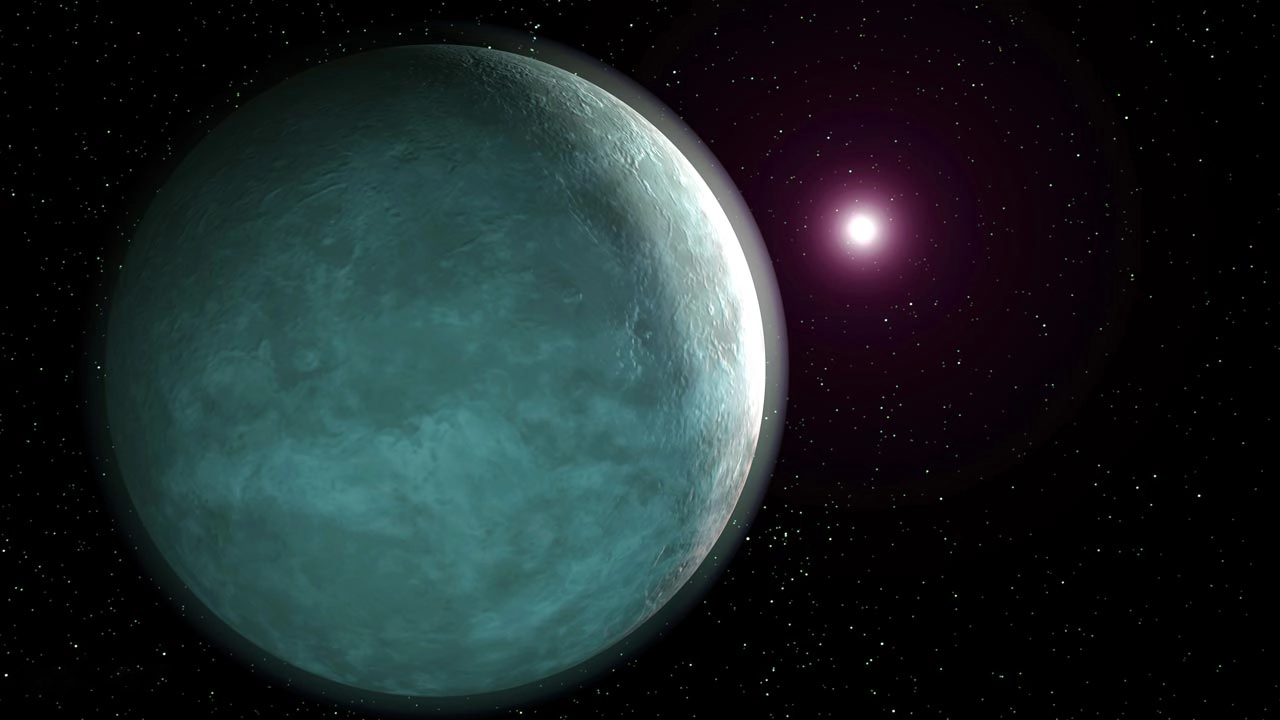
Astronomers in Italy and Brazil have discovered a temperate super-Earth orbiting Ross 318, a quiet red-dwarf star just 28 light-years from the Sun, and the planet sits squarely inside what scientists call the conservative habitable zone — the orbital band where liquid water could plausibly exist on a rocky surface. The find, posted as a preprint to the arXiv server on May 11 and now circulating through peer review at the journal Astronomy & Astrophysics, immediately moves Ross 318 b into the short list of nearby worlds that next-generation telescopes will target for atmospheric study.
The planet, designated Ross 318 b, has a minimum mass of 6.21 Earth masses and an estimated radius of 1.74 Earth radii, placing it firmly in the super-Earth category. It orbits its host star, also known as Gliese 48 or TIC 379084450, every 39.63 days at a distance of 0.16 astronomical units — about a sixth of the Earth-Sun separation. Because Ross 318 is a small, cool M3.5V dwarf with only a fraction of the Sun's luminosity, that tight orbit translates into a relatively gentle climate: the planet receives roughly 58 percent of the stellar flux Earth gets from the Sun, comparable to what an icy Mars would have experienced billions of years ago when the Red Planet still had standing water.
The discovery was led by astronomer Silvio Antonio Correa Junior and colleagues at the Federal University of Rio Grande do Sul and Italy's Institute of Astrophysics and Space Science, working with archival radial-velocity data from the HARPS-N spectrograph on the Telescopio Nazionale Galileo in the Canary Islands and the Habitable-zone Planet Finder at the Hobby-Eberly Telescope in Texas. "What is remarkable is that Ross 318 is one of the calmest M dwarfs we have monitored," Correa told phys.org. "It does not flare aggressively, and its rotation period is long enough that it is unlikely to have stripped the atmosphere of a planet in this orbit."
The quiet behavior of the host star matters because red dwarfs are notorious for blasting close-orbiting worlds with X-ray and ultraviolet radiation, eroding atmospheres in the process. Ross 318's measured chromospheric activity index sits well below that of Proxima Centauri or TRAPPIST-1, the two most famous nearby M-dwarf systems with habitable-zone planets, suggesting Ross 318 b's atmosphere — if it has one — would face less aggressive sputtering. The researchers also see hints in the radial-velocity data of a possible second, smaller planet on a 12-day orbit, though they emphasize that signal needs more observations before it can be confirmed.
Next steps will fall to the James Webb Space Telescope, which has time allocated in Cycle 5 to attempt transmission spectroscopy on several recently discovered nearby super-Earths. Because Ross 318 b is not yet known to transit its star — radial-velocity detections do not require a transit geometry — the team has applied for TESS follow-up to search for any partial transits, which would open the door to direct atmospheric characterization. "At 28 light-years, this is essentially in our cosmic backyard," said Dr. Sara Seager, an MIT exoplanet researcher not involved in the discovery. "If Ross 318 b transits at all, it will jump to the very top of the JWST priority list."