JWST Captures First Detailed Atmosphere of Saturn-Sized Temperate Exoplanet TOI-199b, Reveals Methane-Dominated Skies at 175 Degrees
Penn State astronomers used a seven-hour transit and 20 hours of baseline observations with the Webb telescope to detect methane at an unprecedented 11-sigma confidence level, with hints of ammonia and carbon dioxide, opening the first clean window into a planet class that fills the gap between hot Jupiters and our own solar system.
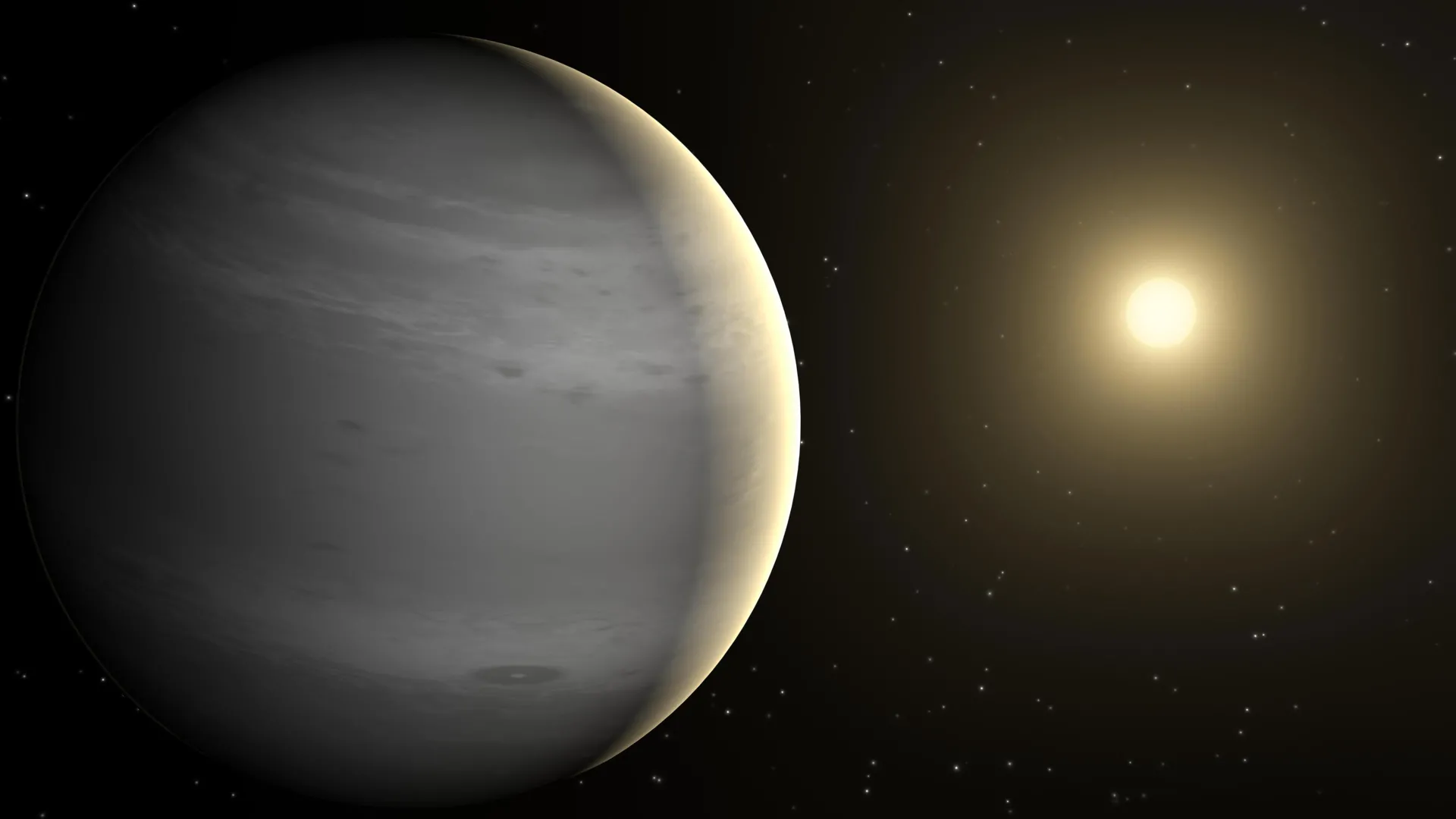
Astronomers have used the James Webb Space Telescope to perform the first detailed atmospheric analysis of a temperate gas-giant exoplanet, finding that the Saturn-sized world TOI-199b has an atmosphere unmistakably rich in methane, with hints of ammonia and carbon dioxide — a chemical fingerprint that for the first time gives scientists a look at a class of planet that fills the gap between the broiling "hot Jupiters" they have studied for two decades and the cool gas giants of our own solar system. The findings, led by graduate student Andy Skemer and Penn State astronomer Dr. Suvrath Mahadevan, were published May 19 in The Astronomical Journal and announced on ScienceDaily on May 21.
TOI-199b orbits a Sun-like star about 330 light-years from Earth in the constellation Volans, completing one circuit every 104 days at a distance that produces an equilibrium temperature of roughly 175 degrees Fahrenheit — only slightly hotter than the warmest summer day in Phoenix and a striking departure from the more than 5,000 known exoplanets, the vast majority of which sit at temperatures above 1,000 degrees Fahrenheit. "This is a class of planet that JWST was practically designed to study but that we have never been able to characterize before," Mahadevan said. "For the first time we have a clean, methane-dominated transmission spectrum from a planet whose temperature is in the range we associate with potentially habitable worlds."
The team used the transit-spectroscopy technique, in which JWST stares at the host star for roughly 20 continuous hours while the planet crosses in front of it. As starlight filters through the planet's atmosphere, different gases absorb specific wavelengths of infrared light, leaving spectroscopic fingerprints that can be read with extraordinary precision. The seven-hour transit produced 11 sigma detections of methane — the strongest detection ever made for an exoplanet — and tentative 3 sigma detections of ammonia and carbon dioxide. "The methane signal was so strong that we initially worried about instrument systematics, and then we realized: no, the planet really does have an atmosphere ten times the methane content of Saturn at the cloud tops," Skemer said.
Methane is of particular interest to astrobiologists because it is one of two key gases — the other being molecular oxygen — whose simultaneous presence in an atmosphere can be a biosignature, since both should rapidly react and disappear unless they are being continually replenished. TOI-199b is far too gaseous and massive to host life, but its chemistry serves as a vital laboratory for understanding the atmospheres of smaller, rocky temperate planets that JWST and its successors will eventually study. The detected mixing ratios closely match models of disequilibrium chemistry in which a planet's atmosphere is stirred from below by rising plumes of warmer gas — a process well documented on Saturn and Jupiter but never before measured outside our solar system.
The Penn State–led team plans to return to TOI-199b for a longer set of observations in the JWST Cycle 4 schedule, which begins July 1. Those data will allow them to constrain the planet's interior heat flow, the abundance of water vapor and the presence or absence of high-altitude haze layers — measurements that will sharpen models of what mature, temperate gas giants look like throughout the galaxy. "For 30 years we've been studying hot Jupiters because they're the easiest planets to detect," said Heather Knutson, a Caltech astronomer not involved in the study. "What this paper shows is that we can finally start studying the cool ones. The chemistry is different, the clouds are different, the dynamics are different, and TOI-199b is going to be a touchstone for the field for the next decade."