Webb Telescope Detects Methane on Interstellar Comet 3I/ATLAS, a First for a Visitor From Another Star
NASA's James Webb Space Telescope has directly detected methane gas streaming from 3I/ATLAS, revealing that the rare interstellar comet formed in a chemical environment unlike anything in our solar system.
Astronomers using NASA's James Webb Space Telescope have directly detected methane gas escaping from 3I/ATLAS, the third interstellar object ever observed passing through our solar system, marking the first time the molecule has been identified on a visitor from another star.
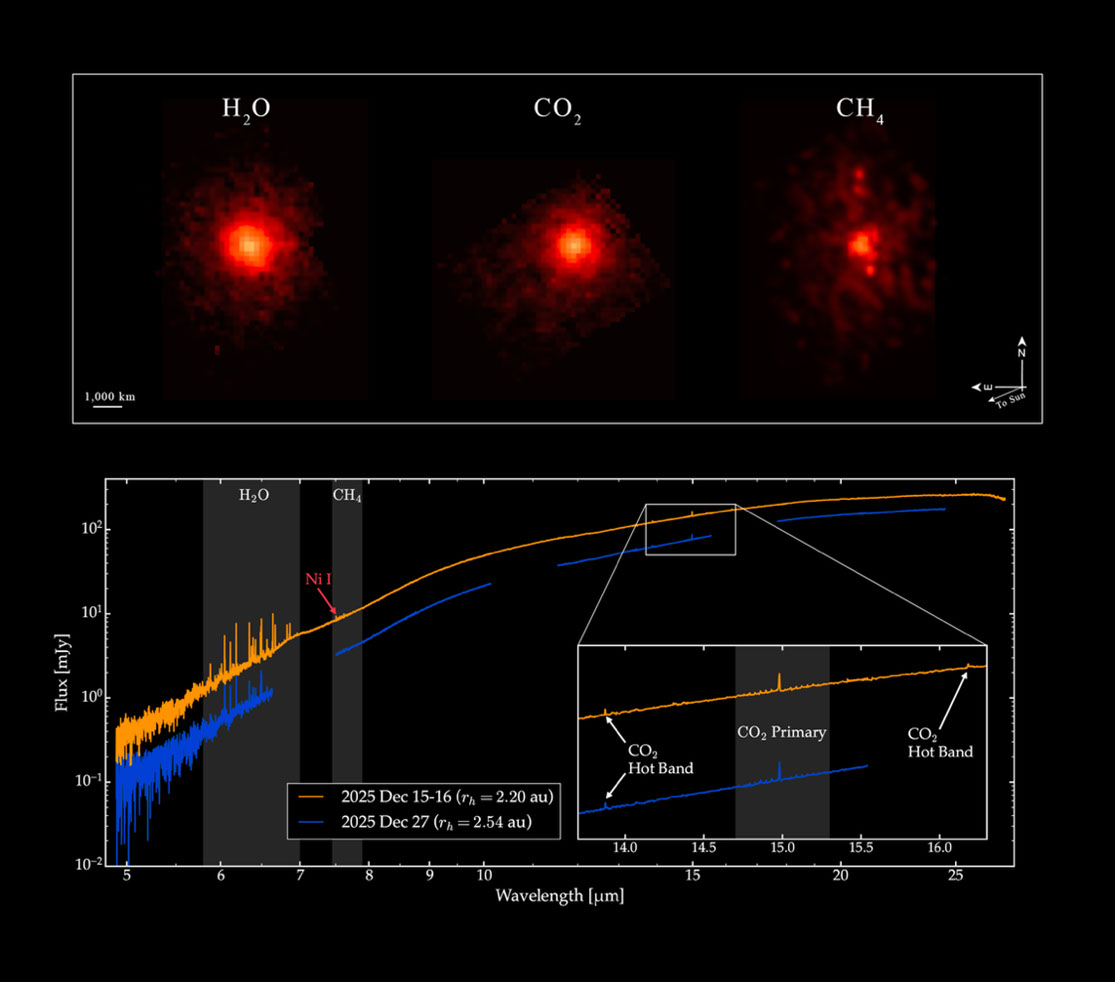
The detection, made with Webb's Mid-Infrared Instrument, captured methane sublimating from the comet's icy body as it neared the Sun. Methane turns easily from solid ice into gas, and scientists found it appeared in surprisingly high concentrations relative to the comet's water content, with the gas emerging from subsurface layers and concentrated near the nucleus. Few comets born in our own solar system show a comparable chemical signature, making the find an immediate puzzle for researchers.
The team observed 3I/ATLAS twice, first on December 15 and 16, when the comet was about 205 million miles from the Sun, and again on December 27, by which point it had receded to roughly 236 million miles. Between the two observations, the comet's gas production dropped sharply as it moved farther from the Sun's warmth, giving researchers a rare window into how an interstellar body responds to solar heating over a span of just days.
For scientists, the unusual mix of high methane and carbon dioxide relative to water is the most tantalizing clue. It suggests 3I/ATLAS coalesced in a fundamentally different formation environment than the comets that populate our solar system, preserving chemistry from a planetary system around a distant, unknown star. Such objects are effectively time capsules from other solar systems, and their composition offers a direct sample of materials forged light-years away that would otherwise be impossible to study up close.
The findings, reported in The Astrophysical Journal Letters, drew on analysis from researchers including M. Belyakov of Caltech and I. Wong of the Space Telescope Science Institute. Their work adds 3I/ATLAS to a very short list of interstellar interlopers, following 1I/'Oumuamua, discovered in 2017, and the comet 2I/Borisov in 2019, each of which arrived on a hyperbolic trajectory that betrayed its origin beyond the Sun's gravitational grip.
Detecting methane required separating the comet's faint infrared fingerprint from the glare of sunlight and the broader chemistry of its coma, a task suited to Webb's unprecedented sensitivity. Astronomers said the measurement demonstrates how the observatory can characterize fleeting visitors that earlier telescopes could only glimpse, opening the door to chemical surveys of future interstellar objects.
Each interstellar object that streaks through has given astronomers a fleeting chance to study the building blocks of worlds beyond our own, and 3I/ATLAS is proving to be the most chemically informative yet. As it heads back toward interstellar space, never to return, the methane signature captured by Webb will remain a permanent record of an alien chemistry, helping scientists understand how common, or how strange, our own solar system's recipe really is.