Euclid Telescope Spots Most Distant Quasar, 630 Million Years After Big Bang
The object, nicknamed Dún Aonghasa, is powered by a black hole of 360 million solar masses, raising the question of how it grew so large so quickly.

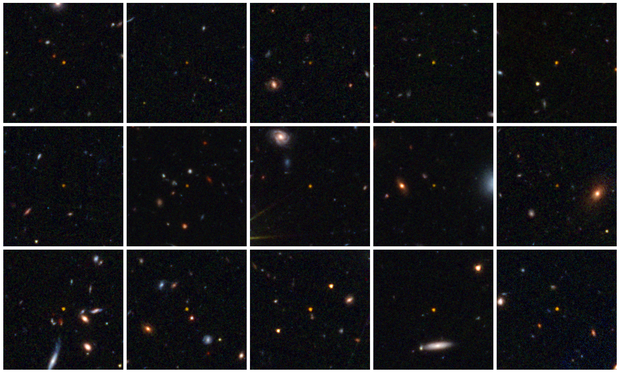
Astronomers have found the most distant quasar yet seen, a brilliant galactic core powered by a black hole that had already grown enormous when the universe was only about 630 million years old.
A German-led team reported the discovery Tuesday after searching through millions of observations from the European Space Agency's Euclid space telescope. Light from the object shows it as it was roughly 13.1 billion years ago, when the universe was less than 5% of its present age. The full results appear in the journal Astronomy & Astrophysics.
Quasars shine because gas falling toward a supermassive black hole heats up and releases immense energy. They are bright enough to be seen across most of the observable universe, which makes them valuable markers of conditions in the earliest era. Finding one this far back is rare.
The new find breaks the old distance record by a wide margin. "This time the leap in cosmic time is huge!" said Julien Wolf of the European Southern Observatory, who led the study. "The previous two records each took us back by about 15 million years or less. This one takes us back by nearly 40 million years, the biggest advance in nearly a decade!"
Follow-up work with the Hubble and James Webb space telescopes, along with other observatories on the ground and in space, backed up the finding. Webb data indicate that the central black hole contains the mass of about 360 million suns. Wolf said the object is also unusual because the black hole is a relatively slow eater, pulling in surrounding material at a modest rate despite its size.
That combination poses a puzzle. Black holes born from collapsing stars are thought to start small, and building one hundreds of millions of times heavier than the sun takes time that was in short supply so soon after the Big Bang. "Dun Aonghasa gives us a new deadline," Wolf said. "About 630 million years after the Big Bang, its black hole had already grown to about 360 million times the mass of the sun. But how?"
The quasar's nickname comes from Dún Aonghasa, a prehistoric stone fort on Ireland's Aran Islands. Wolf, whose wife and daughter are Irish, said he was struck during a family visit by the fort as a frontier holding the promise of a vast horizon still to explore, an image he connected to the new object. Its catalog redshift, a measure of how far its light has been stretched by cosmic expansion, is 8.13.
Euclid launched in 2023 on a mission to map galaxies and probe the dark matter and dark energy that make up most of the universe and drive its expansion. Its wide view of the sky also makes it well suited to catching rare, faint targets that smaller surveys would miss.
How long the record will stand is unclear. "Honestly, the record could fall again in a few months or it could stand for years," Wolf said.