Faintest Supernova Ever Seen Kept Glowing for Nearly a Whole Year
An exploding star 30 million light-years away gave off less than 1% of the light of a typical supernova, then refused to fade, raising questions about how white dwarfs blow up.

Astronomers have identified the faintest supernova ever observed, a stellar explosion so weak it was barely detectable even in a relatively nearby galaxy, yet so stubborn that it stayed visible for almost a year.
The blast, cataloged as SN 2024vjm, produced less than 1% of the light of a typical supernova, according to a study published in Nature Astronomy by an international team that includes Paul Groot, a professor of astronomy at Radboud University in the Netherlands. The paper's lead author is Erez A. Zimmerman.
The researchers spotted it as a new point of light in the galaxy NGC 6744, about 30 million light-years from Earth, using BlackGEM, a set of three telescopes at the European Southern Observatory's La Silla site in Chile built to catch faint flashes. The object was 100 to 300 times dimmer than an ordinary supernova.
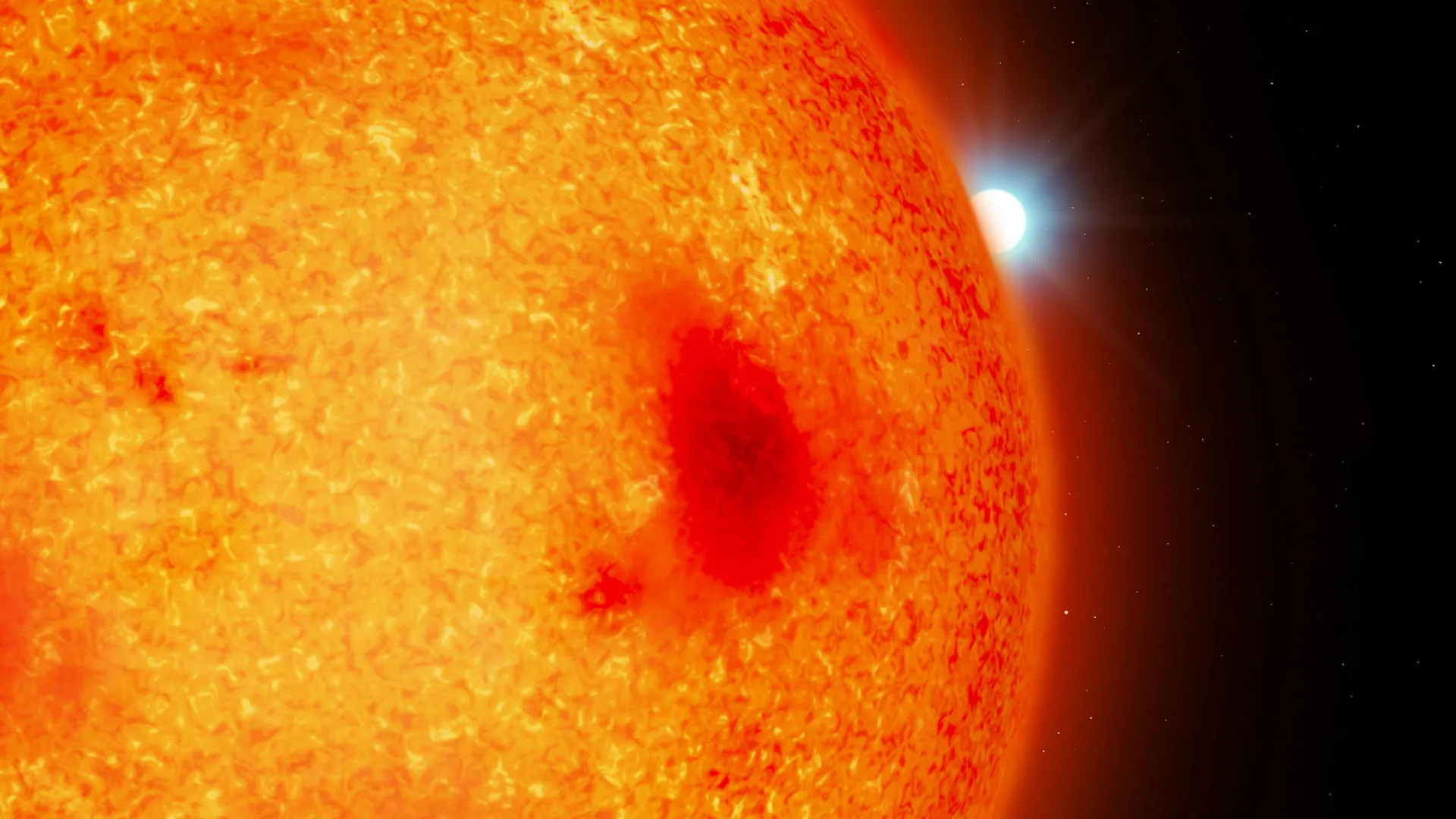
A spectrum taken with the New Technology Telescope, also at La Silla, confirmed that a star had exploded. Debris was expanding at about 3,000 kilometers per second, or 1,900 miles per second, far slower than the more than 10,000 kilometers per second seen in typical blasts. Its chemical makeup matched that of Type Ia supernovae, the powerful explosions that destroy white dwarfs, the burned-out cores of stars like the sun.
Images the Euclid space telescope happened to take 11 months before the explosion helped narrow down the culprit. No star showed up at the site, so the team concluded that no bright star could have been involved. The likeliest origins are a white dwarf paired with a faint companion, or two white dwarfs orbiting each other.
The long afterglow was the other surprise. Supernovae shine because radioactive nickel made in the blast decays and heats the expanding gas, which fades once the cloud thins enough for the radiation to escape. A normal event of this kind stays bright for about one to one and a half months. In this weak explosion, the cloud remained compact for more than 70 days and the radioactive material moved slowly, trapping energy inside and keeping the gas hot.
The finding could matter for cosmology. Type Ia supernovae are used as "standard candles" to measure the expansion of the universe because they are thought to peak at about the same brightness. Astronomers may have been seeing only the most luminous members of a wider family.
"It turns out that exploding white dwarfs can be much fainter than previously thought. That is probably why we have missed part of this population in the past," Groot said. The bright standard candles are probably white dwarfs of about 1.4 times the sun's mass, he said, which leaves open whether much lighter ones can explode too, and what would set them off. The team is using BlackGEM to hunt for more.