Physicists Make Disordered Light More Coherent by Letting It Reach Equilibrium
In a Nature Physics study, a fiber-loop experiment moved about 82% of optical power into one wave pattern, a possible new route to combining many weak beams.

Researchers have shown that jumbled light can organize itself into a far more orderly beam, using the same kind of collective behavior that drives a physical system toward equilibrium. The work, by teams at the University of Southern California and Friedrich Schiller University Jena in Germany, was published in Nature Physics.
Coherence describes how consistently the phases of light waves relate to one another. Highly coherent light, such as a laser beam, can be focused tightly and controlled precisely. Merging several independent, low-power beams into one powerful beam with that quality has long been a difficult problem.
"Simply bringing beams together does not make their waves oscillate in step," said Mercedeh Khajavikhan, a senior author of the study. Passive lenses and mirrors cannot combine mutually incoherent inputs into a single brighter, coherent beam while keeping all the power. Filters can improve coherence, but only by throwing light away. Standard beam-combining methods instead require carefully synchronizing every source, which grows harder as the number rises.
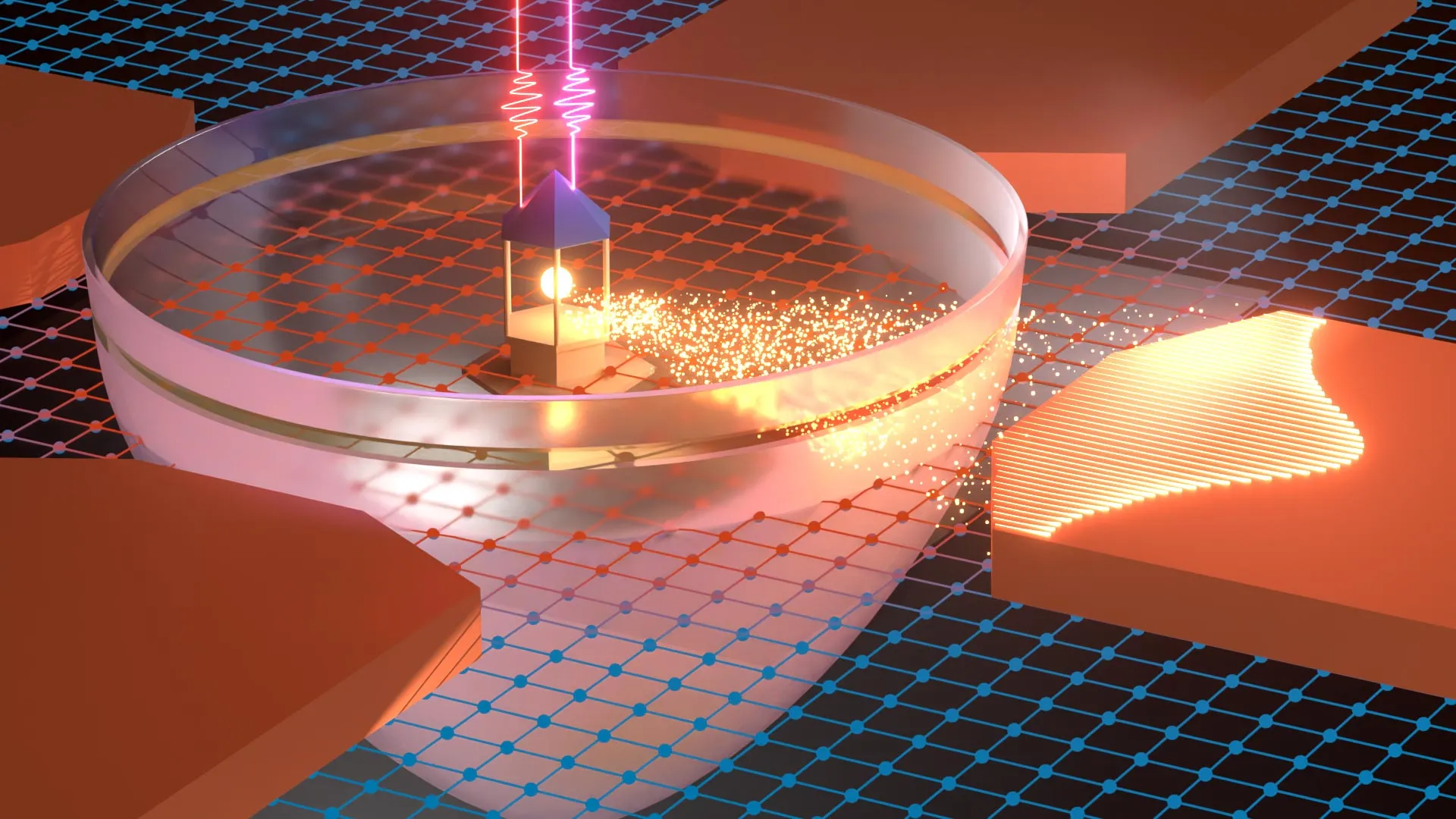
The team drew on a framework called optical thermodynamics, which treats light traveling through a system with many possible wave patterns, known as modes, in statistical terms. When the material responds to the intensity of the light, those modes can trade power until the overall distribution settles into a stable state. Under the right conditions, theory says, most of the power should gather in a single mode.
To test the idea, the researchers built a synthetic lattice from two linked loops of optical fiber with slightly different lengths. Light pulses circulate through the loops and interfere when they meet at a coupler, with arrival times standing in for different positions in an array. "We prepared an input with equal power in the two lowest-order modes and randomized their relative phase across repeated experiments, creating a statistically incoherent mixture," said lead author Abraham Berman Bradley.
Once the system reached statistical equilibrium, about 82% of the total optical power sat in the fundamental mode, the simplest wave pattern, up from an initial 50%. The researchers compared their measurements with the Rayleigh-Jeans distribution, which predicts how power is shared among modes at thermal equilibrium, and concluded that the light had reached a near-zero optical temperature.
"Here, 'temperature' describes how optical power is distributed among the available modes; no refrigeration is involved," said senior author Demetrios Christodoulides. A low value simply means the power is strongly concentrated in the fundamental mode, which is what beam combining aims to achieve.
The result may seem to run against intuition, because the light became more spatially coherent even as its entropy, a measure often linked with disorder, went up. Christodoulides said the two quantities describe different features of the light. The team also found that fluctuations in the power held by the main mode were strongly suppressed, important for any practical source that needs a steady output.
The researchers next want to apply the principle in multimode fibers and integrated photonic chips and extend it to more independent sources. They also plan to study how quickly light settles into equilibrium and how differences in wavelength and competing effects influence the process, questions that will determine whether the method delivers brighter beams in practice.