A Shaken Vial of Oil, Water and Nickel Keeps Reforming Into a Greek Urn
UMass Amherst physicists found that strongly magnetized particles can defy entropy, reshaping a liquid mixture into the same elegant curve every time it is disturbed.
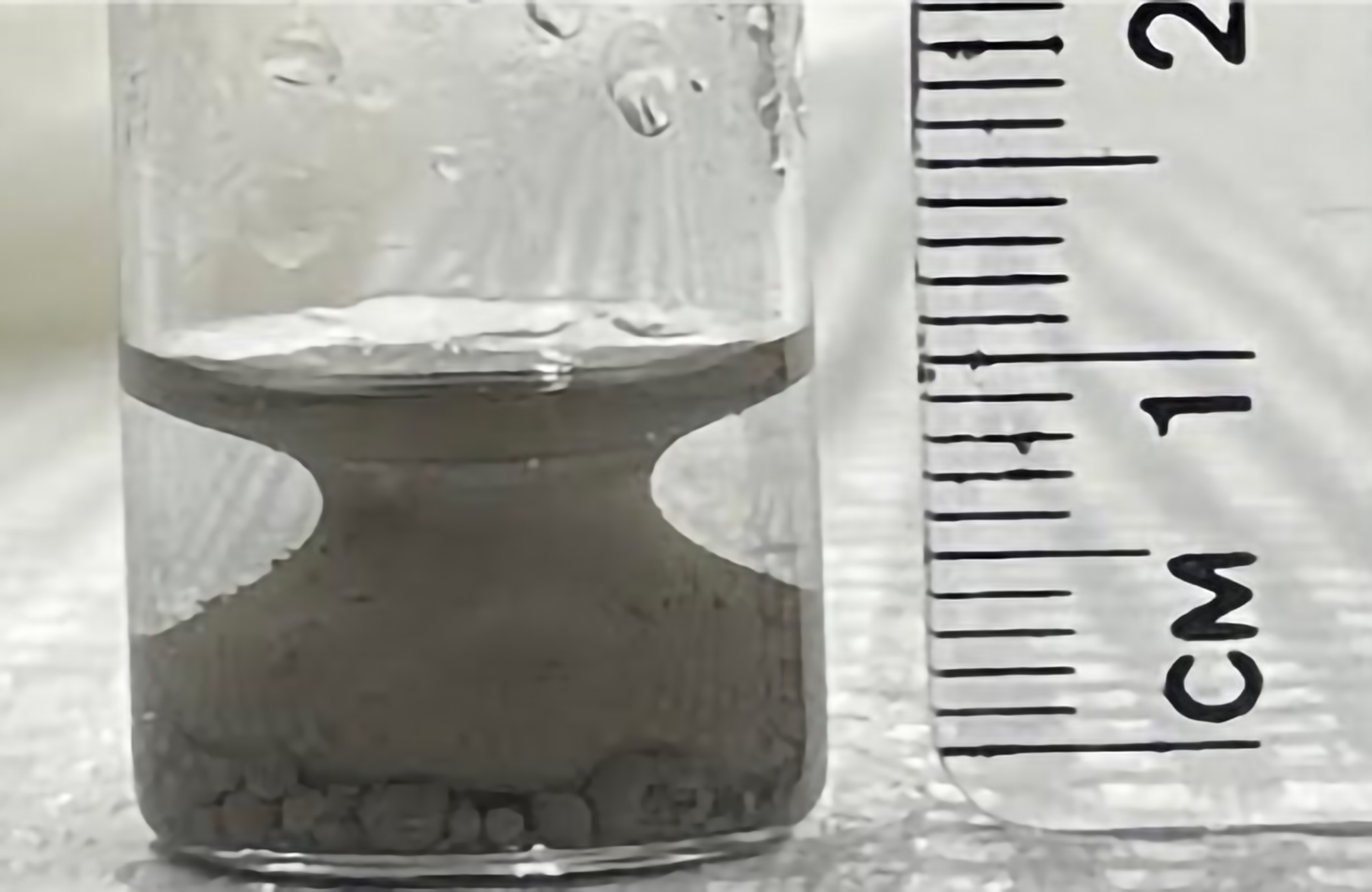
Shake a vial of oil and water and you expect chaos — droplets scattering, the two liquids slowly creeping back toward separation. But when physicists at the University of Massachusetts Amherst added magnetized nickel particles to the mix, the liquid did something that should not happen. No matter how hard they shook it, the blend kept reassembling itself into the same shape: the graceful, curving silhouette of a classical Greek urn.
The discovery, reported in the journal Nature Physics, began almost by accident. Anthony Raykh, a graduate student in the university's polymer science and engineering department, was experimenting with a simple vial containing water, oil and magnetized nickel particles when he noticed the mixture stubbornly returning to its elegant form again and again. "It was so cool," he and his colleagues recalled — a result strange enough to make the team question what they were seeing.
What makes the behavior so startling is that it appears to run against the grain of thermodynamics. The second law predicts that shaking should drive a system toward disorder, with entropy pushing the particles to mix and the interface between oil and water to flatten and minimize. Instead, the liquid organized itself into a structured, repeatable shape — a kind of order emerging from agitation rather than dissolving into it.
The key, the researchers found, lies in the strength of the magnetism binding the nickel particles together at the boundary between the oil and the water. Particles magnetized strongly enough actually increase the interfacial tension, bending that boundary into a smooth, curving wall. The collective magnetic force overrides the entropy-driven tendency to mix, holding the elegant urn shape in place. Weaken the magnetism, and the strange effect disappears.
To confirm the mechanism, the UMass Amherst team worked with collaborators at Tufts and Syracuse universities, pairing laboratory experiments with detailed computer simulations that reproduced the curving interface. The agreement between theory and the vial on the bench gave the group confidence that they had identified a genuine, if counterintuitive, physical phenomenon rather than a quirk of one experiment.
For now, the shape-recovering liquid has no immediate application. But the researchers say it opens a new frontier in soft-matter science, where magnetism, surface tension and the geometry of fluids interact in ways textbooks did not anticipate. Understanding how particles can be tuned to sculpt liquid interfaces could eventually inform the design of self-assembling materials — and, in the meantime, it offers a rare, vivid reminder that even familiar physics can still surprise.