Venus Blast Scars Suggest Lava Resurfaced the Planet Bit by Bit
A map of 592 marks left by space rocks exploding in Venus's thick air shows they cluster in patches, hinting that volcanoes erased the surface region by region over time.

Marks left by space rocks that exploded above Venus suggest the planet's surface was repaved by lava piece by piece, according to a new analysis of radar images from NASA's Magellan spacecraft.
T. J. Austin of Arizona State University and colleagues mapped 592 likely scars from such airbursts, which occur when an incoming object breaks apart in the planet's dense atmosphere. Some surround craters and others stand alone. Together they cover at least 2.7% of the surface, the team reported in the journal AGU Advances.
The scars can be large. In one radar image, a dark spot about 20 kilometers (12 miles) wide sits inside two bright halos, the fainter of which spans about 180 kilometers (110 miles), with no obvious crater at the center. A fireball reaching the ground might melt rock and leave a smooth, radar-dark patch, while blast winds could sweep away sand and expose rougher terrain that reflects radar more strongly.
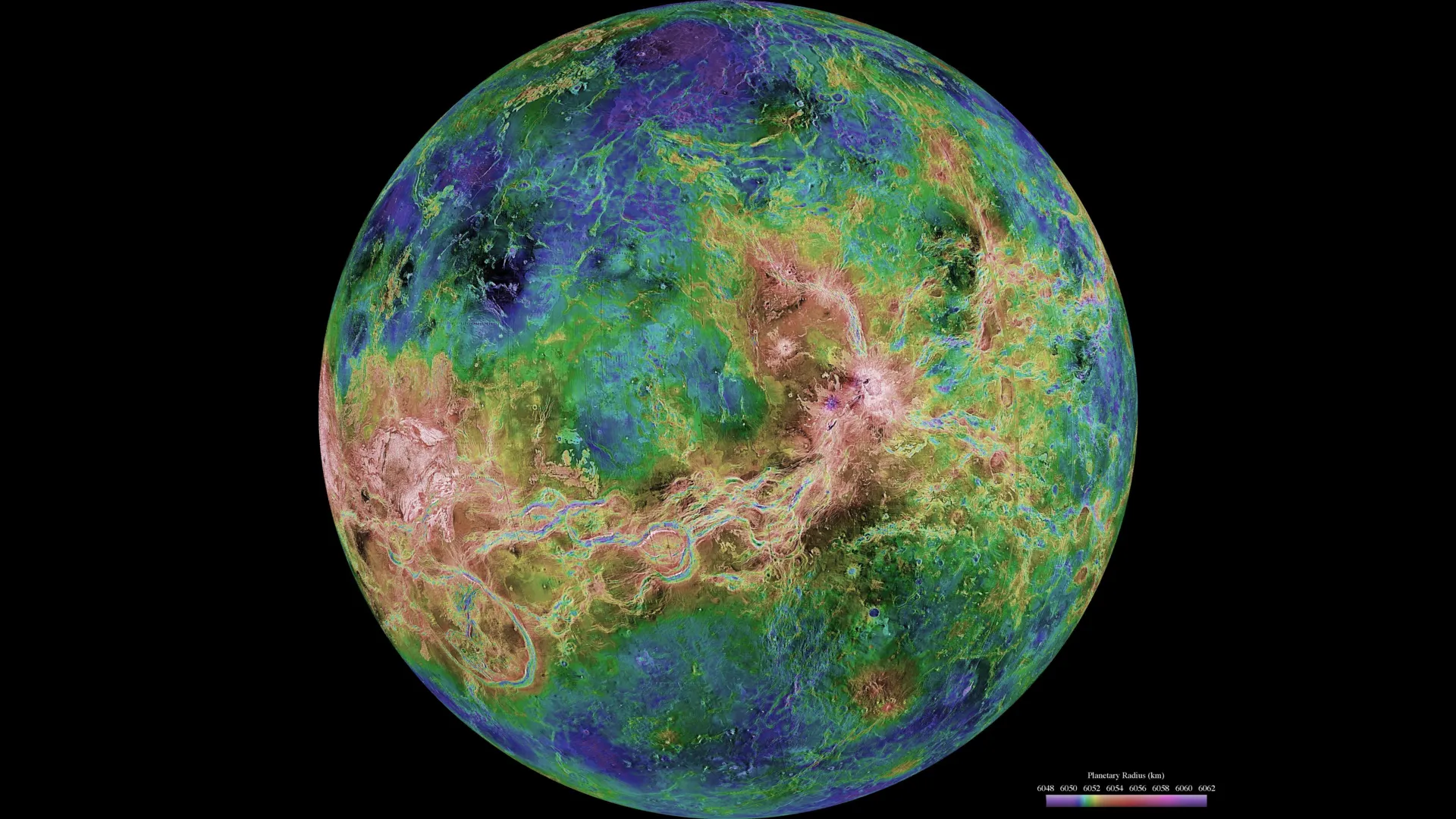
What caught the researchers' attention is how the marks are arranged. Venus's roughly 1,000 impact craters appear to be scattered at random, which has been read as evidence that volcanic eruptions buried nearly the whole planet during one geologically brief episode, resetting the clock everywhere at about the same time. The airburst scars, by contrast, bunch together.
To check that the pattern was real, the team compared 359 sites on mapped plains, away from known blankets of wind-blown impact debris, with 10,000 simulations that scattered the same number of points randomly over the same ground. The actual scars had closer neighbors than chance could readily explain.
The researchers then simulated scars accumulating on a virtual Venus while lava periodically wiped out every mark inside a randomly placed circle. Ground that went longer without burial collected more scars. Clearing patches roughly 2,000 to 6,000 kilometers (1,200 to 3,700 miles) across reproduced the observed clustering, and patches at the smaller end also fit earlier simulations of the crater record.
The two records can differ because lava could completely cover a thin blast scar while only partly filling a crater, leaving its rim visible. "The spatial distribution of airburst scars seems incompatible with a uniform surface age," the researchers wrote.
Lava may not be the only eraser. Streaks trailing from some dark scars suggest wind is carrying sediment away, and faster erosion on some plains could leave surfaces of equal age with different numbers of marks. Sharper radar views could help separate a partly buried scar from material that wind or lava simply deposited there. The team has made its catalog and software public so that future maps of Venus can combine scars with craters to refine the history of the planet's crust.