Negative Mass Might Not Break Physics After All, Two Theorists Argue
In Physics of the Dark Universe, Shin'ichi Nojiri and Sergei Odintsov find that objects with negative mass can arise consistently in a universe filled with negative-pressure fluid or extra scalar fields, and could bend light the wrong way.

Every mass ever measured has been positive, and positive masses always attract. Negative mass, stuff that would push ordinary matter away, has lived mostly in science fiction since H.G. Wells imagined an anti-gravity metal he called "cavorite" in his 1901 novel "The First Men in the Moon." A new theoretical paper argues that it may deserve more serious attention than physicists usually give it.
Writing in the journal Physics of the Dark Universe, Shin'ichi Nojiri, a theorist in Japan, and Sergei Odintsov, based in Spain, conclude that negative mass "does not always lead to any inconsistency" with Einstein's gravity once you place it in the right kind of universe. The work is purely mathematical. No one has seen a negative mass object, and the authors do not claim one exists. Their point is that the standard objection, that general relativity simply does not allow it, may be too quick.
Their starting intuition is an everyday one: a bubble in water. "The bubble behaves as if it has a negative mass because the water around the bubble falls [away] due to gravity," they write. The researchers then imagine a positive point mass, such as a compact star, sitting in a fluid with negative pressure, the property that dark energy has. Because of that negative pressure, the star pushes the surrounding fluid away, and stable pockets of negative energy density can form. Working with a version of Einstein's equations just one step beyond Newton's law of gravity, they find that such a negative mass object exerts a repulsive force on the positive mass. By Einstein's equivalence principle, it also has negative inertial mass, the "m" in F = ma.
From there the pair solve several simple cosmological models. In one, negative mass objects appear when the cosmological constant is negative. In another, where the fluid's pressure is proportional to its energy density, they appear when that ratio drops below minus two-thirds. The authors also test modified gravity theories inspired by string theory, adding two extra scalar fields to Einstein's equations. Such fields are often invoked to drive cosmic inflation or to stand in for dark matter and dark energy. In some cases the fields evolve naturally into regions of negative mass.
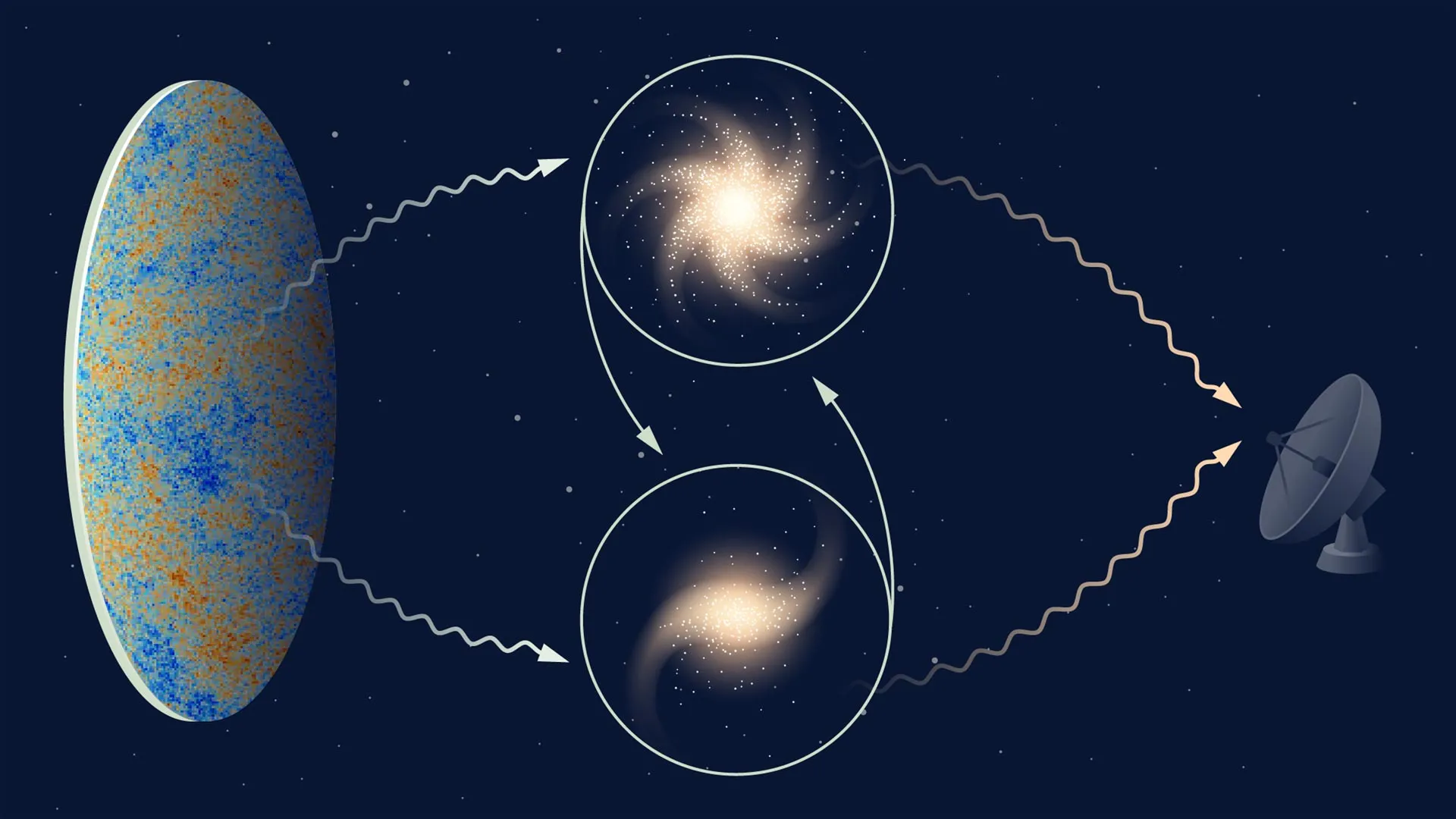
The strange consequences follow. Around a negative mass object, light would not bend inward as it does near stars and black holes. It would curve away, making the object act like a gravitational lens with the opposite shape. Because its inertial mass is also negative, a positive mass and a negative mass would behave oddly together, and two negative masses would repel each other.
Could anyone ever spot one? Not easily. In one calculation, a negative mass region would need a density above about 10^18 kilograms per cubic meter, roughly 200 trillion times Earth's average density, comparable to the inside of a neutron star. But the authors suggest several places to look: unusual lensing that pushes light outward, a negative mass object partly screening the gravity of a normal body, black hole jets whose behavior is altered, and neutron star-black hole mergers whose gravitational-wave signals depart from general relativity's predictions. "Such a system might also be observed due to the rather strange lensing effect," they write.
The paper arrives as cosmologists wrestle with growing tension in measurements of dark energy and the expansion rate of the universe, which has renewed interest in alternatives to the standard model of cosmology. General relativity has passed every test so far, but it does not explain what dark matter and dark energy actually are, leaving room for theorists to probe what else the equations might allow.