Scientists Propose Dying Stars Could Birth New Universes Instead of Black Holes
Revolutionary gravastar theory suggests massive stellar collapse triggers miniature universe creation, challenging conventional black hole formation.
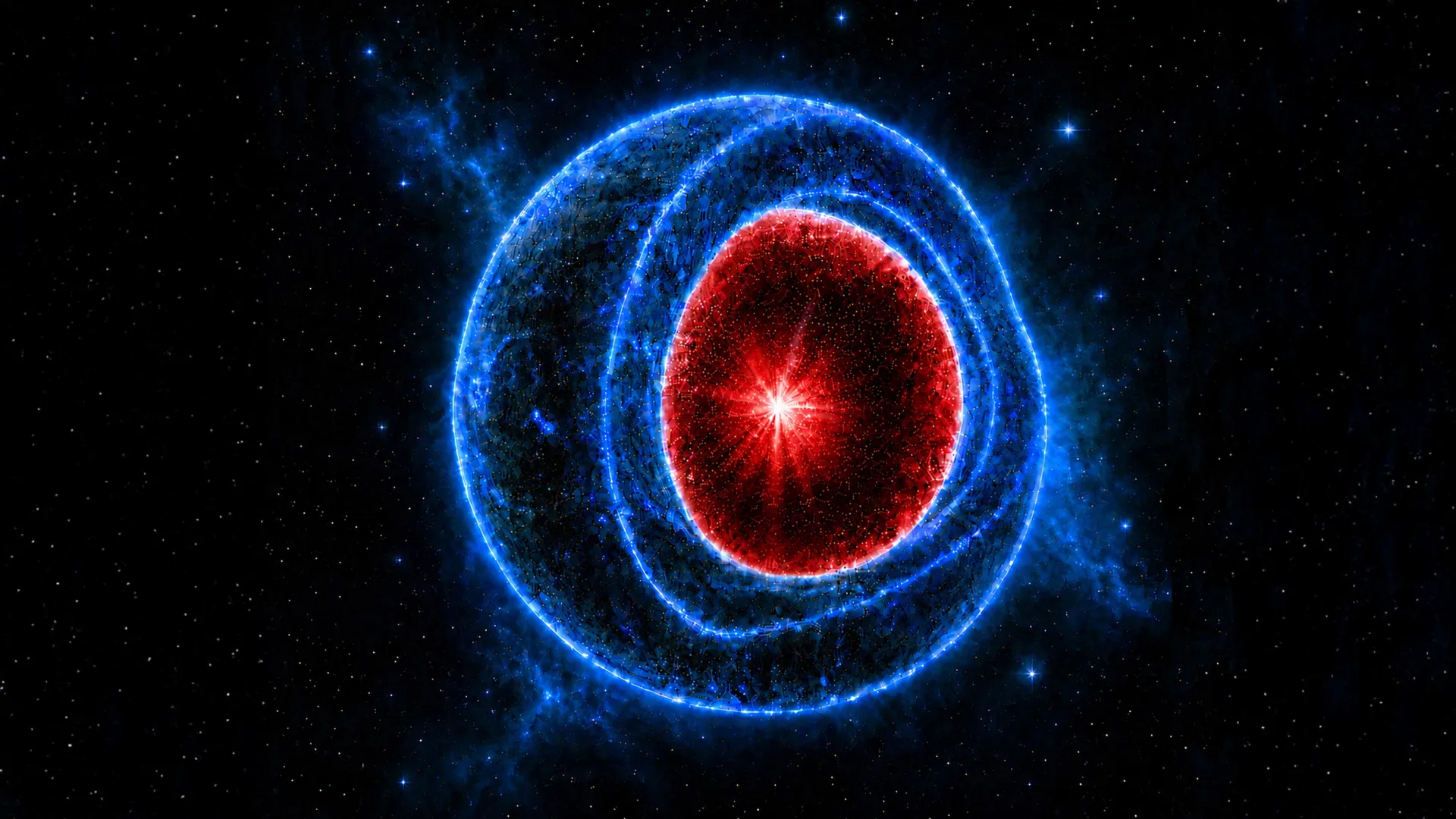
When massive stars exhaust their nuclear fuel and begin collapsing under their own gravity, they may not form the black holes that scientists have long predicted. Instead, according to groundbreaking new research, these stellar deaths could trigger the birth of tiny new universes within the collapsing matter itself, creating exotic objects known as gravastars that challenge our understanding of cosmic evolution.
The research, published by theoretical physicists Daniel Jampolski and Professor Luciano Rezzolla, presents what they describe as the first dynamic solution to Albert Einstein's equations of General Relativity that explains how collapsing stars could produce gravastars rather than black holes. Their work suggests that the collapse of a massive star may trigger the formation of a miniature universe, similar to the Big Bang that created our own cosmos, but contained within the stellar remnant.
According to their theory, this newly formed mini-universe would be driven by dark energy, the same mysterious force responsible for our universe's accelerating expansion. As this internal universe expands, it creates an outward pressure that counteracts the inward pull of gravity, preventing complete collapse and the formation of a traditional black hole with its problematic singularity and event horizon.
Gravastars offer an appealing alternative to black holes because they avoid some of the most troubling conceptual problems in modern physics. Black holes require the existence of singularities where mass becomes infinitely dense and spacetime curves infinitely, conditions that push the known laws of physics beyond their limits and create regions where scientific understanding breaks down completely.
The new theory addresses a fundamental question that has puzzled physicists for decades: how could gravastars actually form in nature? While these ultra-compact objects would be nearly as dense and massive as black holes, making them extremely difficult to detect due to their intense gravitational pull, they would lack the event horizon that makes black holes impossible to observe directly. This research provides the first plausible mechanism for their formation and could reshape our understanding of stellar evolution and cosmic structure.