Astronomers Tested Newton's Inverse-Square Law Across Hundreds of Millions of Light-Years. It Held
Penn researchers used the Atacama Cosmology Telescope to watch galaxy clusters pull on each other at the largest scale ever measured — and squeezed the room left for modified-gravity alternatives to dark matter.
Newton wrote down the inverse-square law in the 17th century: the pull between two masses falls off as the square of the distance between them. Einstein absorbed it into general relativity as the weak-field limit. It has been checked in laboratories, in the solar system, around binary pulsars and, since 2015, in the merger of black holes. Until now nobody had checked it between galaxy clusters separated by hundreds of millions of light-years.
A team led by Patricio A. Gallardo at the University of Pennsylvania has done that, and reports in Physical Review Letters that gravity's strength falls off with distance almost exactly as Newton and Einstein say it should. It is the largest-scale test of the gravitational force law performed to date.
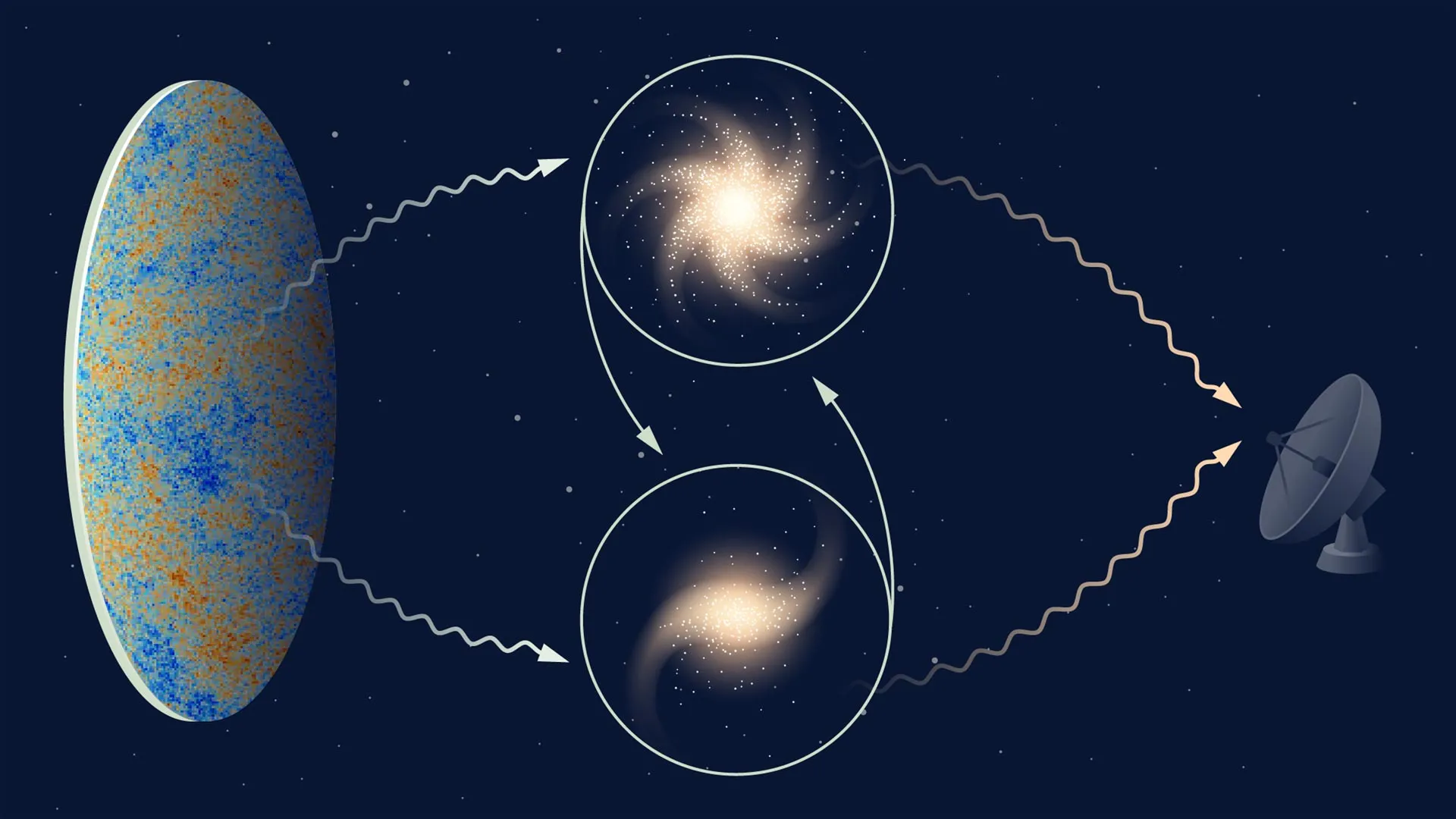
The measurement uses the Atacama Cosmology Telescope, a three-to-four-story instrument on a high plateau in northern Chile, developed largely by Penn researchers under Mark Devlin. ACT maps the cosmic microwave background — light released about 380,000 years after the Big Bang. Massive galaxy clusters moving through that light leave a faint imprint on it, because the hot gas in a moving cluster shifts the photons' energy slightly. Reading those imprints across many pairs of clusters lets astronomers infer how fast the clusters are falling toward each other, and therefore how strongly gravity is pulling at that separation.
The result matters because of the fork it forces. Galaxies rotate faster than the visible matter in them can explain, and clusters hold together more tightly than their glowing gas and stars would allow. As Gallardo put it, there are two ways out: "Either gravity behaves differently on very large scales, or the universe contains additional matter that we cannot directly see." The first branch is modified gravity, including Modified Newtonian Dynamics and its relativistic descendants, which change the force law at very low accelerations. The second is dark matter.
By pinning the force law at cluster separations, the ACT analysis removes a large class of the first branch. Modified-gravity models that survive have to reproduce standard behavior at exactly the scales where the deviation was supposed to show up — which leaves them describing something other than what they were invented to describe. The measurement does not rule out every alternative theory, but it narrows the space they can occupy considerably.
What the study does not do is say what dark matter is. It strengthens the case that something with mass and without light is supplying the missing gravitational pull, while leaving the identity of that something exactly where it was: undetected in every direct-detection experiment built so far, unproduced at the Large Hadron Collider, and inferred entirely from its gravitational effects. Physicists now have a very well-tested force law and a substance that obeys it and refuses to be found any other way.
For observational cosmology, the technique itself is part of the result. Using the microwave background as a backlight to weigh and track clusters is a method that improves automatically as surveys deepen. The next generation of instruments will apply the same test at larger separations and tighter error bars — and any deviation that does eventually show up will be far harder to explain away than a rotation curve.