Astronomers Pin Down the Big Bang's Helium to 0.5%, Tightening the Test of Neutrino Families
A team measured 15 pristine galaxies over 130 hours at the Large Binocular Telescope. Their uncertainty is three times smaller than the previous standard.

Astronomers have measured how much helium the Big Bang made in its first five minutes to a precision of 0.5%, a threefold improvement over previous standards and one of the sharpest tests yet of what happened in the early universe.
The work, led by Evan Skillman, a distinguished professor at the University of Minnesota, was published in The Astrophysical Journal. It brought together researchers from Minnesota, Ohio State, Gonzaga, Northwestern, the University of Texas at Austin, Indiana University, the University of California Santa Cruz, the University of Illinois, Mexico's Universidad Nacional Autonoma de Mexico and Canada's TRIUMF laboratory.
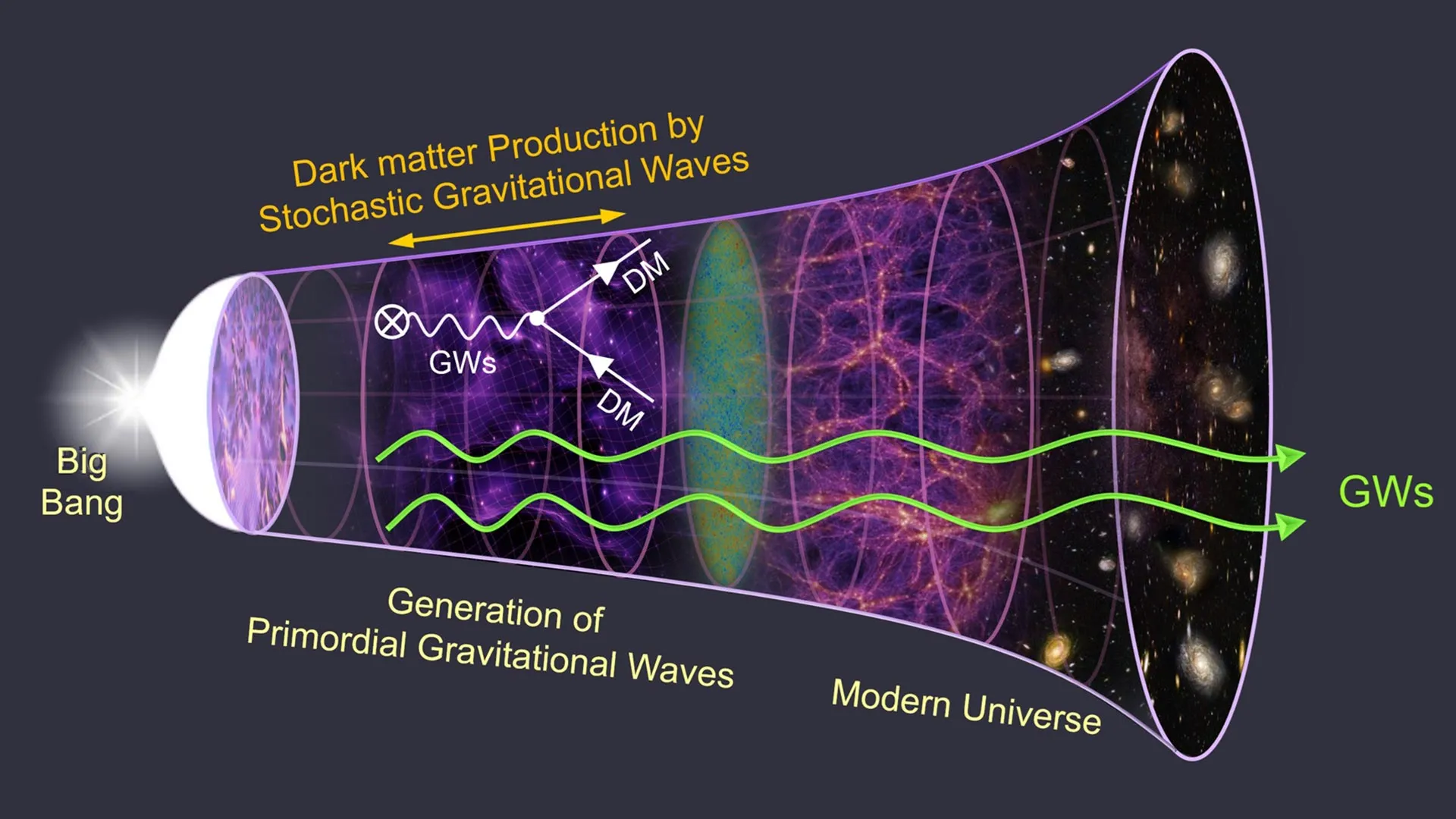
The measurement matters because the amount of helium formed in the first minutes depends on conditions in the young universe, including how many kinds of light particles, such as neutrinos, were present. Helium made then has not been fully diluted by stars, but stars have since added more of it. So the best place to measure the primordial amount is in galaxies that have barely made any stars at all.
The team studied 15 such pristine, chemically unevolved galaxies with the Large Binocular Telescope, using 130 hours of observing time. They looked at more than 10 helium emission lines and 15 hydrogen lines at once, with spectrographs built at Ohio State. Measuring many lines at the same time lets researchers correct for the ways that gas temperature, density and dust can distort a single reading.
"We promised a half-percent uncertainty in our proposal, and we got there," Skillman said. "In the unpredictable world of science, that doesn't happen very often."
The result gives cosmologists a tighter number to hold predictions against. The Standard Model of particle physics and the theory of Big Bang nucleosynthesis together predict a specific helium fraction. If the measured value had landed far from the prediction, it would have pointed to extra particle families or other new physics. A half-percent measurement leaves much less room for that kind of surprise to hide.
Helium made in the Big Bang is also one of the pillars on which the standard picture of the early universe rests, alongside the cosmic microwave background and the expansion of space. Independent measurements of it, made with different methods than the microwave background, act as a cross-check on the whole picture. This one now stands as the most precise of its kind, and it will serve as the benchmark for future searches for physics beyond the Standard Model.