Astronomers Measured the Big Bang's Helium to Half a Percent
It Says There Are Three Kinds of Neutrino, Just as the Standard Model Predicts.
Using the Large Binocular Telescope to read helium lines in 48 metal-poor galaxies, the LBT Yp Project pinned the primordial helium fraction at 0.2458 ± 0.0013, cut the uncertainty from about 2% to nearly 0.5%, and found no room for a fourth neutrino in the universe's first seconds.
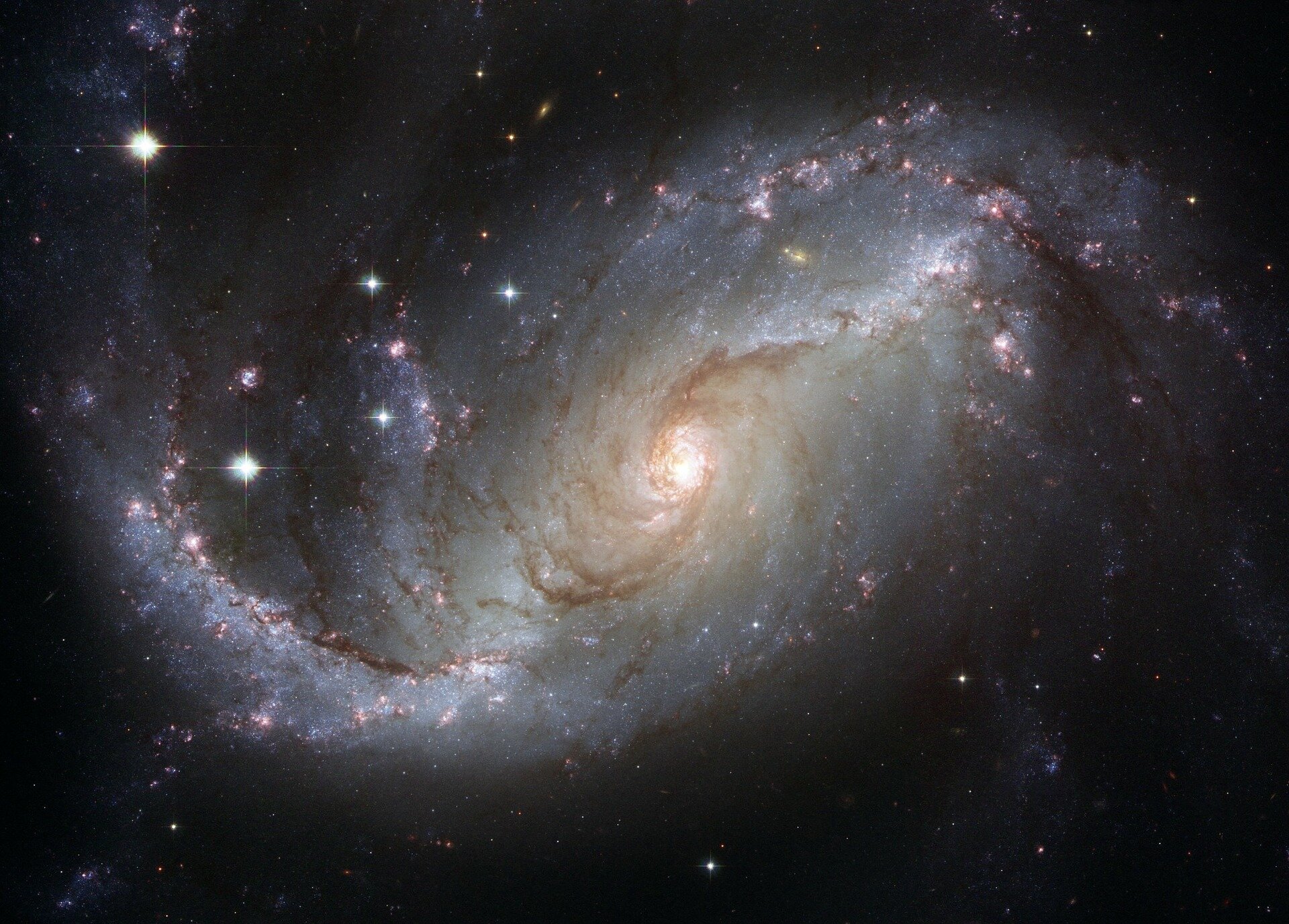
Roughly 90% of the helium in the universe was forged in the first few minutes after the Big Bang, and exactly how much depends on what the cosmos contained when it was one second old. A team led from The Ohio State University has now measured that primordial helium more precisely than ever before, and the answer matches the Standard Model of particle physics with no room to spare. Reporting in a series of papers in The Astrophysical Journal, the LBT Yp Project used the Large Binocular Telescope in Arizona to observe helium in 48 metal-poor nebulae, gas clouds in distant dwarf galaxies that have been barely touched by later generations of stars, and cut the uncertainty on the primordial helium abundance from about 2% to nearly 0.5%.
The measurement works because helium is a fossil. Stars have made some of it over the past 13.5 billion years, but only about 10%; the rest was set during Big Bang nucleosynthesis, when protons and neutrons in the cooling fireball fused into the lightest elements. How fast the universe expanded in those seconds, and therefore how many neutrons survived to be locked into helium, depended on the number of light neutrino species carrying energy at the time. More neutrino types would have meant a faster expansion, more surviving neutrons and more helium. That makes the primordial helium fraction, written Yp, a direct readout of the particle content of the universe at one second, long before the cosmic microwave background was released about 400,000 years later.
Reading that fossil is hard. The galaxies with the cleanest gas are rare and faint, such as the tiny dwarf Leo P, and Earth's atmosphere contaminates the signal. The team analyzed helium emission lines in both optical and infrared light to nail down the temperature and density of the gas in each system, then extrapolated to zero metal content to isolate the primordial value. "Everything that we need to live here on Earth was once fused inside a star," said Miqaela Weller, the lead author of the new paper and a Ph.D. student in astronomy at Ohio State who leads the project's infrared data reduction. "Understanding precisely where those elements come from helps inform us about how our universe evolved and how it will evolve in the future."
The headline number is Yp = 0.2458 ± 0.0013, the most precise determination to date. Combined with standard Big Bang nucleosynthesis and the measured lifetime of the neutron, it yields an effective number of neutrino species of 2.925 ± 0.082, squarely consistent with the three known families, and rules out any additional relativistic species beyond about 0.125 of a neutrino at 95% confidence. The same analysis returns a baryon density that agrees with the value derived independently from the cosmic microwave background, tying together two snapshots of the universe taken 400,000 years apart. "By making this exciting measurement, we've learned something fundamental about the universe," said Richard Pogge, a professor of astronomy at Ohio State and a founding member of the project.
For physicists hunting for cracks in the Standard Model, the result is a door closing. A sterile neutrino or some other light particle active in the early universe would have left its fingerprint in the helium, and the LBT data say it did not. "Finally having atomic data precise enough to show how the universe worked seconds after it began gives us the ability to make meaningful constraints on the nature of physics itself," Pogge said. That is the flip side of precision cosmology: the same tools that would reveal new physics can, when the numbers line up, confirm that the picture assembled over decades is right in its first seconds.
The collaboration includes Evan Skillman and John H. Miller Jr. of the University of Minnesota, Erik Aver of Gonzaga University, Noah Rogers of Northwestern University, Danielle Berg of the University of Texas at Austin, John Salzer of Indiana University and Jayde Spiegel of Ohio State. The team plans to extend the method to more metal-poor galaxies, likely drawing on large survey archives such as DESI. "It's going to take us many years to try to explore new galaxies and turn the techniques we've developed onto them," Pogge said. "So it's an enormous pleasure to be able to pass these decades-long findings on to those who are going to be the future of this field."