CMS Detects Jet Diffusion Wakes in Quark-Gluon Plasma, a 20-Year-Old Prediction
Physicists saw the wake a fast quark or gluon leaves behind in the primordial liquid of the early universe, using millions of lead-lead collisions at the LHC.

Physicists on the CMS experiment at CERN have for the first time measured the diffusion wake that a fast-moving quark or gluon leaves as it plows through quark-gluon plasma, the liquid state of matter that filled the universe in its first microseconds. The result was published in Physical Review Letters.
The wake was predicted about 20 years ago, after experiments at the Relativistic Heavy Ion Collider at Brookhaven National Laboratory showed that quark-gluon plasma behaves like a liquid and not like a gas. A boat on smooth water leaves a pair of waves behind it, and theorists expected a high-energy particle to do the same in the plasma.
The plasma is thought to have existed from about a trillionth of a second after the Big Bang to a few microseconds after it. It is about 200,000 times hotter than the center of the sun. Its ratio of viscosity to entropy density is less than one-tenth that of water, which makes it what Olga Evdokimov of the University of Illinois Chicago, a collaborator on CMS, calls the "hottest, densest and most perfect fluid in the universe."
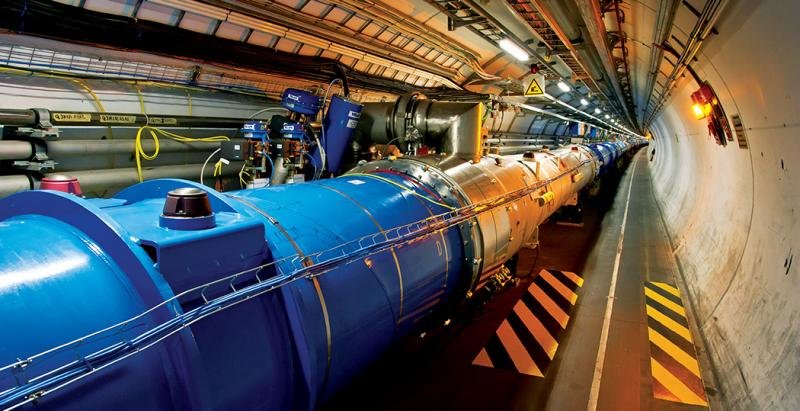
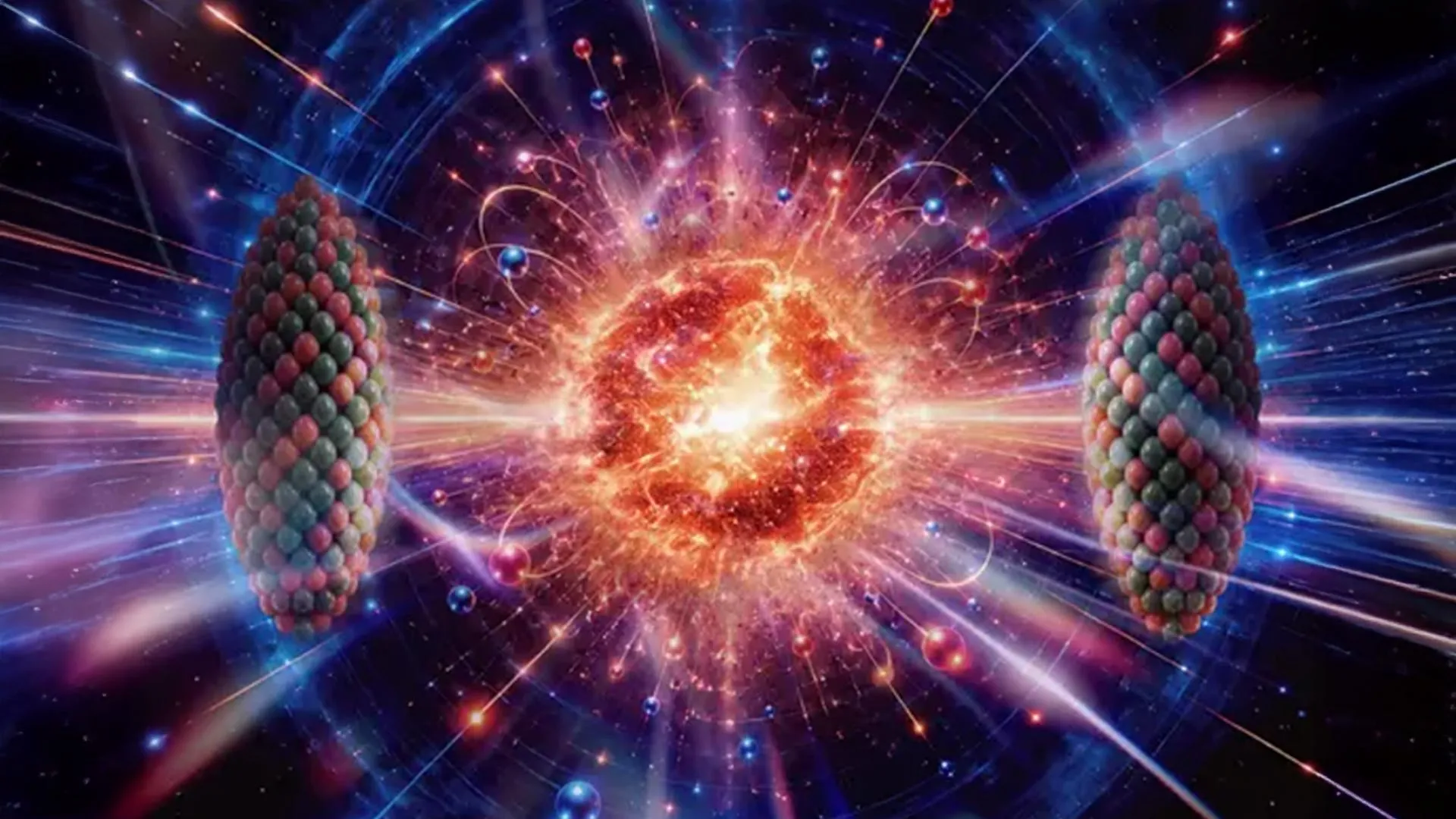
To look for the wake, CMS collided lead nuclei at the Large Hadron Collider. Each collision creates a droplet of plasma that lasts about 10^-22 seconds. Occasionally a quark or gluon shoots off in one direction with an equal and opposite partner, forming back-to-back jets. As a jet travels through the droplet, it should push the fluid and leave a depletion behind it.
Finding that is hard because the droplet expands violently, at about half the speed of light according to Evdokimov, and the collision produces thousands of particles in a region only a few times the width of a proton. Large ridges, bumps and valleys in the particle distribution are much bigger than the tiny dip expected from a single wake, so they have to be subtracted. Even then, the wakes cannot be seen in one collision. The team analyzed millions of events, selected those with high transverse momentum, and looked for a pattern statistically.
"The biggest surprise, or rather, excitement for us was being able to finally observe the phenomenon," Evdokimov said. Earlier searches, including some by her group, had not seen the signal or had not been conclusive. "We were thrilled to confirm this experimentally."
The result matters because it tests the picture of the early universe as a nearly perfect liquid and gives a new probe of how energy and momentum spread through it. The paper is titled "Observation of the Jet Diffusion Wake Using Dijets in Heavy-Ion Collisions."
Other experiments, including ATLAS and ALICE at the LHC, may now look for the same signal, and a confirmation from an independent detector would strengthen the case that the wake is real.