All Four LHC Experiments Now Say the Collider's Smallest Nuclei Are Making the Universe's Hottest Matter
Physicists thought you needed lead — 200 times heavier than a proton — to melt matter into quark-gluon plasma. Oxygen and neon just did it, and ALICE, ATLAS, CMS and LHCb all saw it independently.
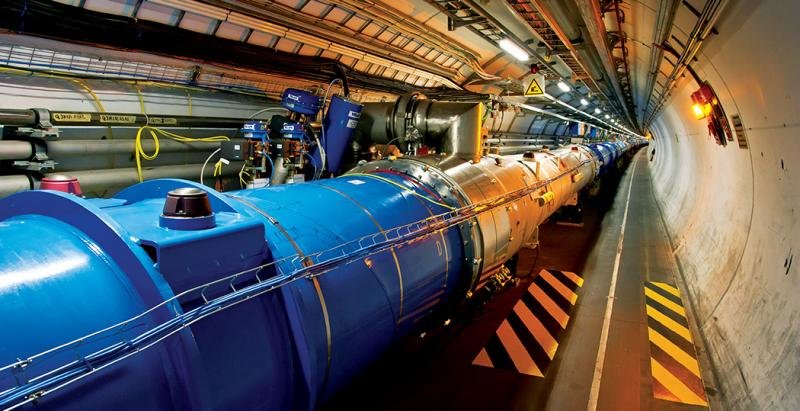
A year after the Large Hadron Collider smashed oxygen nuclei together for the first time, all four of its main experiments have independently reported signs of quark-gluon plasma — the state of matter that filled the universe for a few microseconds after the Big Bang, and which physicists long believed could only be produced by colliding something far heavier.
Quark-gluon plasma forms at temperatures more than 100,000 times hotter than the center of the sun. Under those conditions protons and neutrons stop existing as separate objects and their constituent quarks, along with the gluons that normally bind them, flow together as a single fluid. Since the plasma was first produced at Brookhaven and later at CERN, the recipe has been to collide gold or lead — lead nuclei are more than 200 times heavier than the protons the LHC usually collides. The assumption was that you needed that much matter in one place to create a fireball large and dense enough to melt.
Oxygen and neon are not that. They are light nuclei, and the collisions the LHC ran with them in 2025 were expected to serve mainly as a reference point — a control against which heavy-ion results could be compared. Instead the four collaborations, reporting at the Hard Probes 2026 conference, each found the fingerprints they had been taught to look for in lead.
ATLAS unambiguously observed the effect known as parton energy loss, measured as an imbalance between pairs of particle jets produced in oxygen-oxygen and neon-neon collisions. When a quark or gluon is knocked out of a collision it normally produces a jet of particles balanced by an opposite jet on the other side; if the pair has to plow through a dense medium on the way out, one loses more energy than the other, and the balance breaks. ATLAS found the imbalance grew in more head-on collisions, exactly what a larger plasma volume would predict. Preliminary work on charged particles recoiling against photons showed the same centrality dependence.
CMS approached it from a different angle, comparing charged-particle production in oxygen-oxygen and neon-neon collisions against proton-proton baselines and finding it suppressed — again the signature of partons losing energy in a medium. CMS also measured differing suppression of upsilon mesons, bound states of a bottom quark and its antiquark, between the two systems. LHCb reported that particles containing a charm quark are suppressed more strongly in the heavier neon collisions than in oxygen, and presented preliminary evidence for upsilon suppression using proton-oxygen and oxygen-oxygen data. That ordering — more suppression as the colliding system gets bigger — is what a growing plasma volume should produce.
ALICE, the experiment purpose-built for heavy-ion physics, supplied what the collaborations describe as unambiguous evidence of parton energy loss through comparisons of neutral pion production, and detected anisotropic flow: the collision debris streams out more strongly in some directions than others, with baryons showing a stronger directional preference than mesons. Flow is the most direct evidence that the collision products behave collectively, as a fluid, rather than as independent particles.
The results reframe a long-running question in the field. If a system as small as two oxygen nuclei can produce plasma-like behavior, then the size threshold for creating the early universe's matter is lower than assumed — and some of the "reference" measurements taken in small collision systems over the past two decades, used to calibrate what a plasma-free collision looks like, may have contained plasma all along.