Large Hadron Collider Detects Particle Behavior That May Challenge Standard Model
Scientists studying rare 'penguin decays' found results that disagree with 50-year-old physics theory, suggesting unknown particles or forces may exist.
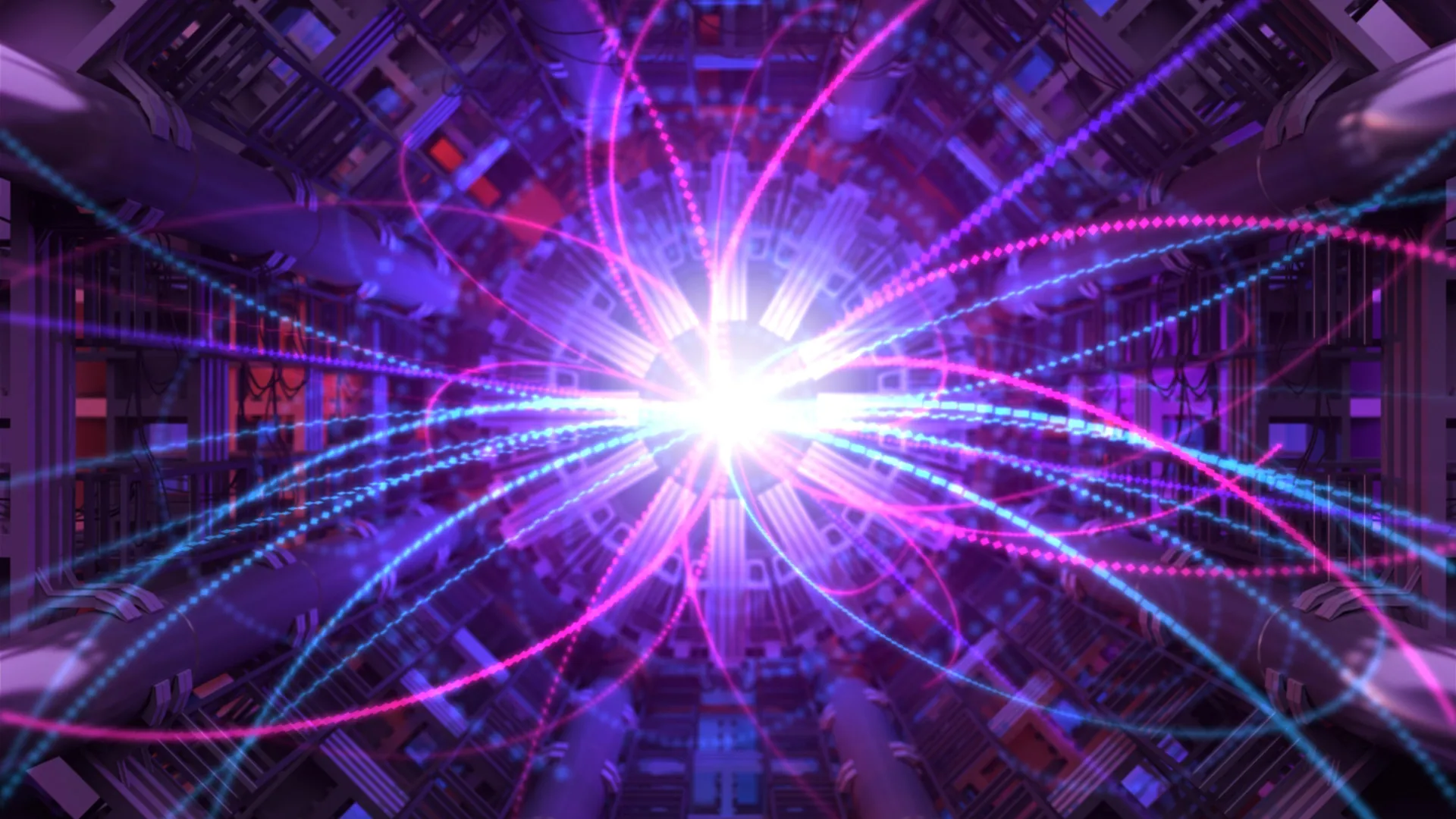
Scientists working at CERN's Large Hadron Collider have detected strange particle behavior that could represent the strongest hints yet of physics beyond the Standard Model, the decades-old theory that explains the fundamental particles and forces of the universe. The findings, based on incredibly rare particle transformations called "penguin decays," show behavior that doesn't fully match theoretical predictions, raising the possibility that unknown particles or forces are influencing the results.
The research, conducted by the LHCb experiment at the Large Hadron Collider, focused on studying the decay of sub-atomic particles called B mesons. When these particles transform into other particles, they do so in ways that disagree with predictions based on the Standard Model. The measurement shows a tension of four standard deviations from the Standard Model's expectations, meaning there is only a one in 16,000 chance that such extreme results would occur randomly if the theory is correct.
While this falls short of the five sigma standard required for a definitive discovery in particle physics, the evidence is mounting when combined with similar results from other LHC experiments. The CMS experiment published independent results earlier in 2025 that also showed tensions with Standard Model predictions, creating a compelling pattern that suggests something may be missing from our current understanding of fundamental physics.
The Standard Model, built on quantum mechanics and Einstein's special relativity, has successfully withstood over 50 years of increasingly rigorous testing. Despite knowing the theory is incomplete because it cannot explain gravity or dark matter, physicists have been unable to find definitive cracks in its predictions until potentially now. The discovery of deviations from Standard Model predictions would represent a revolutionary advancement in our understanding of the universe's fundamental workings.
If confirmed through additional experiments and data collection, these findings could overturn the theoretical framework that has dominated particle physics for half a century. The researchers are continuing to collect more data to determine whether these anomalies represent genuine new physics or are simply statistical fluctuations that will disappear with larger data sets. The implications of discovering physics beyond the Standard Model would be profound, potentially revealing new fundamental forces or particles that could reshape our understanding of reality itself.