Large Hadron Collider Hints at Physics Beyond the Standard Model
CERN researchers detect rare particle transformations that disagree with 50-year-old theory, potentially pointing to unknown forces or particles.
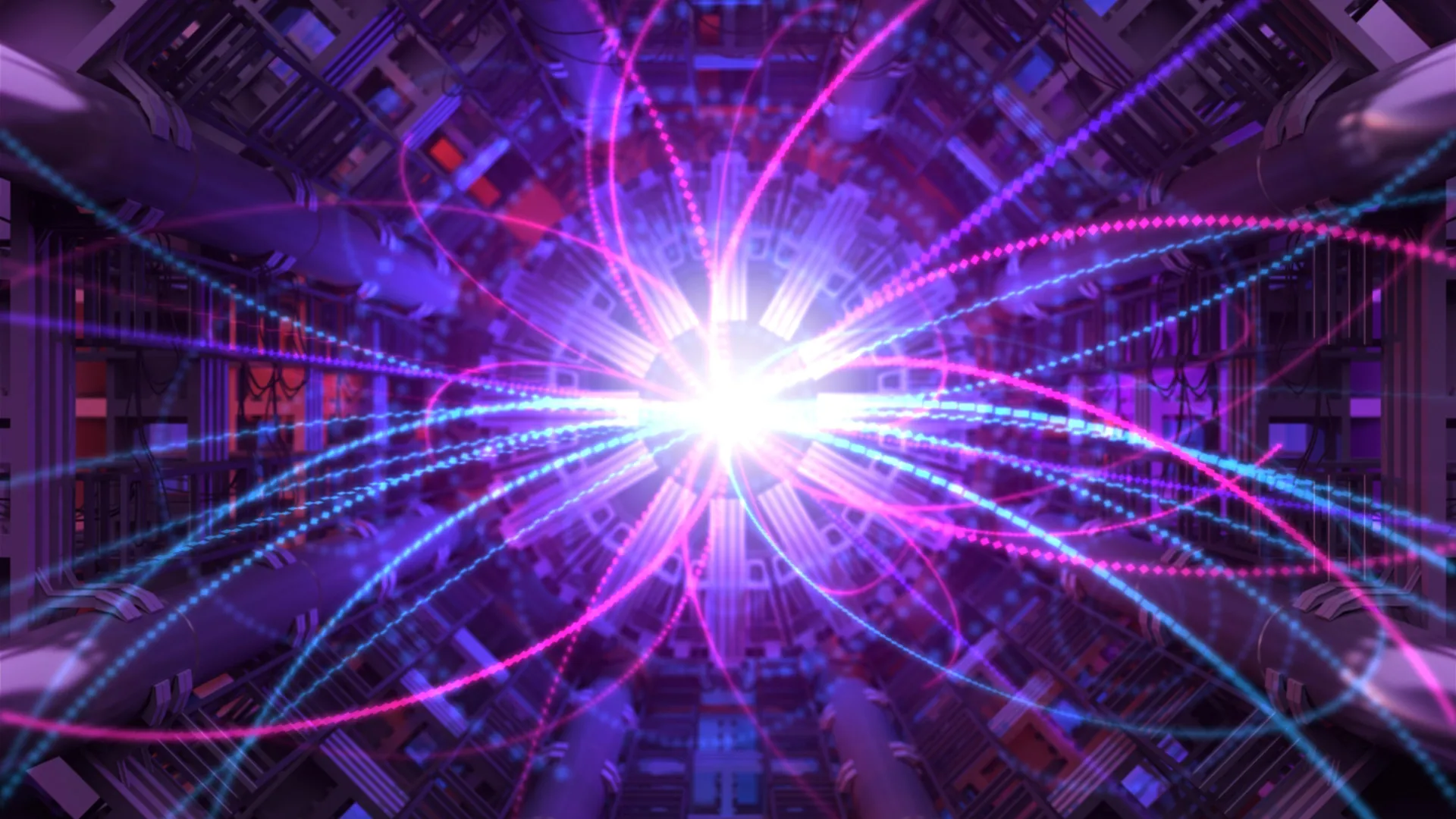
Scientists working at CERN's Large Hadron Collider have detected evidence of particle behavior that may represent the strongest hints yet of physics beyond the Standard Model, the decades-old theory that explains fundamental particles and forces. The findings, which involve extremely rare particle transformations known as "penguin decays," show behavior that doesn't fully match theoretical predictions.
The research team studied the decay of subatomic particles called B mesons, investigating how these particles transform into other particles through specific pathways. Their measurements, accepted for publication in Physical Review Letters, show a tension of four standard deviations from Standard Model expectations, meaning there's only a one in 16,000 chance that random fluctuation could explain the discrepancy.
While this falls short of the five sigma standard required for a definitive discovery in physics, the evidence is mounting when combined with results from an independent LHC experiment called CMS that were published earlier in 2025. The accumulation of anomalous results from multiple independent experiments strengthens the case that unknown physics may be at work.
The Standard Model, built on quantum mechanics and Einstein's special relativity, has dominated particle physics for 50 years despite being known to be incomplete. It fails to explain gravity or dark matter, which comprises approximately 25% of the universe, leading scientists to search for cracks in the theory that might point toward new physics.
The LHC operates by colliding beams of protons traveling in opposite directions through a 27-kilometer circular tunnel under the French-Swiss border. These high-energy collisions recreate conditions similar to those just after the Big Bang, allowing researchers to study fundamental particles and potentially discover new phenomena that could revolutionize our understanding of the universe's basic building blocks and forces.