CERN Collided Oxygen and Neon and Got the Big Bang's First Millionth of a Second Anyway
Physicists thought only heavy nuclei like lead could produce quark-gluon plasma. The ALICE collaboration just made it with nuclei a fraction of the size, which means the recipe is not what anyone assumed.
For about the first millionth of a second after the Big Bang, the universe was too hot for protons and neutrons to exist. Quarks and gluons, the constituents that would later be bound into ordinary matter, moved freely in a state called quark-gluon plasma. Physicists recreate small droplets of it by slamming heavy atomic nuclei into each other at nearly the speed of light, and for two decades the operating assumption has been that you need something big to do it: gold at Brookhaven, lead at CERN.
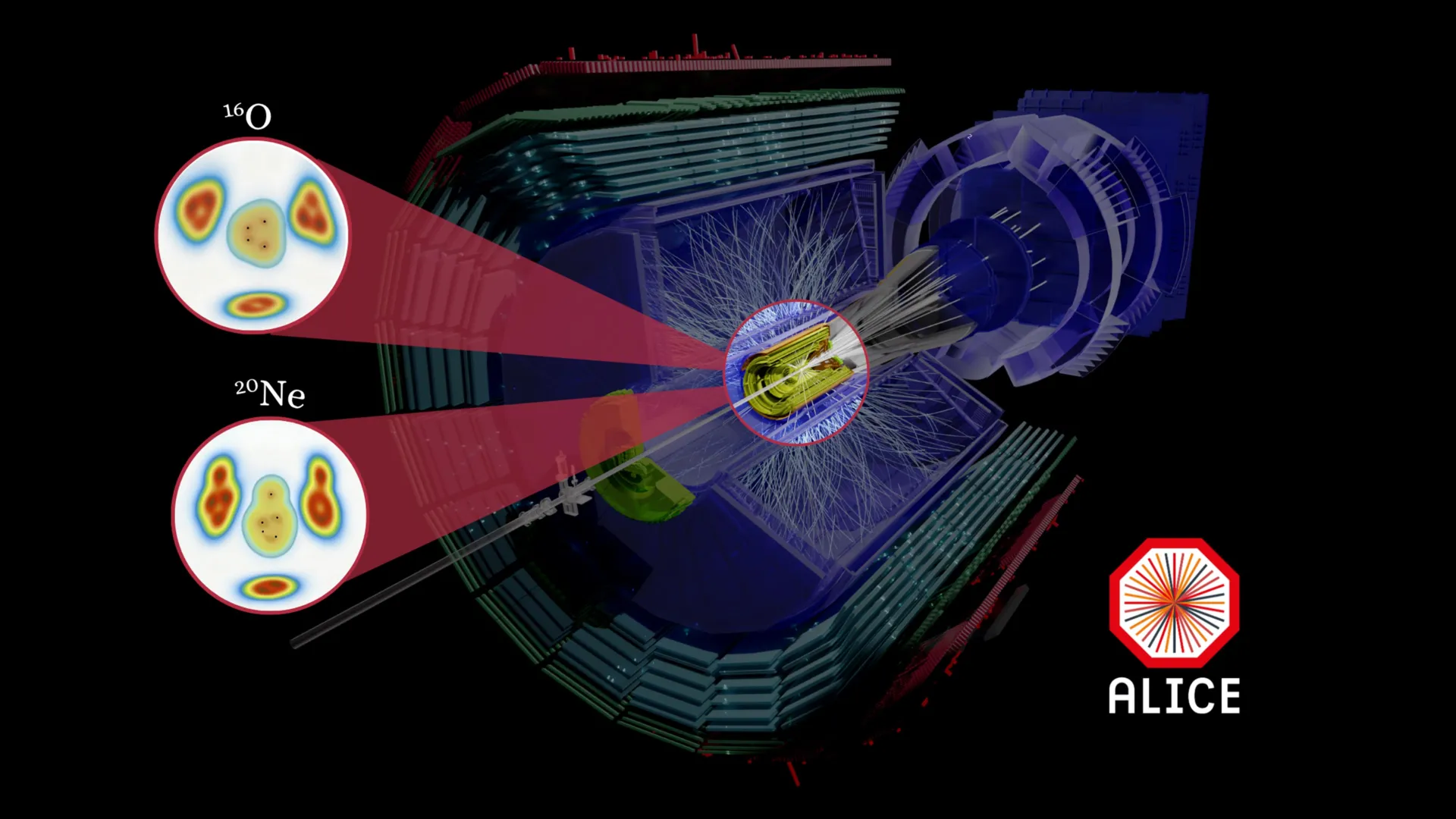
That assumption is now wrong. Researchers at the University of Copenhagen's Niels Bohr Institute, working within the international ALICE collaboration at CERN's Large Hadron Collider, have produced quark-gluon plasma by colliding oxygen-16 and neon-20 nuclei, which are a fraction of the size of lead.
"We have pushed the boundary for how small the atomic nuclei can be while still recreating this primordial matter," said Associate Professor You Zhou, who led the Copenhagen effort. The findings appear in Physical Review Letters.
The difficulty with a droplet this small is that it cannot be observed directly. It lasts a tiny fraction of a second and then falls apart into ordinary particles, so its existence has to be reconstructed from the debris. The telltale sign is collective flow: if a plasma genuinely formed and behaved like a fluid, the particles that stream out afterward carry a correlated angular pattern that reflects the shape of the region they came from. If no plasma formed, the particles fly out independently and that structure is absent.
"It is a bit like shining light on an object and seeing its shadow," said postdoctoral researcher Emil Gorm Dahlbaek Nielsen, describing how the team inferred the plasma's presence and geometry from the particle correlations rather than from the plasma itself.
Using light nuclei has a specific advantage beyond the size record. Oxygen-16 and neon-20 have well-understood internal structure, including clustering of nucleons into alpha-particle-like groups, and neon-20 is deformed rather than spherical. That means the initial shape of the collision zone is known reasonably well in advance, which lets the flow measurements be read as information about the plasma's properties instead of being tangled up with uncertainty about the starting conditions.
The broader consequence is about what actually generates the plasma. If a system with a few dozen nucleons can produce collective fluid behavior, then the threshold is not simply about mass, and the transition from ordinary nuclear matter to free quarks and gluons happens under a wider range of conditions than the heavy-ion program was built to assume. That reopens questions about signals seen in even smaller collisions, including proton-lead and high-multiplicity proton-proton events, which have shown flow-like patterns that nobody has been able to explain comfortably.
The LHC ran its light-ion collisions in a short dedicated period, and the ALICE result argues for more of them.