The Hottest Fluid in the Universe Turns Out to Be Accelerating Hard Enough to Rewrite Its Own Thermodynamics
Fudan University physicists mapped acceleration inside quark-gluon plasma for the first time and found it peaks at several hundred MeV along the fireball's edge — enough, through the Unruh effect, to mimic the temperature at which matter changes state.
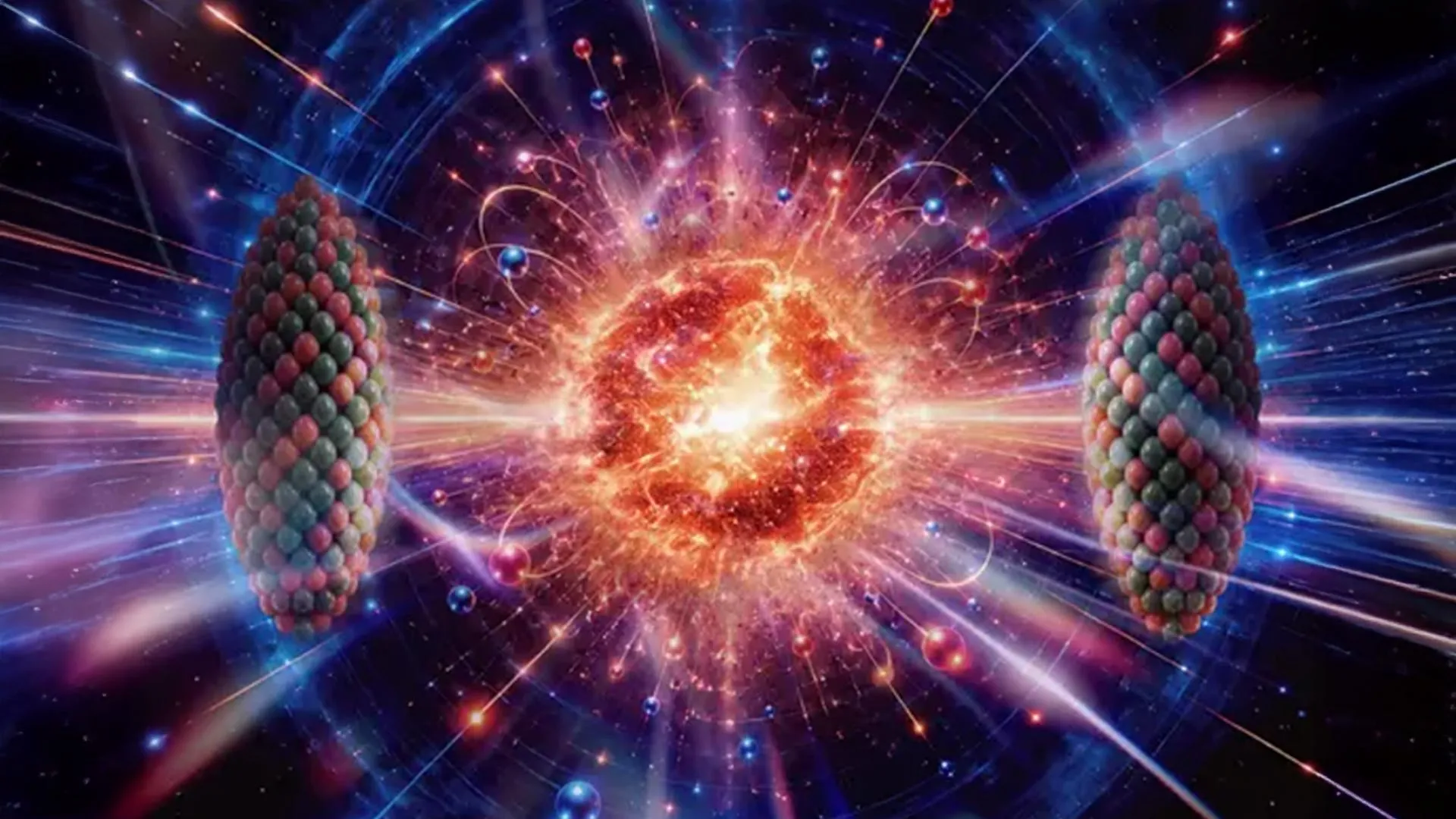
When two atomic nuclei smash into each other at nearly the speed of light, they melt. For a few billionths of a trillionth of a second, the protons and neutrons dissolve and their constituent quarks and gluons roam free in a fireball hotter than anything else known to exist — quark-gluon plasma, the state the universe itself was in microseconds after the Big Bang.
Physicists have spent two decades characterizing that fireball's spin and its magnetic fields. What almost nobody had measured was how hard it accelerates. A team led by Yu-Gang Ma and Xu-Guang Huang at Fudan University in Shanghai has now done that, and the answer is large enough to change how the plasma should be described.
Writing in Nuclear Science and Techniques, the group combined two standard particle transport simulations — AMPT and UrQMD — with a technique called Gaussian smearing, which converts the discrete positions of simulated particles into smooth, continuous fields of energy, momentum and velocity. That conversion is what makes acceleration calculable at all: you cannot take the derivative of a cloud of dots, but you can take it of a field. The team then tracked acceleration across an enormous span of collision energies, from 3.5 GeV up to 2.76 TeV, covering the range explored at both Brookhaven's Relativistic Heavy Ion Collider and CERN's Large Hadron Collider.
The peak proper acceleration they found reaches several hundred MeV, and it does not sit at the center of the fireball. It concentrates along the outer boundary, where the plasma meets vacuum and blows outward — the pressure gradient there is steepest, and the material is effectively being flung apart.
That number is where the result gets strange. Under the Unruh effect, a prediction of quantum field theory, an accelerating observer perceives empty space as a warm bath of particles, with an apparent temperature proportional to the acceleration. An acceleration of a few hundred MeV corresponds to an Unruh temperature in the same neighborhood as the QCD transition temperature — the point at which ordinary nuclear matter melts into quark-gluon plasma in the first place.
"Acceleration is not merely a kinematic detail — it may act as a thermodynamic control parameter of QCD matter," Huang said.
If that holds up, the phase diagram of nuclear matter, usually drawn against temperature and density alone, may need a third axis. The team's next step is to look for the fingerprint in data rather than simulation: acceleration should leave a mark on how the spins of hyperons — heavier cousins of the proton containing strange quarks — line up as they fly out of the collision. Those measurements already exist at RHIC and the LHC, and the group plans to fold more realistic hydrodynamic evolution into its calculations to predict exactly what to look for.
Originally reported by ScienceDaily.