RHIC's Final Data Show a 5-Sigma Dip That Could Point to Nuclear Matter's Critical Point
Brookhaven's STAR detector found temperature-linked fluctuations bottoming out in its densest gold-ion collisions, the kind of suppression theory predicts near a long-sought phase-diagram landmark.

Physicists at Brookhaven National Laboratory's Relativistic Heavy Ion Collider have found a statistically significant dip in their data that may be the first footprint of a long-sought "critical point" in the behavior of nuclear matter, the STAR Collaboration reports in Physical Review Letters.
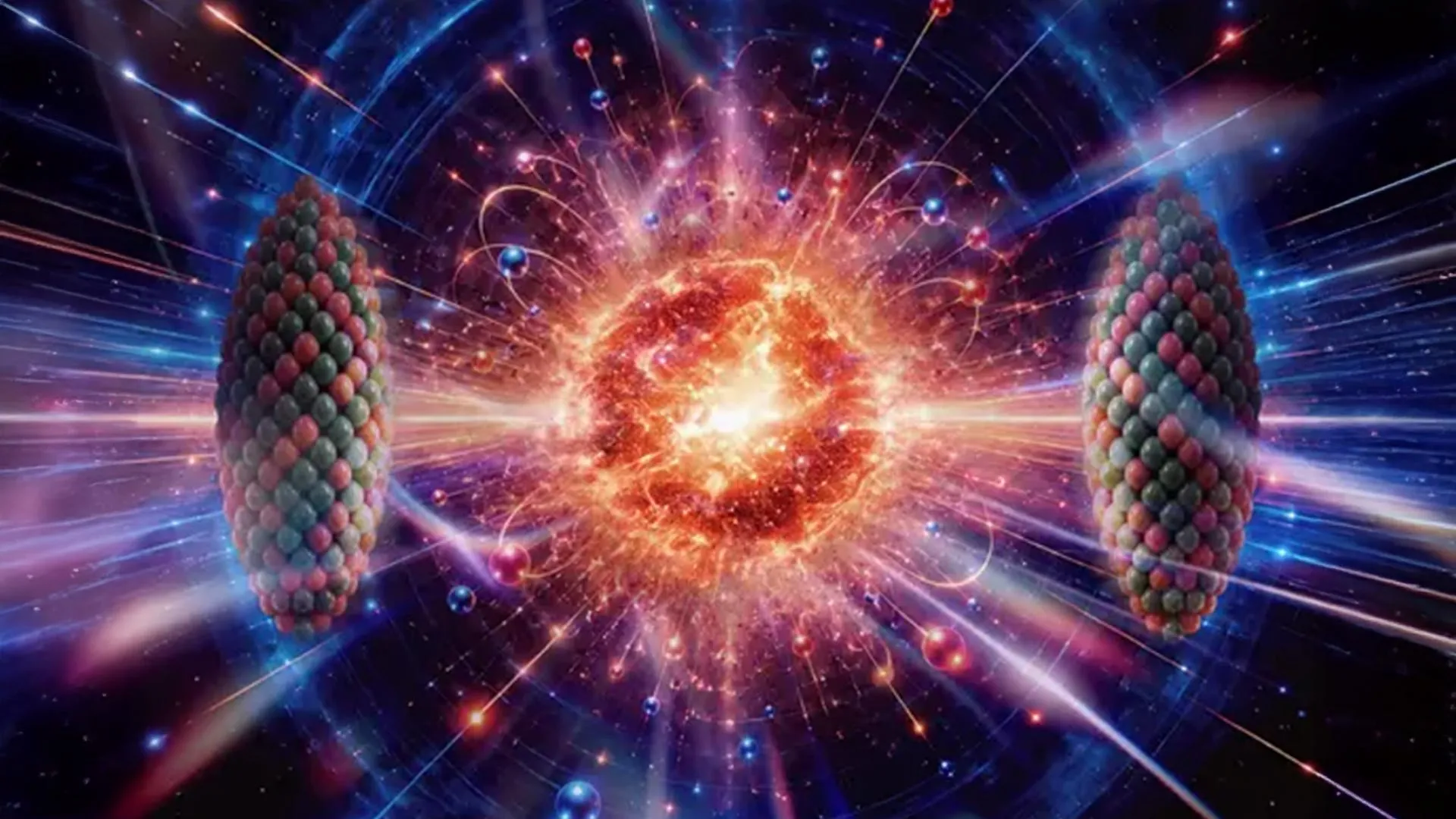
RHIC, which ran as a Department of Energy user facility from 2000 to 2026, smashed gold nuclei together at nearly the speed of light to recreate conditions from the first moments after the Big Bang. At its highest energies, the collisions melt protons and neutrons into a quark-gluon plasma, a soup of the particles' inner building blocks. At lower energies they leave the protons and neutrons intact but squeeze them to extreme densities, approaching the interior of a neutron star. By scanning across energies, physicists map the nuclear phase diagram, much as earlier scientists mapped where water is solid, liquid or gas.
The new analysis covers RHIC's lowest energies, 3 to 7.7 billion electron volts, and compares them with earlier STAR data reaching 200 billion. The team measured how much each outgoing particle's momentum strayed from the average and how that varied from one collision to the next. Because hotter matter throws off faster particles, this acts as a thermometer for how much the fireball's temperature fluctuates. "This momentum correlation measurement gives us an experimental window into temperature fluctuations," said Chunjian Zhang of Fudan University, a co-leader of the analysis.
The fluctuations fall steeply as energy rises from 3 GeV, bottom out between about 5.2 and 7.7 GeV, and then climb again. The departure from a smooth trend reaches about 5 sigma, the standard physicists use to call a deviation statistically significant. That dip is what the critical-point picture predicts. Near a critical point, matter's heat capacity should balloon, so it can absorb energy while barely warming, suppressing temperature swings. Beyond it, at higher densities, theory expects an abrupt first-order transition, like ice melting in a glass of water that stays at zero degrees Celsius until the last cube is gone. At RHIC's top energies, the change from nuclei to free quarks is known to be a smooth crossover, "more like butter softening slowly in a warm pan," as the collaboration describes it. Somewhere in between, the character of the transition must change.
"The existence of a critical point would tell us about all the phases of matter that could have existed when the universe began," said Rutik Manikandhan of the University of Houston, who helped lead the work. "It would sharpen our understanding of the quark-gluon plasma, how it condensed into the protons and neutrons that make up visible matter, and how matter behaves inside neutron stars."
The team is careful not to claim a discovery. "No single observable settles the question of finding the critical point, and other explanations for this new STAR result still remain open," Manikandhan said. A recent theory paper offers a non-critical explanation. But a standard transport model without critical behavior, known as AMPT, fails to reproduce the dip, meaning something is happening that the conventional picture misses. "What's compelling is when independent measurements start pointing in the same direction," Zhang said.