CosmoCube, a Suitcase-Sized Probe, Would Listen From the Moon's Far Side for the Universe's Dark Ages
Cambridge-led researchers plan a lunar orbiter to catch a faint hydrogen radio signal from before the first stars, a window Earth's radio noise blocks.
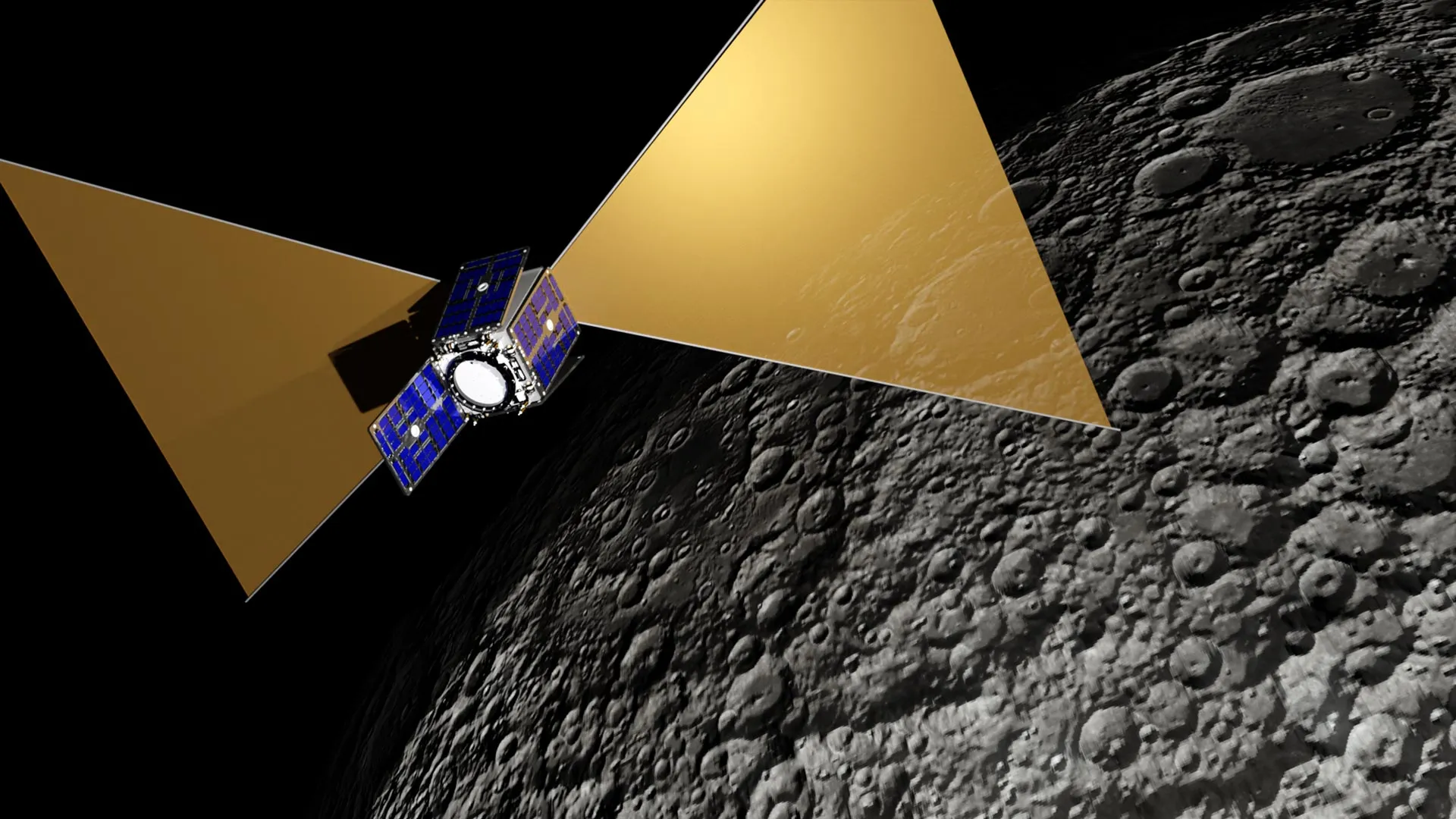
A spacecraft roughly the size of a suitcase could give astronomers their first look at the universe's darkest chapter. CosmoCube, a lunar orbiter proposed by researchers at the University of Cambridge, is designed to detect a faint radio signal from the cosmic dark ages, the period before the first stars lit up, and to do it from the one place in the inner solar system quiet enough to hear it.
The signal is the 21-centimeter line, a radio emission given off by hydrogen atoms. The dark ages ran until roughly 150 million years after the Big Bang, when the universe was filled with mostly neutral hydrogen gas and no stars had yet formed. Because the universe has expanded since, that emission has been stretched to radio frequencies between about 10 and 50 megahertz.
That band is nearly impossible to observe from Earth. The atmosphere's ionosphere blocks or distorts it, and human radio transmissions swamp it. The far side of the Moon is permanently shielded from Earth by the Moon itself. "The far side of the Moon is really the only option: it solves multiple problems at once, opening a clear window to the very early universe," said Professor Eloy de Lera Acedo of Cambridge's Cavendish Laboratory, who leads the project.
CosmoCube would orbit the Moon for two years and gather about 1,000 hours of observations while it passes over the far side. Surrey Space Technology Limited is building the spacecraft, with collaborators including Portsmouth University, STFC RAL Space and researchers from European countries such as Malta. Funding so far has come from the UK Space Agency, the Kavli Foundation and the Science and Technology Facilities Council. The team is aiming for a budget below 50 million euros, and launch is targeted within five years.
The science payoff could be large. The dark-ages signal carries information about how matter was distributed before galaxies formed, which is a clean test of what dark matter did in building the first structures. It also sets a baseline for the cosmological model, since almost nothing complicated has happened yet at that time and the physics should be simple.
Other experiments are already chasing the later stages of this signal, when the first stars began to heat the gas. The dark ages come earlier and have never been measured. If CosmoCube works, it would show that a small, relatively cheap spacecraft can reach a target that once seemed to demand a large lunar observatory.