Cambridge Simulations Find Comets Rarely Delivered Life's Ingredients to Early Earth
A study of 100,000 simulated impacts suggests the fragile chemistry in comets usually did not survive arrival, challenging a popular theory of life's origin.
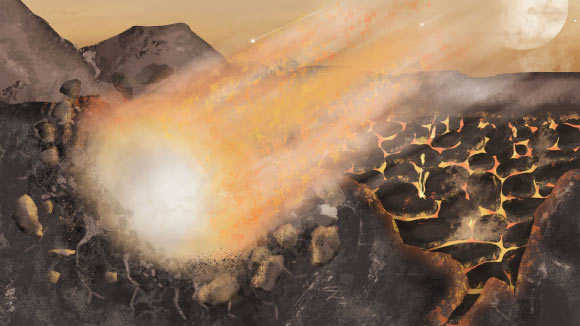
For decades, scientists have pictured comets as cosmic delivery trucks that seeded the young Earth with the chemistry needed for life. A new study from the University of Cambridge suggests the delivery usually would have failed.
Comets are known to contain many of the compounds associated with life's origins, often called prebiotic molecules. Researchers have long proposed that comets striking the early Earth supplied a steady stream of them. "Historically, scientists thought that comets were important for the origin of life on Earth, because they carried carbon and nitrogen-bearing molecules, so these giant space snowballs were almost like a 'get out of jail free card' that brought all the molecules a planet would need to seed life," said lead author Dr. Richard Anslow of Cambridge's Institute of Astronomy. "It's kind of a romantic idea, but our results suggest it's highly unlikely."
The team ran 100,000 computer simulations of early Earth conditions using current models of how comets form and evolve. They focused on hydrogen cyanide, a molecule central to several proposed routes to the building blocks of life. The results, published in Scientific Reports, show that comets generally reach Earth at speeds and angles that make it very hard for delicate organic molecules to survive.
Comets broke up in the atmosphere, lost their cargo to the heat of impact, or landed in the ocean, where molecules were diluted. In more than half of the scenarios, no meaningful amount of hydrogen cyanide reached Earth's land surface at all. Successful delivery, the authors conclude, would have been an extraordinarily rare event.
The paper also found that Mars may have offered somewhat better conditions for receiving these molecules, though the chance of success there remains very low.
The work follows a 2023 paper from the same group in the Proceedings of the Royal Society A. That study explored how close encounters between planets could slow comets enough for their molecules to survive. The new simulations test that idea against the faster, steeper approaches typical of comets headed for Earth.
The authors are careful about what they are not claiming. They say their results are not intended to rule out a significant contribution of prebiotic compounds from comets, and rare successful deliveries remain possible. An outside expert quoted by the Spanish Science Media Centre also cautioned against overstating the result: the paper calculates a probability rather than proving comets played no role.
The finding matters because it pushes the question back to Earth itself. If comets were not a reliable supplier, then the molecules needed for the first living cells more likely formed on the planet, in places such as the atmosphere, the oceans or hydrothermal systems. That leaves origin-of-life researchers with a shorter list of sources and a harder question about how quickly chemistry could have started at home.