Interstellar Comet 3I/ATLAS Was Born in a Metal-Poor Nursery, Its Heavy Water Suggests
The visitor's water holds roughly 30 to 60 times more deuterium than solar system comets. A RIKEN-led team says a star-forming cloud poor in heavy elements explains that and its odd carbon.

The third interstellar object ever spotted passing through our solar system carried chemical fingerprints unlike anything born around our sun. A new study argues those oddities point to a single cause: 3I/ATLAS formed in a stellar nursery that was poor in the heavier elements astronomers call "metals."
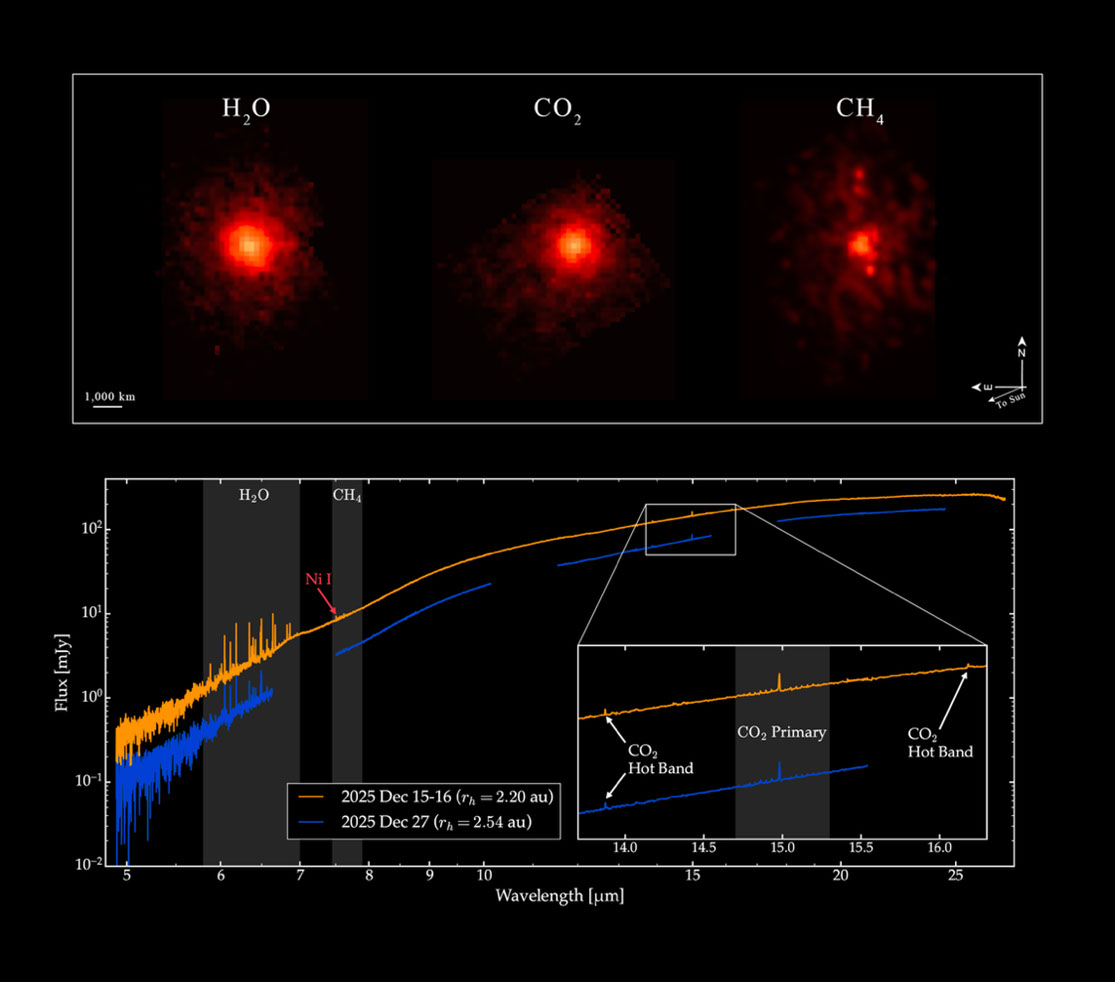
The paper, led by Kenji Furuya of the RIKEN Pioneering Research Institute in Japan and submitted to The Astrophysical Journal Letters, is available as a preprint on arXiv. It tackles two puzzles that surfaced after the comet was discovered in July 2025 and drew the attention of some of the world's most powerful telescopes.
The first puzzle is carbon. In our solar system, the ratio of carbon-12 to the slightly heavier carbon-13 hovers around 90, and in the interstellar medium it averages about 68. In 3I/ATLAS it measured between 123 and 191. The second puzzle is water. Hydrogen has a heavy form, deuterium, with an extra neutron. In 3I/ATLAS's water the ratio of deuterium to ordinary hydrogen was around 1%, compared with 0.015% to 0.03% in a typical solar system comet, roughly 30 to 60 times higher. The object carries far more "heavy water" than anything from home.
Astronomers have long suspected that a high carbon-12 to carbon-13 ratio signals formation in a low-metallicity environment, since to astronomers "metals" means every element heavier than helium, and the universe has become steadily richer in them as generations of stars exploded. Furuya's team set out to test whether the same origin could explain the deuterium. They simulated the full life cycle of water ice, from its formation in a cold interstellar cloud through the cloud's collapse into the disk of gas and dust that builds a star and its planets.
The key step happens at about 10 kelvin, or minus 263 degrees Celsius. Cosmic rays striking the gas make a molecule called H3+, which sometimes swaps a hydrogen for a deuterium from HD molecules to form H2D+. At such low temperatures the reaction cannot easily run backward, so deuterium gets trapped and is later released as atomic deuterium that ends up in water ice. The team found three reasons a metal-poor cloud boosts this process: less carbon monoxide to destroy H2D+; less ultraviolet-driven breakup of water, which would otherwise flood the gas with ordinary hydrogen; and a lower cosmic-ray ionization rate, which leaves less energy to reverse the reaction.
As a check, the researchers compared deuterium in the comet's methane, about 3% compared with 0.2% in the well-studied comet 67P/Churyumov-Gerasimenko. While both absolute values differ wildly, the ratio of methane deuteration to water deuteration is similar, 3.4 for 3I/ATLAS and 4.8 for 67P, which the team says is what their model predicts: the environment raises deuteration across the board without changing the relationship between molecules.
3I/ATLAS has now moved beyond the reach of telescopes. If the model holds, it offered a rare sample of ice from a very different, and likely older, corner of the galaxy, and future interstellar visitors will show whether such chemistry is common.