
Physics
Physicists Get Light and Sound to Strongly Couple in Ordinary Optical Fiber for First Time
A German team saw the signature gap of strong coupling in a single pass of light through fiber cooled to 4 kelvin, with no cavity needed.
The physics desk
Physics from the quantum to the cosmos: particle physics, quantum computing, astrophysics, cosmology and the discoveries that change what is possible.
A German team saw the signature gap of strong coupling in a single pass of light through fiber cooled to 4 kelvin, with no cavity needed.

Australian physicists showed an infrared handover method that works with crystalline mirror coatings that absorb the green light current detectors rely on.

Researchers in Scotland and Japan optically detected spin resonance in a metal-organic framework for the first time, opening a route to molecular-scale sensors.

A Science Advances review marking a century of spin physics says optimal control now reaches from MRI scanners to chiral molecules, and may need machine learning next.
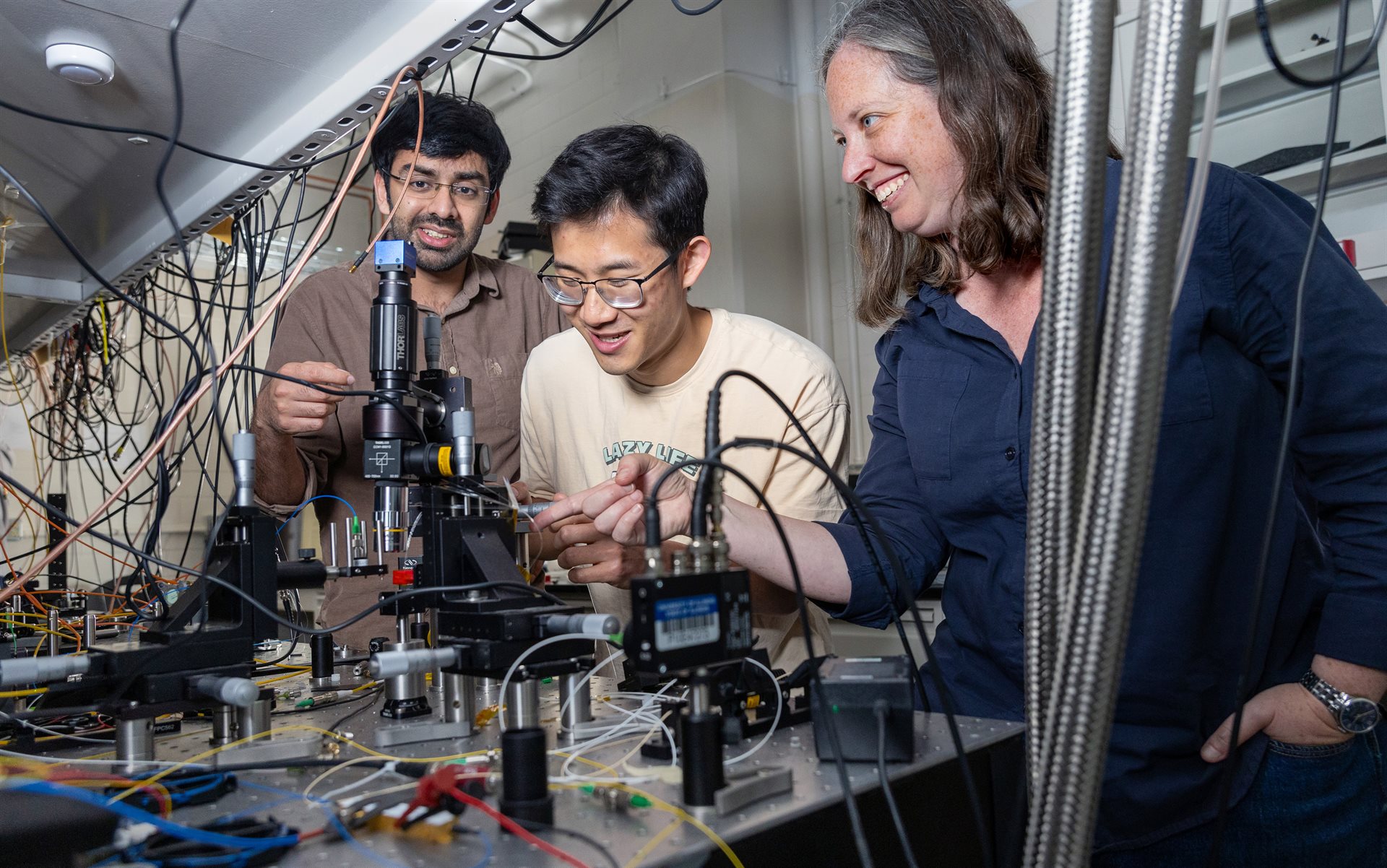
Erbium atoms in thin-film lithium niobate act as a photon memory that could be manufactured at scale, researchers at Urbana-Champaign report in Nano Letters.

CMS and LHCb both see small, consistent differences in a decay that happens about once in 10 million beauty-particle decays, though neither result is conclusive.

Khalifa University researchers computed how Planck stars, Bonanno-Reuter and Hayward black holes would sound compared with Einstein's, though today's detectors cannot hear the difference.

Konstanz and Max Planck physicists report in Nature Physics that a particle in a gooey liquid can yield extra energy when measured twice.

Istanbul Technical University physicists say a teleparallel f(T) model produces a sign change about 9.5 billion years ago with no extra free parameters, matching the hints in DESI data.

A BRIN-led team tested the method on a Soviet Venus lander, a NASA telescope and a Chinese rocket stage, with all three reported fall times landing inside the predicted window.

Italian physicists say treating the electron and the nucleus together, instead of separately, makes a 30-year-old anomaly disappear. The work appears in Physical Review Letters.

Researchers traced the main source of errors in parallel control to a microwave side effect and fixed it with a calibration scheme that scales.

A Berkeley, Vienna and Caltech team says a chilled loop of helium-4 could rival space-based measurements of frame-dragging, on the ground.

A Physical Review Letters paper shows that a measure of how distinguishable quantum states are, evaluated at a horizon, yields the semiclassical Einstein equations.

A Caltech and UC Santa Barbara team built a Brillouin ring-laser gyroscope that measures rotation as slow as 37 degrees per hour, using only milliwatts of optical power.

Published in Science, the method converts selected layers of tungsten diselenide into the semiconductor, insulator and metal-like contacts a transistor needs, with control near 0.7 nanometers.

Ultraviolet nanosecond pulses added fresh light-emitting flaws in a diamond crystal without disturbing the nitrogen-vacancy centers used in quantum sensors.

A new framework in Physical Review X classifies phases of matter in open, noisy systems, where the usual energy-gap approach fails.

Researchers at the Joint Quantum Institute and partners lock a chip-based comb into a single clean set of 'tick marks' using light solitons, a Nature paper reports.

Without ground stations, a 60-day simulation of 24 BeiDou satellites drifted 7.85 meters. Adding four lunar orbiters cut that to 0.35 meters.

Qubits stood in for a magnetic field and ion vibrations for matter, in a Nature Physics experiment that simulates lattice gauge theory, the framework used in particle physics.

The source, TXS 2354+015, sits at redshift 4.946, when the universe was under 1.2 billion years old, and its radio output beats the previous record from a 2008 census.

About one-third of the disks carry silica-rich debris from Mars-sized collisions, while the rest point to smaller grazing impacts, a Webb-led team reports in The Astrophysical Journal.

By separating three overlapping sources of X-rays, astronomers isolated Sagittarius A East for the first time and mapped its iron, sulfur, argon and calcium.

GRB 220706A kept flaring in X-rays for about 51 days after detection, and its central engine stayed active roughly 20 days longer than any burst on record. No single explanation fits every detail.

The Nano Letters demonstration on thin-film lithium niobate is a step toward chip-scale quantum memories that could be manufactured at scale.

Acoustic-metamaterial experiments in Singapore and China confirm a long-theorized idea that robust topological states can coexist with a quantum critical point.

Neutron scattering at Rice University shows manganese spins in YbMnBi2 line up in a preferred direction without forming magnetism, a 'spin nematic' state that appears near room temperature.

Tsinghua-led scanning-tunneling images show electronic stripes growing stronger at vortex cores, with one of two vortex types hosting the exotic particle that is its own antiparticle.

A University of Osaka team grew a one-atom-thick ytterbium-copper film on copper and saw two heavy-fermion states, a step toward designing exotic superconductors.