
Physics
Massive Supercomputer Simulations Unlock Universe's Magnetic Field Mystery
Scientists discover how cosmic turbulence creates enormous organized magnetic structures spanning galaxies and star systems.
The physics desk
Physics from the quantum to the cosmos: particle physics, quantum computing, astrophysics, cosmology and the discoveries that change what is possible.
Scientists discover how cosmic turbulence creates enormous organized magnetic structures spanning galaxies and star systems.

Researchers studying rare 'penguin decays' at CERN detected particle behavior that doesn't match theoretical predictions, suggesting unknown forces may exist.
Scientists used advanced plasma simulations to discover how turbulence in space creates enormous organized magnetic structures throughout the universe.

TIC 295741342 — two sun-like stars in a 4.75-day binary plus a red giant 9.7 times the radius of the Sun on a 412-day orbit — is the most precisely aligned triple-star architecture ever measured, and astronomers say the swelling giant will likely tear the inner binary apart within 100,000 years.
Massive plasma simulations reveal how cosmic turbulence creates the enormous organized magnetic structures found throughout space, from stars to galaxies.

UC Davis researchers achieve lab-quality spectral analysis using silicon sensors and machine learning, eliminating the need for bulky optical equipment.

Researchers believe the 220 PeV particle detected in Mediterranean Sea originated from supermassive black holes shooting jets directly toward Earth.
Researchers using terahertz laser pulses discover bizarre effect where atomic rotations unexpectedly reverse direction due to crystal symmetry.
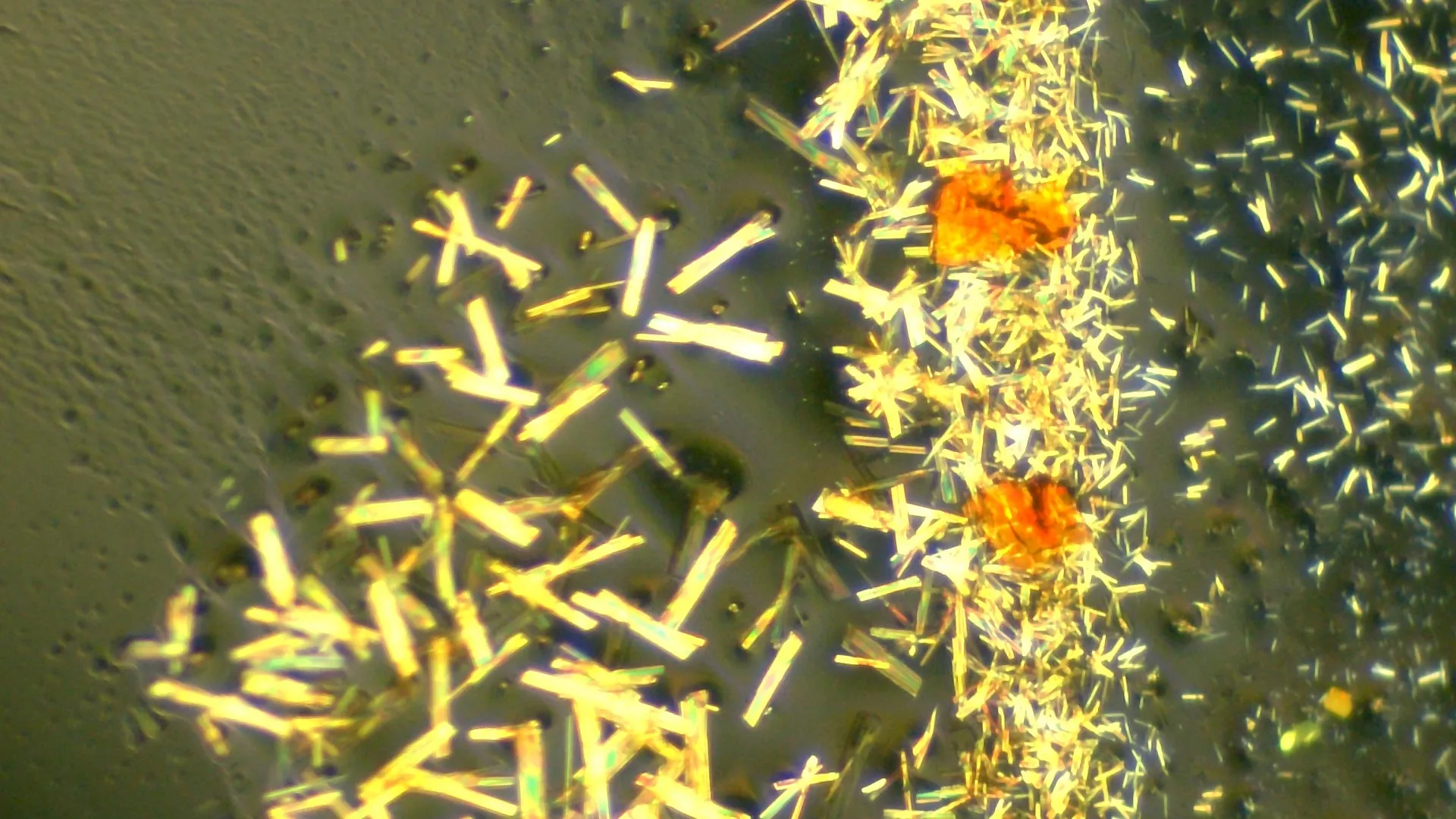
Researchers at OIST successfully characterized an unstable intermediate structure in metallocene formation for the first time.

Scientists adapted centuries-old glassmaking methods to create customizable porous materials for gas storage and separation.
Researchers believe the record-breaking 220 PeV particle detected in the Mediterranean Sea originated from supermassive black holes shooting jets directly toward Earth.
Ultra-powerful terahertz lasers reveal how atomic rotations can unexpectedly flip direction as momentum transfers through quantum materials, offering new insights into magnetism's fundamental origins.
University of Edinburgh's William Barter and Imperial College London's Mark Smith analyzed 650 billion B meson events recorded between 2011 and 2018 and found the electroweak penguin decay to four particles occurring more often than the Standard Model predicts.
Researchers identify blazars as likely culprits behind record-breaking cosmic particle detected in Mediterranean Sea.
Scientists directly watch angular momentum move through crystal for first time, discovering unexpected reversal effect.
Researchers capture rare double ring-slip structure in metallocene formation, revealing new insights into how these versatile molecules assemble and transform.
Scientists directly observe angular momentum moving through crystals for the first time, discovering bizarre reversal effect caused by quantum symmetry.
Researchers trace mysterious 220 PeV particle that slammed through Mediterranean Sea to blazars—supermassive black holes shooting jets directly at Earth.
Scientists adapt centuries-old glassmaking techniques to improve revolutionary porous materials for clean energy and gas storage applications.

German researchers demonstrate surveillance system that recognizes individuals using ordinary wireless signals, even when phones are turned off.

Revolutionary breakthrough shows light can be confined to extraordinarily small spaces using lossless materials, potentially enabling ultra-efficient photonic chips and quantum technologies.
German researchers demonstrate startling new technology that can recognize individuals using ordinary wireless signals, even without devices or when phones are turned off.
German researchers demonstrate technology that can recognize individuals using ordinary wireless signals, even when phones are turned off.
Researchers adapt centuries-old glassmaking techniques to create advanced materials for clean energy and gas storage applications.

International team develops mathematical framework explaining why some laser pulses rhythmically grow and shrink like they're breathing.
Researchers at OIST capture rare 'double ring-slip' intermediate that provides new insights into how these important industrial molecules form.
Scientists adapt centuries-old glassmaking techniques to develop advanced materials that could revolutionize clean energy and gas storage.
Physicists have uncovered a new way to confine light in extremely small spaces using purely dielectric materials, avoiding the heat losses that plague current technologies.
Scientists discover how to fine-tune futuristic porous glass using centuries-old techniques, potentially accelerating clean energy development.

Finnish researchers achieve breakthrough precision that could improve quantum computers and enable detection of elusive dark matter particles from space.