Scientists Discover 50-Foot Ancient Snake That Rivals the Legendary Titanoboa
Named Vasuki indicus, the massive prehistoric serpent lived 47 million years ago in India and represents a unique lineage that originated on the subcontinent.
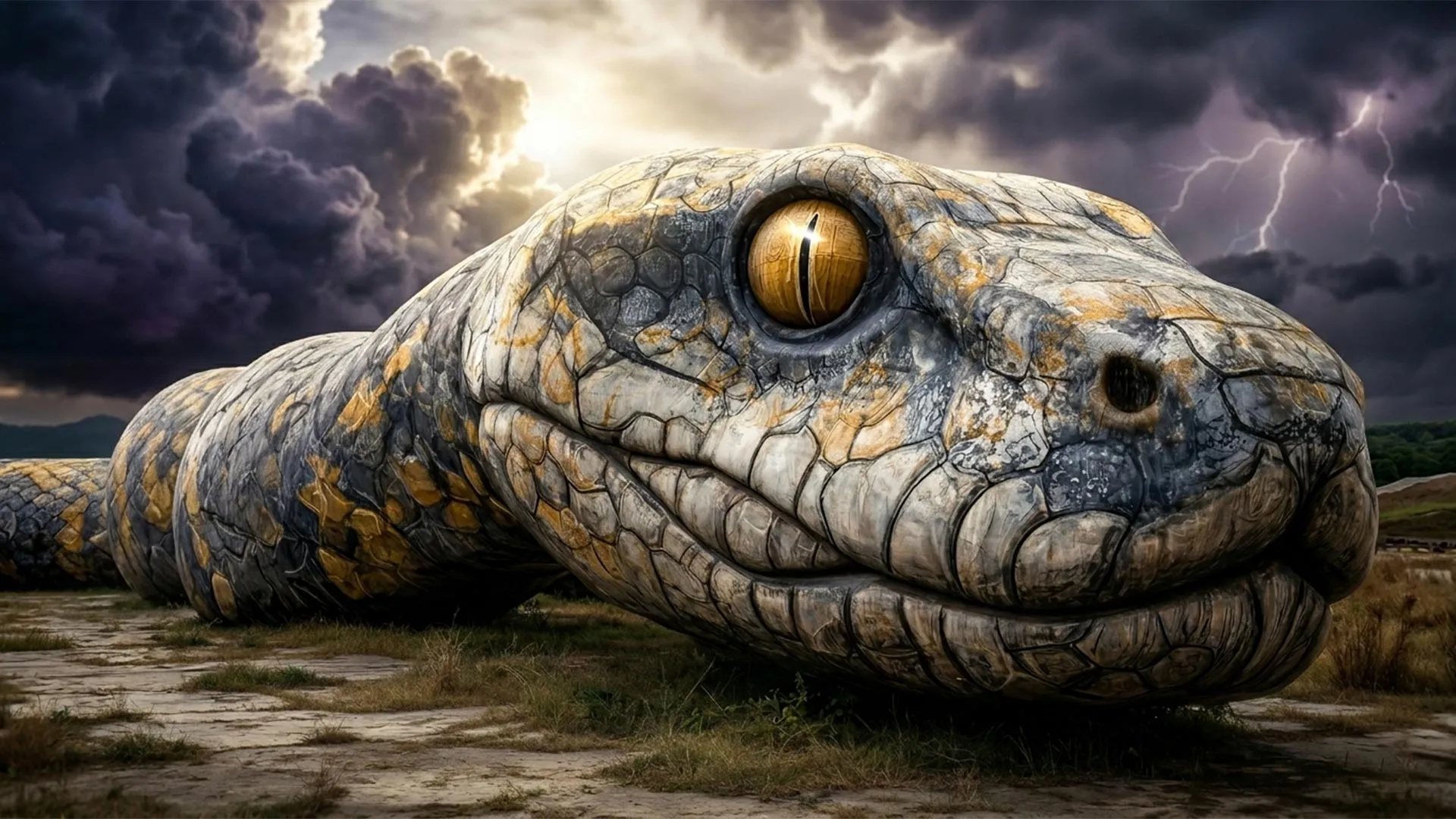
Paleontologists have identified a colossal prehistoric snake that may rank among the largest serpents ever to exist on Earth, with fossil evidence suggesting it measured an extraordinary 11 to 15 meters in length—comparable to the famous Titanoboa. Named Vasuki indicus in honor of the mythical serpent associated with the Hindu deity Shiva, this ancient giant lived approximately 47 million years ago during the Middle Eocene period in what is now Gujarat, India. The discovery, published in Scientific Reports, provides new insights into the diversity and distribution of massive snakes that dominated ancient ecosystems millions of years before modern species evolved.
Researchers Debajit Datta and Sunil Bajpai made the identification based on fossil remains recovered from the Panandhro Lignite Mine in Kutch, Gujarat State. The specimen includes 27 mostly well-preserved vertebrae, some still connected in their original positions, indicating they belonged to a fully mature snake. Each vertebra measures between 37.5 and 62.7 millimeters in length and 62.4 to 111.4 millimeters in width, dimensions that point to an animal with a thick, cylindrical body structure similar to modern anacondas. These measurements enabled scientists to calculate the snake's estimated total length, placing it firmly in the size range of the largest known prehistoric serpents.
Vasuki indicus belonged to the madtsoiidae family, an extinct group of snakes that existed for nearly 100 million years, spanning from the Late Cretaceous to the Late Pleistocene periods. Members of this diverse family lived across extensive geographic regions including Africa, Europe, and India, suggesting they were highly successful predators in ancient ecosystems. The newly identified species appears to represent a distinct evolutionary lineage that first developed on the Indian subcontinent before potentially spreading to other regions during the Eocene epoch, roughly 56 to 34 million years ago.
The snake's massive build suggests it was likely a slow-moving ambush predator, similar to modern anacondas that rely on stealth and powerful constriction to subdue prey. Given its enormous size, Vasuki indicus would have been capable of taking down large vertebrate prey, potentially including early mammals and other reptiles that shared its ancient habitat. The discovery adds important context to our understanding of prehistoric ecosystems, demonstrating that gigantic snakes were not unique anomalies but rather represented successful evolutionary strategies in ancient environments with different climate conditions and prey availability.
This finding contributes to growing evidence that the Indian subcontinent served as a crucial center for snake evolution during the Eocene period, when global temperatures were significantly warmer than today. The research suggests that these massive madtsoiid snakes may have originated in India before dispersing through southern Europe and into Africa, highlighting the subcontinent's role as a source of biodiversity that influenced ecosystems across multiple continents. As climate conditions changed over millions of years, these giant serpents eventually disappeared, leaving only their fossilized remains to tell the story of a time when massive snakes ruled ancient landscapes.