Fossil Sea Reptile 245 Million Years Old Still Holds Its Stomach, Liver and Last Meal
The 60-centimeter Austronaga minuta from southern China preserves the oldest known largely complete digestive system in a reptile, with traces of blood still in its liver.

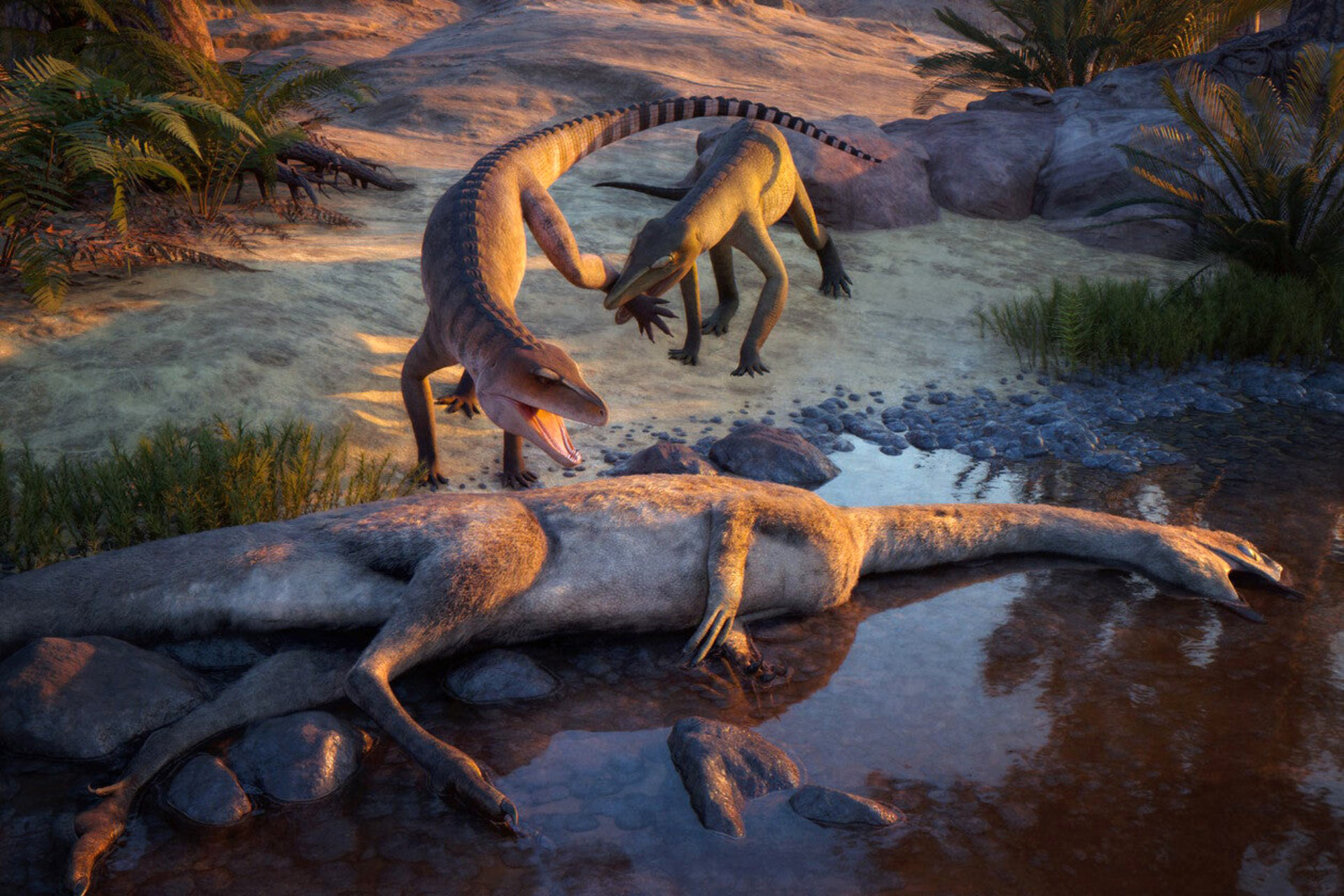
A small marine reptile that died in a shallow sea about 245 million years ago has kept its stomach, liver and intestines, giving scientists the oldest known largely complete digestive system in a reptile.
The animal, named Austronaga minuta, is about 60 centimeters, or two feet, long, with a long neck and an even longer tail. Its skeleton was found at Waina Village in Luoping County, Yunnan Province, in southern China, split across two limestone slabs. It is now held in Beijing.
Between the ribs is a dark smear that holds the organs. A large, sac-like stomach sits at the front. Behind it is a strikingly red liver, in which traces of hemoglobin can still be detected. Farther back is a long, simple tube that formed the small and large intestines. Under the electron microscope, iron from the blood appears to have mineralized in place, leaving tiny iron-rich clusters against the surrounding rock.
The fossil also carries its last meal. Fish scales still sit where the gut used to be, showing the animal ate fish shortly before it died.
The team, led by Wei Wang of the Institute of Vertebrate Paleontology and Paleoanthropology in Beijing, reported the find in Science Advances on July 29, 2026. Stephan Spiekman of the State Museum of Natural History Stuttgart and the University of Hohenheim and Nick Fraser of National Museums Scotland were among the co-authors, working with colleagues from China, Europe and the United States.
The anatomy matters for family history. Austronaga belongs to the archosaurs, the lineage that later produced crocodiles, dinosaurs and birds. Its long neck and tail point to a life in the water. "Early representatives of this lineage had already developed complex adaptations to life in the oceans," Spiekman said, contrary to earlier assumptions.
The stomach has a single chamber. That suggests the ancestral archosaurs had a simpler digestive system than modern birds and crocodiles, which have more elaborate stomachs. Soft organs almost never survive for hundreds of millions of years, so a specimen like this offers a direct look at how the gut of that ancestral group was built.
A skeleton alone would have told researchers what Austronaga looked like. The organs tell them how it lived and ate.
The site in Yunnan is part of a set of Triassic marine deposits in southern China that have produced many well-preserved fossils. Those rocks record the recovery of ocean life after the end-Permian mass extinction, and finds like this one show how quickly reptiles moved back into the sea.