240-Million-Year-Old 'Sand Creeper' Giant Amphibian Discovered Hidden in Garden Wall
A forgotten fossil embedded in a retaining wall has been identified as one of Australia's most remarkable prehistoric finds, revealing a fearsome river predator with rare skin preservation.
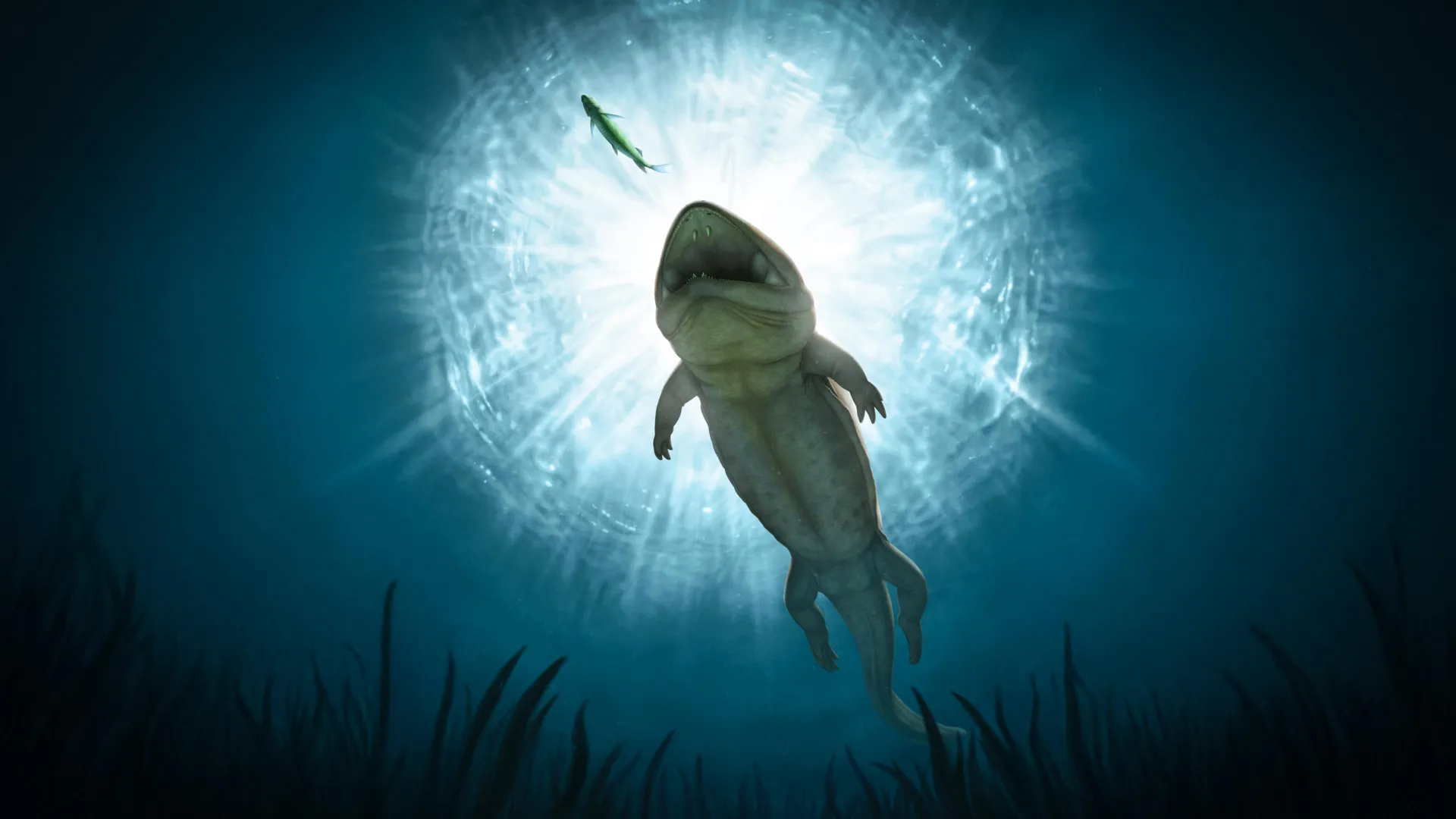
A fossil that spent decades hidden inside a garden retaining wall has been identified as one of Australia's most significant prehistoric discoveries, revealing a 240-million-year-old giant amphibian that prowled ancient rivers with fearsome fang-like teeth. Researchers from UNSW Sydney and the Australian Museum have formally named and described the creature Arenaerpeton supinatus, meaning 'supine sand creeper', after the specimen's exceptional preservation allowed detailed study of both its skeleton and rare soft tissue remains.
The remarkable discovery began in the 1990s when a retired chicken farmer sourced rocks from a nearby quarry to build a garden retaining wall, unknowingly incorporating the ancient fossil among the stones. The specimen was later donated to the Australian Museum in Sydney, where it remained until recent advanced analysis revealed its extraordinary scientific value. Paleontologist Lachlan Hart, a PhD candidate affiliated with both UNSW Science and the Australian Museum, led the research that identified this unique example of a temnospondyl, an extinct group of amphibians that lived before and during the dinosaur era.
"This fossil is a unique example of a group of extinct animals known as temnospondyls, which lived before and during the time of the dinosaurs," Hart explained. "We don't often find skeletons with the head and body still attached, and the soft tissue preservation is an even rarer occurrence." The exceptional preservation includes almost the entire skeleton and even faint outlines of the animal's skin, providing unprecedented insight into the anatomy and appearance of these ancient predators.
Arenaerpeton lived approximately 240 million years ago during the Triassic period in freshwater environments within what is now the Sydney Basin. The creature measured about 1.2 meters from head to tail, making it unusually large compared to many of its close relatives from the same time period. In appearance, it may have resembled a modern Chinese Giant Salamander, particularly in head shape, but was considerably more robust with a heavyset build evident from the size of its ribs and preserved soft tissue outline. The animal's dental arsenal included particularly gnarly teeth and a pair of fang-like tusks on the roof of its mouth, suggesting it was a formidable aquatic predator.
Dr. Matthew McCurry, Senior Lecturer at UNSW and Curator of Palaeontology at the Australian Museum, emphasized the discovery's significance: "This is one of the most important fossils found in New South Wales in the past 30 years, so it is exciting to formally describe it." The find provides valuable insights into Australia's ancient ecosystems and the long evolutionary history of temnospondyls, which survived for another 120 million years after Arenaerpeton's time, spanning two major mass extinction events and suggesting that increasing body size may have played a role in their remarkable survival.