A Fossil Sat in a Museum Drawer Since 1948. A CT Scan Just Made It a New Predator
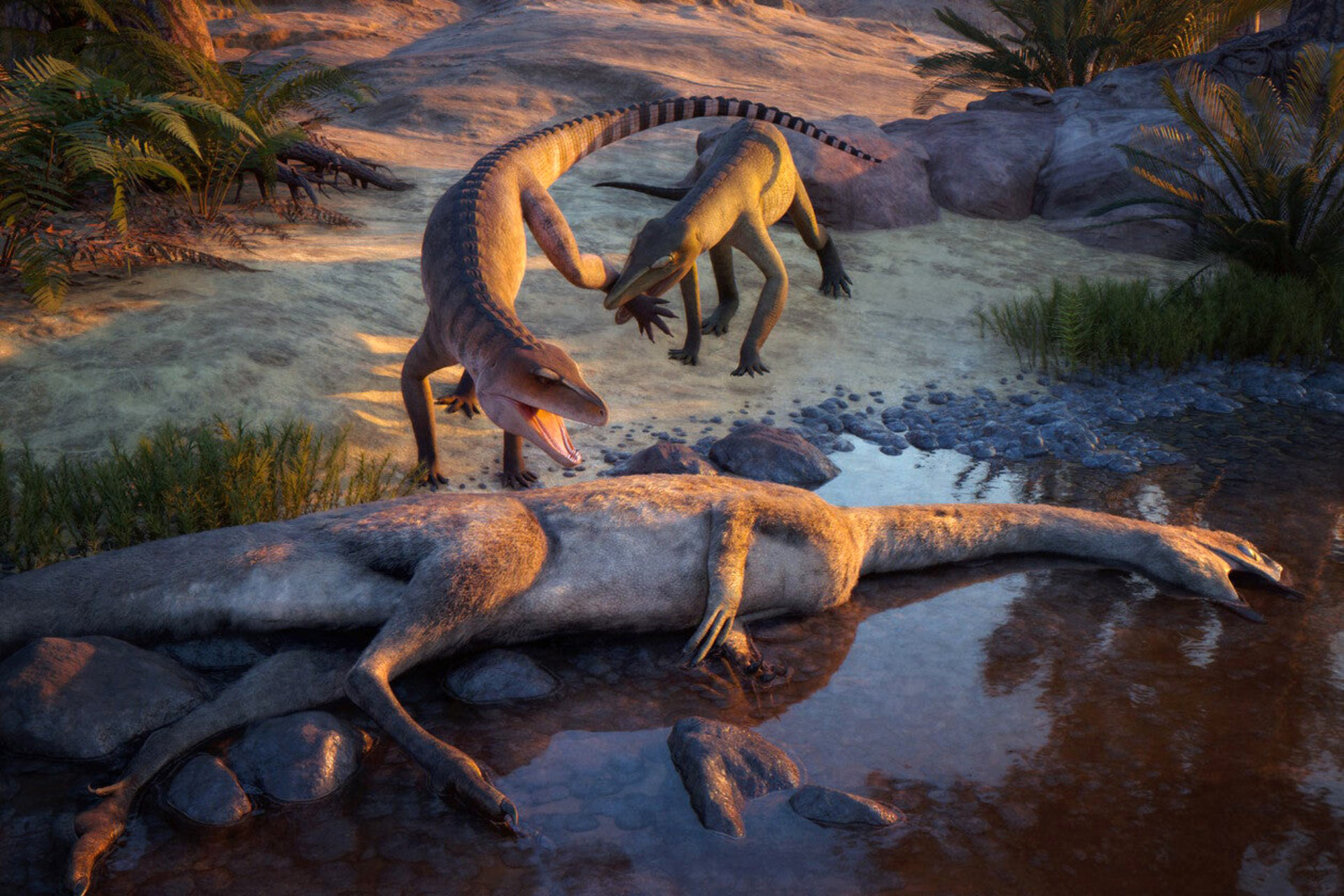
Yale researchers identified Eosphorosuchus lacrimosa, a jackal-sized crocodile relative from 210 million years ago with a short snout and a skull built for crushing.
The bones were dug out of the ground at Ghost Ranch, New Mexico, in 1948. Then they sat, largely unexamined, for about 75 years. A CT scanner has now established that they belong to a species no one had ever described.
Researchers at Yale University have named the animal Eosphorosuchus lacrimosa — from Eosphorus, the Greek dawn-bringer, and soukhos, crocodile. It lived roughly 210 million years ago, in the Late Triassic, and it was not a crocodile in the modern sense but a crocodylomorph: a member of the broader lineage that would eventually produce them. The work was led by Dr. Bhart-Anjan Bhullar of Yale and the Yale Peabody Museum of Natural History, with Yale PhD student Miranda Margulis-Ohnuma, and published in Proceedings of the Royal Society B.
Ghost Ranch is one of the richest Late Triassic fossil sites in the world, best known for producing thousands of Coelophysis skeletons. Material collected there in the 1940s went into museum storage faster than anyone could work through it, and the specimen behind this study was one of many assumed to belong to an already-known species. The holotype includes skull fragments, the lower jaw, vertebrae, limb bones and pieces of body armor.
What the scans revealed was an animal built for a particular job. Eosphorosuchus had a short snout, a heavily reinforced skull and unusually well-developed jaw muscles — the anatomy of a predator that closed hard on prey large relative to its own body. It was roughly jackal-sized, with large hind legs and smaller, more slender forelimbs, a build suited to running rather than ambush from water. This was a terrestrial hunter, not a river lurker.
The significance is less about the animal itself than about the company it kept. Eosphorosuchus lived alongside Hesperosuchus agilis, a closely related crocodylomorph of similar size found at the same site. Two related predators of comparable body size in the same environment would normally be expected to compete directly. Instead, their anatomies diverge: Hesperosuchus has a longer, more gracile skull built for snapping at smaller, quicker prey, while Eosphorosuchus is built to crush. They appear to have split the available prey between them.
"This speaks to the diversification of proto-crocs toward the beginning of the Age of Reptiles," the researchers noted. Ecological niche partitioning of that kind is usually documented in much younger fossil assemblages; finding it this early suggests the crocodylomorph line was experimenting with specialized body plans almost as soon as it appeared, well before the dinosaurs came to dominate the landscape.
It also underlines a point paleontologists make often and quietly: a great deal of undescribed biology is already collected, catalogued, and sitting in museum cabinets, waiting for someone with a scanner and a reason to look again.
Originally reported by Sci.News.