'Gus' the T. Rex Sells for a Record $50.1 Million, the Priciest Fossil Ever Auctioned
A 38-foot Tyrannosaurus discovered on a South Dakota ranch shattered its estimate after a 10-minute bidding war — and reignited a fight between collectors and paleontologists.
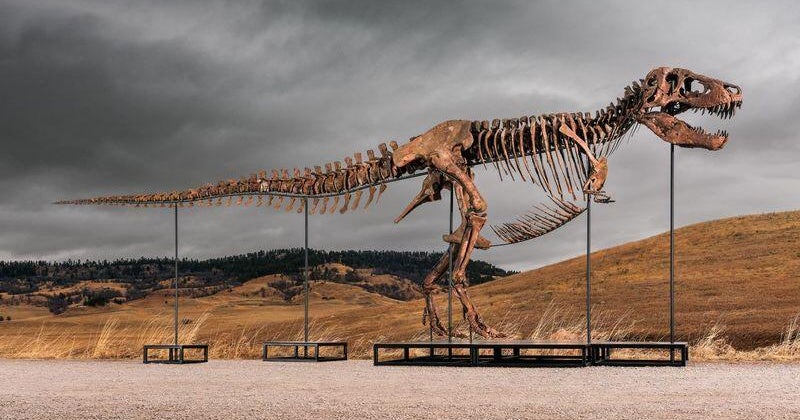
A Tyrannosaurus rex nicknamed "Gus" sold for $50.1 million at Sotheby's, setting a record as the most expensive fossil ever sold at auction and reigniting a long-running dispute over whether such specimens belong in museums or in private hands.
The 38-foot-long, roughly 12-and-a-half-foot-tall skeleton blew past its pre-sale estimate of $20 million to $30 million after a 10-minute bidding war among seven bidders, the auction house said. The winning bid, likely from a private buyer whose identity was not disclosed, eclipsed the previous record — the $44.6 million paid in 2024 for a Stegosaurus skeleton named "Apex," bought by the billionaire hedge-fund founder Ken Griffin.
Gus is one of the more complete Tyrannosaurus specimens ever unearthed. Discovered on a South Dakota ranch in 2021, the dinosaur comprises 183 fossil bone elements and is about 61 percent complete by bone count. It is roughly 67 million years old, dating to the final chapter of the age of dinosaurs. The specimen was named for Gary Licking, the rancher on whose land it was found — a folksy origin story for a fossil that just fetched a fortune.
The eye-popping price drew immediate criticism from paleontologists, who have watched with growing dismay as commercially valuable dinosaur skeletons are swept up by wealthy collectors and disappear from public and scientific view. When a specimen enters a private collection, researchers often lose the ability to study it, and journals generally will not publish findings based on fossils that are not held in accredited institutions where others can verify the work.
Auction houses counter that the soaring prices reflect genuine public fascination and that some private buyers ultimately loan or donate their acquisitions to museums. But there is no guarantee Gus will ever be accessible to scientists or the public, and the anonymity of the buyer left its future uncertain. Critics argue that the market itself distorts fieldwork, incentivizing commercial collectors to prioritize saleable trophies over the painstaking documentation science requires.
The sale is the latest in a string of blockbuster fossil auctions that have turned prehistoric bones into trophy assets alongside fine art and rare cars. For paleontologists, each record price is a mixed blessing: proof of the public's enduring love of dinosaurs, and a reminder that the most spectacular examples are increasingly priced beyond the reach of the institutions best equipped to learn from them. "These animals belong to all of us," one researcher said. "It's hard to watch them vanish behind a paddle number."