Four-Winged 'Dragon' Dinosaur Unearthed in China Glided Through the Trees Hunting Early Birds
Newly named Jian changmaensis, a barn-owl-sized cousin of Velociraptor, is the first non-bird dinosaur found at a Chinese site that has yielded more than 100 ancient birds — and it appears to have preyed on them.
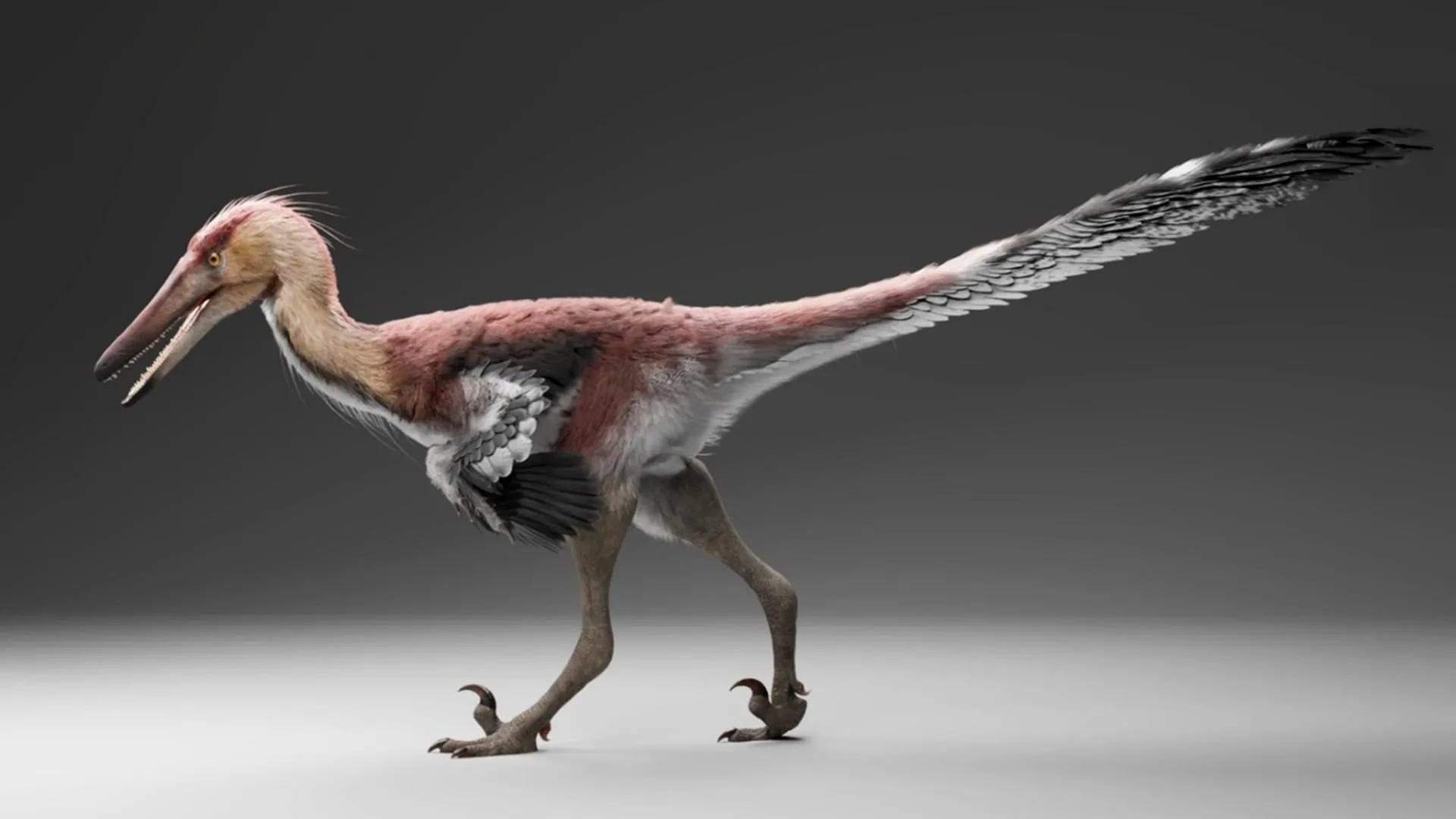
Roughly 120 million years ago, a feathered predator about the size of a barn owl glided between the trees of what is now northwestern China, ambushing the small birds that flitted through the Early Cretaceous forest. Scientists have now given the creature a name — Jian changmaensis — and a story that places it at the top of one of the richest bird graveyards in the fossil record.
Described in the journal Annals of Carnegie Museum, the new species belongs to the microraptorines, a group of small, feathered theropod dinosaurs closely related to Velociraptor. What sets microraptors apart is their startling anatomy: long flight feathers grew not only on their arms but also on their legs, giving them effectively four wings. Jian could not flap its way into powered flight, but its arrangement of feathers would have let it glide from branch to branch.
"They could probably glide like a flying squirrel," said Jingmai O'Connor of Chicago's Field Museum, who led the study with Matthew Lamanna of the Carnegie Museum of Natural History. The fossil's preserved upper arm bone measures only about four inches long, but it implies a wingspan of roughly four feet — making Jian one of the largest microraptor specimens ever found.
The specimen came from the Xiagou Formation in the Changma Basin of Gansu Province, a site that has produced more than 100 fossils of early birds. Remarkably, Jian is the first non-avian dinosaur ever recovered there. That distinction matters, because the same rocks preserve broken, crushed bird bones — fractured in a pattern reminiscent of the pellets coughed up by modern owls — hinting that this little gliding hunter was the dominant predator picking off the site's birds.
The discovery deepens a picture, built over decades of finds in China's Cretaceous beds, of a world in which the boundary between dinosaurs and birds was blurry and the skies and treetops teemed with experiments in flight. Microraptors represent one such experiment: a four-winged design that evolution tried and ultimately discarded, even as the bird lineage that survives today was taking shape in the same forests.
The name itself nods to that legacy. "Jian" refers to a winged creature from Chinese mythology, a fitting label for a dragon-like animal that hunted on the wing. Though the fossil material was first collected back in 2008, it took years of careful study to recognize it as a distinct species — and to realize that the bird-rich beds of Changma had been guarding the bones of the bird-eater all along.
/https://tf-cmsv2-smithsonianmag-media.s3.amazonaws.com/filer_public/3c/1f/3c1f6ba0-0486-41be-90f9-b9d192cfd29a/notebook-and-fossil.jpeg)