Enceladus Sorts Its Own Ocean Samples, Making Signs of Life Easier to Spot
Cassini data show plume droplets freeze slowly and shatter, concentrating salts and organics into separate ice grains, and a second study found a methane-making microbe thriving in simulated Enceladus seawater.
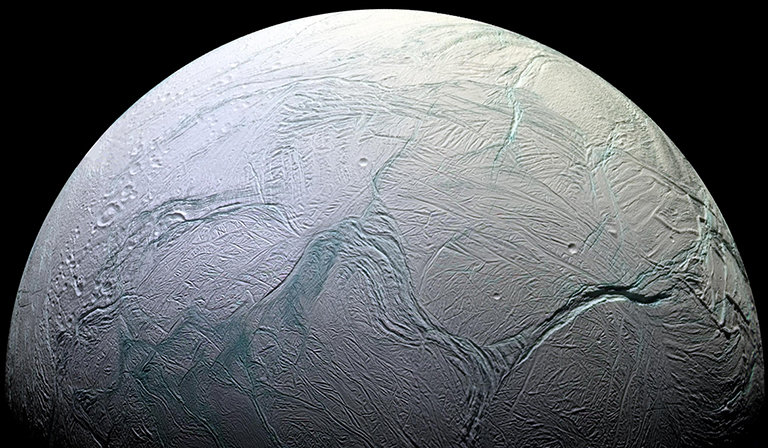
Saturn's moon Enceladus may be doing the hardest part of the search for alien life on its own. Two studies published the same day in Science Advances suggest that the ice grains blasting out of the moon arrive in space already sorted and concentrated, and that at least one kind of Earth microbe can live in water that mimics its hidden ocean.
Enceladus is one of the top targets in the solar system for finding life. Scientists believe a global ocean of liquid water lies beneath its icy crust, above a rocky core. At the south pole, giant plumes shoot through cracks in the ice and hurl particles hundreds of kilometers into space. NASA's Cassini spacecraft flew through those plumes several times and found salts, organic compounds and signs of hydrothermal activity on the seafloor. It is the only alien ocean scientists have been able to sample directly.
The first study, led by Frank Postberg, a planetary scientist at Freie Universität Berlin, reconstructed what happens to the water on its way out. The team combined Cassini data with long-running laboratory experiments and models. Droplets form at the ocean surface when gas bubbles rise and pop, and water vapor carries them up through the cracks. Researchers had assumed they froze instantly. Instead, the new work shows they freeze slowly, which lets their ingredients separate inside each droplet. Salts and organics end up in different places, and even different salts, such as table salt and sodium carbonate, pull apart.
On the way up, the frozen droplets reach speeds of up to 1,000 kilometers per hour. When they strike the walls of the icy cracks, they shatter into fragments a few micrometers across, and many of those fragments consist mostly of one concentrated substance. "Enceladus actually does a lot of the work for us in preparing samples for analysis that usually take a lot of effort in chemical labs on Earth," Postberg said.
That matters for spotting biosignatures, the chemical fingerprints of life. If microbes exist in the ocean, their material could end up concentrated in a small share of ice grains, relatively pure. "That is great news in the search for life," Postberg said. A future spacecraft would need to analyze many individual grains, but if it hit one containing microbial material, it could identify it "relatively easily with already available technology." The findings bear on the European Space Agency's planned L4 mission to Enceladus, which will look specifically for signs of life.
The second study, led by scientists at Ludwig-Maximilians-Universität München with Postberg and Nozair Khawaja contributing, recreated the ocean's chemistry in the lab: almost no oxygen, lots of carbonate and a pH of 10 or 11. They introduced Methanothermococcus okinawensis, a methane-producing microbe from deep-sea vents that needs only hydrogen and carbon dioxide. It failed in a standard lab medium at that pH but kept growing in the Enceladus simulant, using hydrogen from water-rock reactions. "This was an experiment for which we did not expect such a successful outcome," Khawaja said.
Postberg was careful about the limits. The results do not mean life exists on Enceladus, he said, only that one of Earth's oldest metabolisms could work there, and that if life is present, future missions would have a good chance of detecting it.