Saturn's Asymmetric Magnetic Field Mystery Solved Through Cassini Data Analysis
Scientists discover that rapid planetary rotation and plasma from Enceladus create the distorted magnetic bubble around Saturn, unlike Earth's symmetrical field.
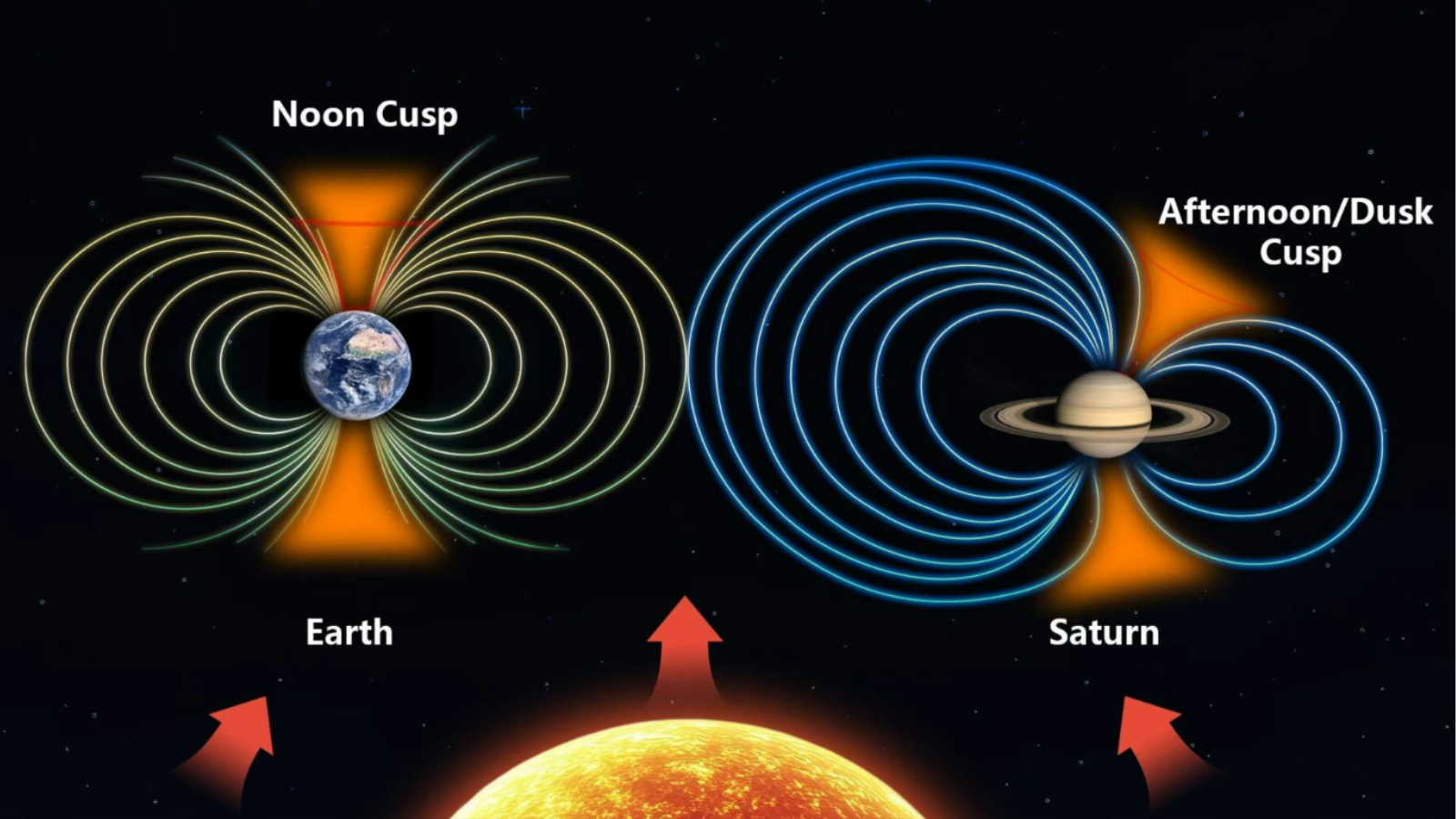
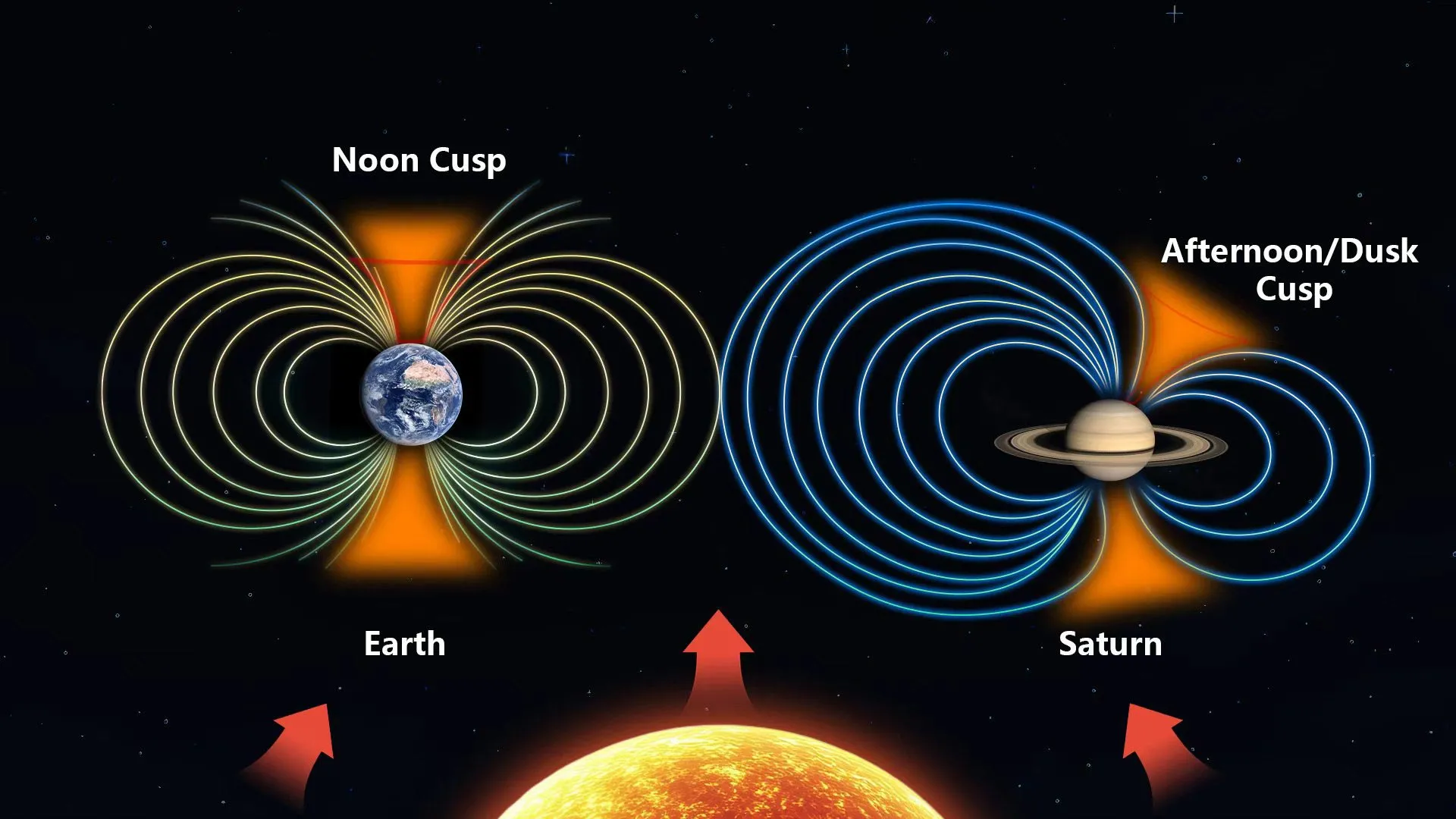
Saturn's magnetic field forms a noticeably uneven and distorted protective bubble around the planet, and scientists have now determined that this asymmetry results from the combined effects of Saturn's extremely rapid rotation and dense plasma environment created by its moons. Unlike Earth's relatively symmetrical magnetosphere, Saturn's magnetic field is consistently shifted to one side, creating what researchers describe as a fundamentally different type of planetary magnetic shield. The breakthrough understanding comes from six years of detailed observations by NASA's Cassini spacecraft.
Researchers focused their analysis on Saturn's magnetic cusp, a critical region where magnetic field lines bend back toward the planet's poles and allow charged particles from the solar wind to funnel into the atmosphere. The Cassini data revealed that this cusp is consistently displaced from its expected central position. When viewed from the Sun, Saturn's cusp appears shifted to the right and is most often located between the 1:00 and 3:00 positions on an imaginary clock face, rather than at the 12:00 position as seen on Earth.
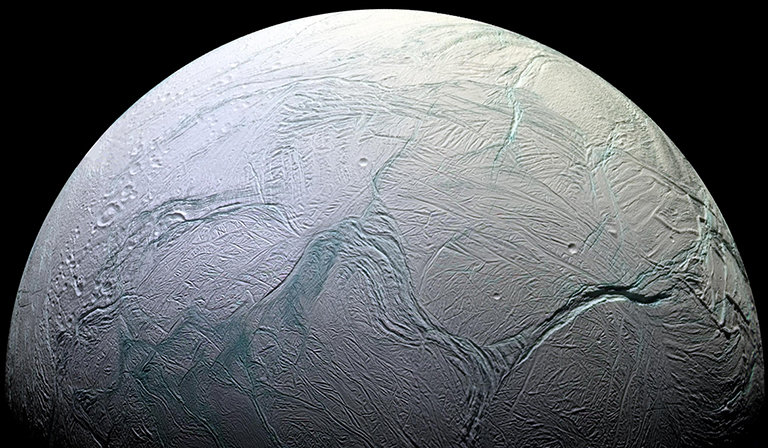
The unusual positioning is driven by two key factors working in tandem. Saturn completes one full rotation in just 10.7 hours, making it one of the fastest-spinning planets in our solar system. Simultaneously, the planet is surrounded by a dense "soup" of plasma—ionized gas—much of which originates from gases released by Saturn's moons, particularly Enceladus. This moon continuously ejects icy plumes from its subsurface ocean, contributing significant amounts of material to Saturn's magnetic environment.
The rapid rotation combined with this heavy plasma environment appears to pull Saturn's magnetic field lines sideways, creating the observed distortion. Professor Andrew Coates from University College London's Mullard Space Science Laboratory explains that "the cusp is the place where the solar wind can slip directly into the magnetosphere," making its precise location crucial for understanding the entire magnetic bubble. The research provides critical evidence for a long-held theory that rapid spinning of massive planets with active moons replaces the solar wind as the dominant force shaping magnetospheres.
These findings have significant implications for future space missions, particularly the proposed European Space Agency mission to Enceladus planned for the 2040s. Understanding Saturn's magnetic environment is essential for mission planning as scientists search for signs of habitability and potential life in Enceladus's subsurface ocean. The study demonstrates that Saturn's magnetosphere, along with those of other rapidly spinning gas giants, likely differs fundamentally from Earth's magnetic field, requiring new models for understanding planetary magnetic protection systems.