Scientists Map Every Neural Connection in Fruit Fly Brain, Revealing Surprising Insights About Intelligence
Groundbreaking connectome of 160,000 neurons suggests complex behaviors emerge from distributed local circuits rather than centralized brain control, offering new clues about how nervous systems work.
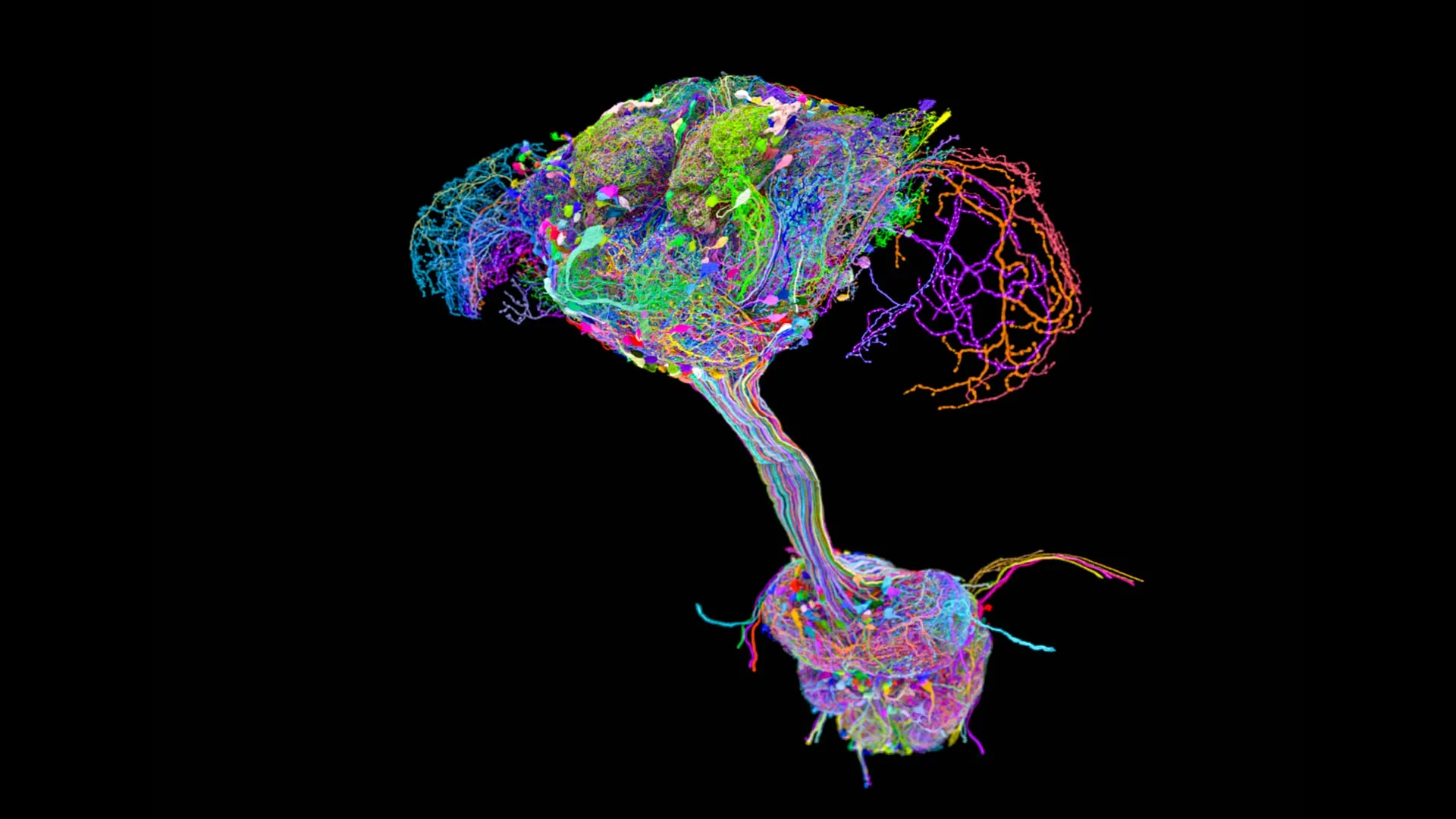
A massive international research collaboration led by Harvard Medical School and Princeton University has achieved a historic milestone in neuroscience by publishing the first complete map of every neural connection in an adult fruit fly's central nervous system. The unprecedented connectome reveals all 160,000 neurons and their connections throughout both the brain and spinal cord equivalent, providing scientists with an entirely new perspective on how nervous systems coordinate complex behaviors like walking, flying, and sensory processing. The achievement represents years of painstaking work using advanced imaging and computational techniques to trace individual neural pathways.
The complete connectome extends previous fruit fly brain mapping efforts by incorporating the nerve cord, which controls legs, wings, and other body appendages, creating the first holistic view of how brain and body neural networks integrate. "It is really important to have a central nervous system connectome that is as complete as possible so we can link up the brain and body and start thinking about behavior holistically," explained study co-senior author Wei-Chung Allen Lee, associate professor of neurobiology at Harvard Medical School. The comprehensive mapping required sophisticated electron microscopy techniques and artificial intelligence algorithms to reconstruct the three-dimensional structure of neural networks.
One of the most surprising discoveries from the connectome analysis challenges conventional assumptions about how complex behaviors are controlled. Rather than finding evidence of centralized command centers in the brain directing all actions, researchers discovered that many fruit fly behaviors appear to be managed by local neural circuits distributed throughout the relevant body parts. This finding suggests that intelligence and behavioral control may be more decentralized than previously understood, with local neural networks capable of sophisticated decision-making independent of higher-level brain oversight.
The fruit fly serves as an ideal model for understanding general principles of nervous system organization because despite having only 160,000 neurons, these insects can perform remarkably sophisticated behaviors including navigation, social interaction, learning, and complex sensory processing. "Fruit flies are simple to breed and keep in the lab," noted Lee, while possessing "an incredibly sophisticated genetic toolkit" that allows scientists to control and monitor individual neurons or groups of neurons with unprecedented precision. This combination of behavioral complexity and experimental accessibility makes fruit flies invaluable for neuroscience research.
The complete connectome is now freely available online as a resource for researchers worldwide, potentially accelerating discoveries about fundamental principles governing nervous system function across species. The mapping achievement, published in Nature and supported by the federal BRAIN Initiative, represents a crucial step toward understanding how neural networks give rise to behavior, learning, and consciousness. Scientists expect the detailed wiring diagram will enable new approaches to studying neurological diseases, developing artificial intelligence systems, and understanding the basic mechanisms that allow nervous systems to process information and control complex behaviors.