Scientists Map Every Neural Connection in Adult Fruit Fly, Revealing Surprising Insights About Intelligence
Groundbreaking connectome study shows complex behaviors emerge from distributed local circuits rather than central brain control, challenging assumptions about how nervous systems work.
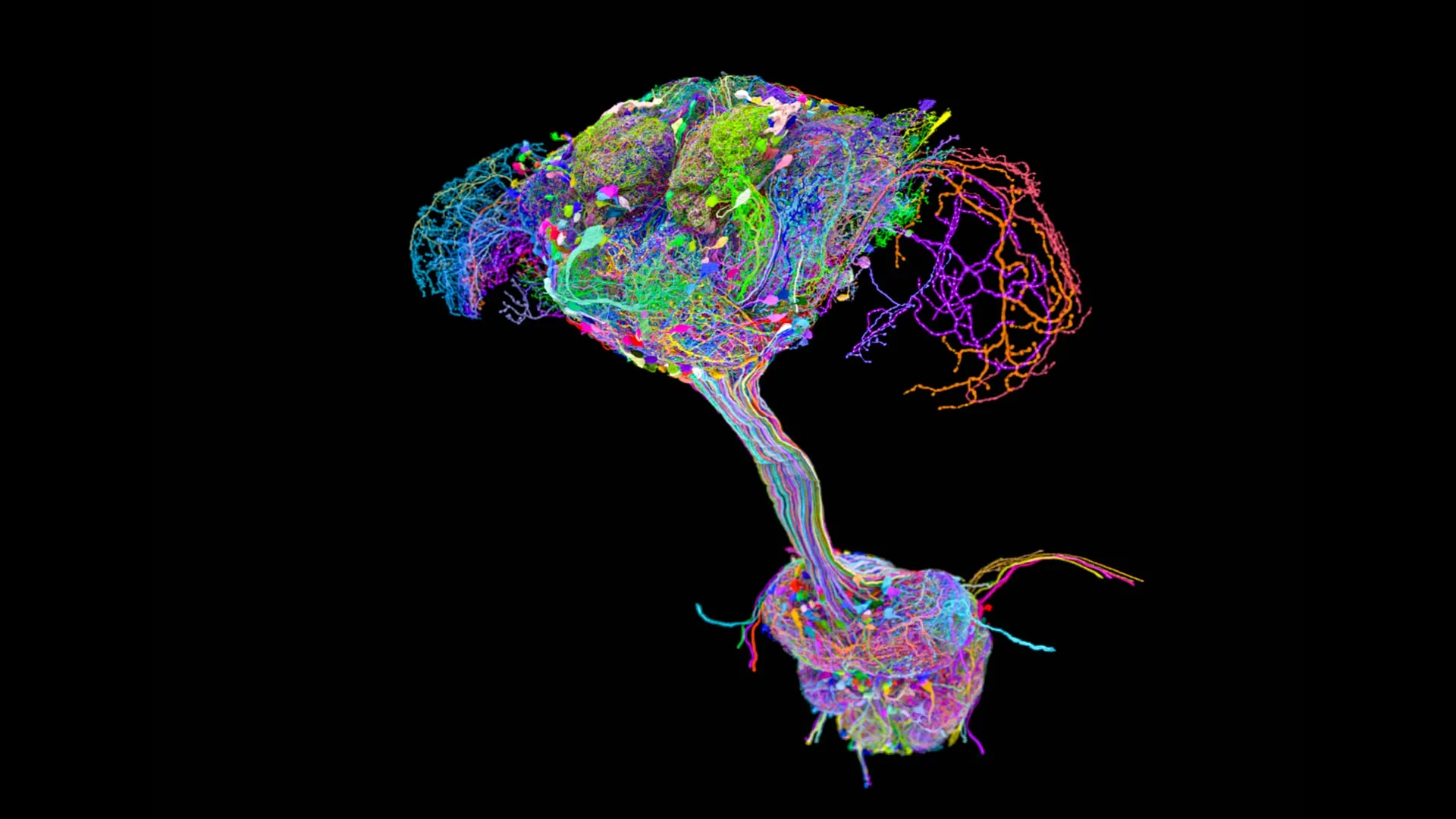
An international research team has achieved a major neuroscience milestone by creating the first complete map of every neural connection in an adult fruit fly's central nervous system. The groundbreaking work reveals surprising insights about how brains and bodies coordinate to produce complex behaviors, suggesting that many actions are controlled by local neural circuits rather than centralized brain commands.
The study, led by researchers at Harvard Medical School and Princeton University, extends previous fruit fly brain mapping by including the nerve cord—the insect equivalent of a spinal cord. The complete connectome provides an unprecedented view of how 160,000 neurons connect and communicate to generate sophisticated behaviors like navigation, social interaction, learning, and sensory processing.
"We can see all of the neurons and their connections as a complete unit for the first time and ask, 'What do we learn from that?'" said study co-senior author Rachel Wilson, the Joseph B. Martin Professor of Basic Research in the Field of Neurobiology at Harvard Medical School. The research team discovered that many fruit fly behaviors appear to be directed by local neural circuits in relevant body parts, challenging traditional views of brain-centric control.
The findings have significant implications for understanding how nervous systems generate behavior across species. Rather than relying on a single central command center in the brain, the fruit fly nervous system appears to use distributed processing networks that can operate semi-independently while still coordinating with other body regions.
The complete connectome is now freely available online as a resource for researchers worldwide, potentially accelerating discoveries about fundamental principles of brain function. According to co-senior author Wei-Chung Allen Lee, associate professor of neurobiology at Harvard Medical School, the work provides crucial insights into linking brain and body function. "It is really important to have a central nervous system connectome that is as complete as possible so we can link up the brain and body and start thinking about behavior holistically," Lee explained.