Perseverance Finds Mars's Jezero Crater Rocks Were Altered by Water Three Separate Times
Instead of lake sediments, the rover's Margin Unit holds ancient igneous rock changed by groundwater, a lake and hot fluids, in one of Mars's largest carbonate exposures.

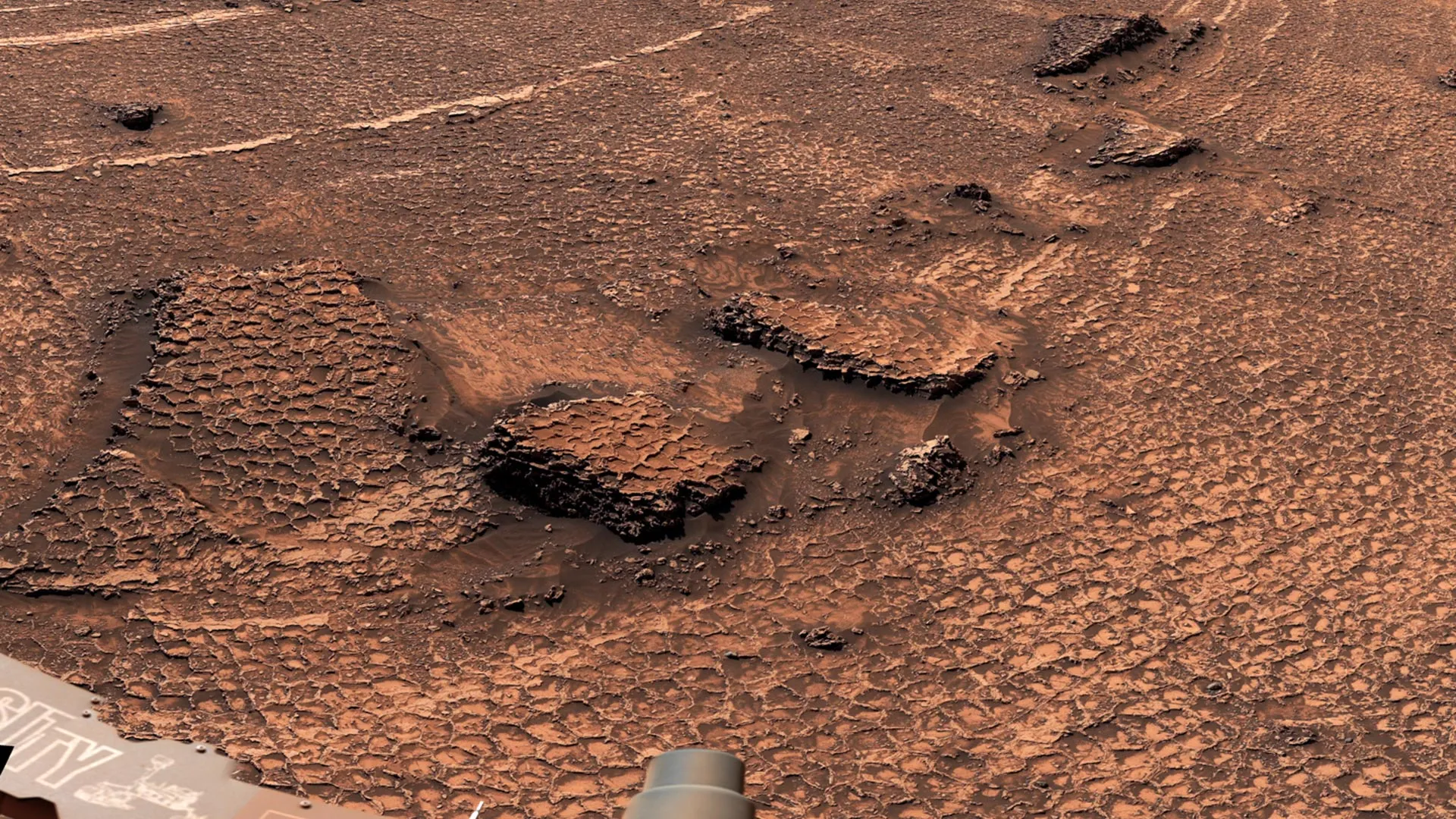
NASA's Perseverance rover has found that the rocks in one part of Jezero Crater on Mars have a more tangled water history than scientists expected. The rover's team thought the crater's Margin Unit, a band of rock along the inner rim, would hold lake sediments. Instead, it is made of ancient igneous rock that water altered on at least three separate occasions.
The first episode involved groundwater rich in carbon dioxide. It reacted with olivine-rich rock and formed carbonate minerals inside fractures, leaving silica behind. In the second, water from the ancient crater lake may have driven further mineral changes, especially in rocks below the lake's waterline, where silica concentrations rose. The third was hydrothermal: heated groundwater moved through the volcanic rock and deposited veins of calcium sulfate and fluorite, some about 10 inches thick in the eastern Margin Unit.
The data come from SuperCam, the instrument on the rover's mast, which fires a laser at rock up to 21 feet away and reads the light from the vaporized material to identify its minerals. The team examined more than 185 bedrock targets across 265 meters of elevation change within the Margin Unit.
"The Margin Unit findings are important because Jezero Crater sits inside one of the largest exposures of carbonate on Mars," said lead researcher Candice Bedford. Carbonates form when carbon dioxide dissolved in water reacts with rock, so they are a record of how much water the planet had, what it was made of, and how long conditions stayed wet.
The results reshape how scientists think about Jezero's habitability and the early Martian climate. Warm, mineral-rich fluids moving through rock are a setting where microbes can live on Earth, and groundwater that reacted with olivine is chemically capable of producing energy sources. The study does not claim any sign of life. It shows that Jezero held several distinct watery environments over time, not just a single lake.
Mars scientists have said for years that Jezero was chosen as a landing site because it once held a lake fed by a river delta. The Margin Unit result adds a layer to that story: the rocks along the crater rim record fluids moving beneath the surface as well as water standing on top of it, and each leaves a different chemical fingerprint that SuperCam can read from a distance.
The findings also bear on what Perseverance should sample. The rover has been collecting rock cores that are meant to be returned to Earth in a future mission. A site with several separate episodes of water alteration offers more types of material to analyze, and gives researchers a clearer map of where the carbonate and silica-rich rocks that preserve chemical history can be found.