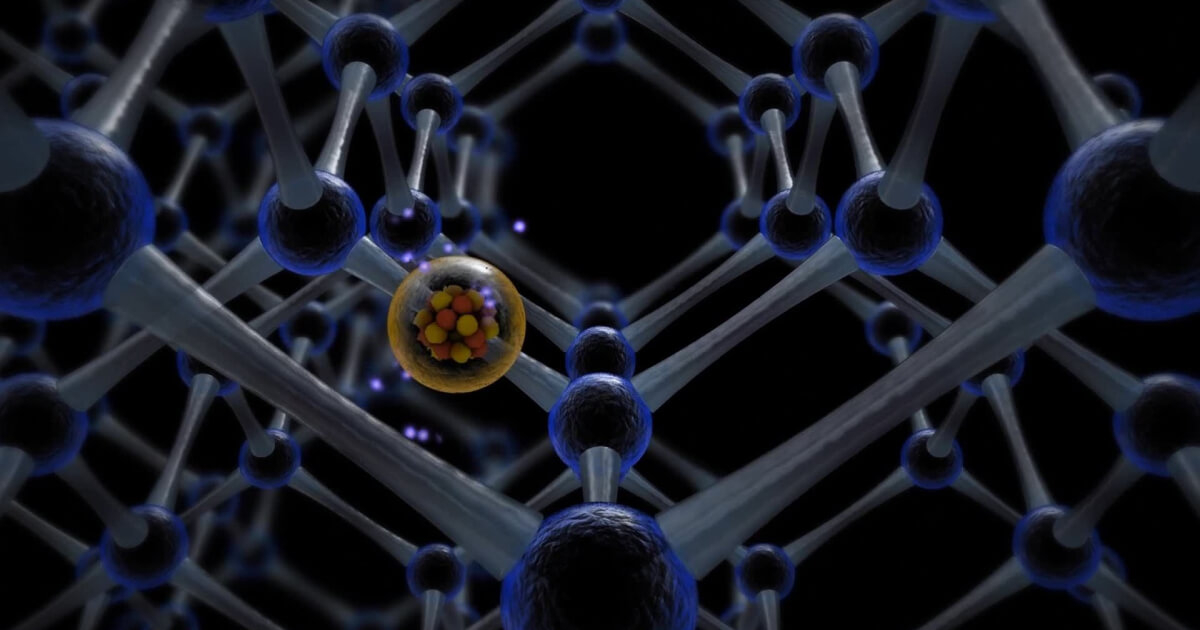
How Electrons Reach Diamond's Quantum Defects: Quantum Tunneling From Nearby Nitrogen
A German-Lithuanian-U.S. team explains how the diamond NV center refills its missing electron, solving a puzzle that matters for room-temperature qubits and sensors.

A diamond's most useful quantum properties come from its flaws. One of them, a nitrogen atom sitting next to a vacancy where a carbon atom is missing, has become a key part of quantum technology. Researchers have now worked out how that flaw recovers once it loses an electron, and the answer is quantum tunneling.
The defect is called the nitrogen-vacancy center, or NV center. It can serve as a qubit that works at room temperature, a building block for quantum computers and quantum networks, or an extremely sensitive magnetic sensor that is read out with a laser and can detect weak fields inside objects such as living cells and microchips.
There is a catch. The NV center only works as a qubit or sensor while it holds one extra electron, which it must obtain from another defect in the crystal. While operating, it often loses that electron, and in some cases it never acquires one at all. Scientists have long known that nitrogen atoms scattered through the diamond supply the electrons. But nitrogen holds onto its electrons very tightly, so how one gets from a nitrogen atom to an NV center had remained a puzzle.
In a typical semiconductor, heat is enough to free an electron from a defect, even at room temperature. The electron then wanders through the crystal until another defect captures it. In diamond's nitrogen, that does not happen: the electron is too tightly bound for heat to release it. Tunneling had been suggested as the alternative, but nobody had worked out how it could occur or how to prove it.
The new study, reported in Physical Review Letters by researchers from Germany, Lithuania and the United States, shows that no thermal release is needed. The electron tunnels directly from the nitrogen atom to the NV center, passing through the energy barrier that holds it in place. According to classical physics, it should never be able to get over that barrier.
Tunneling alone is not enough, though. The transfer releases a burst of energy, and unless something absorbs it, energy conservation forbids the jump. Quantum-mechanical simulations showed that the nitrogen atom is ideally suited to the job. One of its bonds to neighboring carbon atoms is broken, and when it gives up its electron, the missing bond re-forms. The energy goes into vibrations of the crystal.
"When the electron tunnels, it releases a large quantity of energy and the nitrogen atom turns out to be remarkably efficient at absorbing that particular amount," said Lukas Razinkovas, head of the Electronic Structure Theory Laboratory at the Center for Physical Sciences and Technology in Vilnius, Lithuania.
The result gives materials scientists a physical mechanism to design around. Diamond sensors and qubits depend on keeping NV centers in the right charge state, and the new picture explains how the surrounding nitrogen refills them. That could help researchers choose nitrogen concentrations, crystal growth conditions and operating protocols that keep more of the defects working.
It is also a reminder that tunneling, often discussed as an exotic effect, is doing practical work inside a device material. The paper was published in 2026 and covered by Phys.org on Nov. 18.